

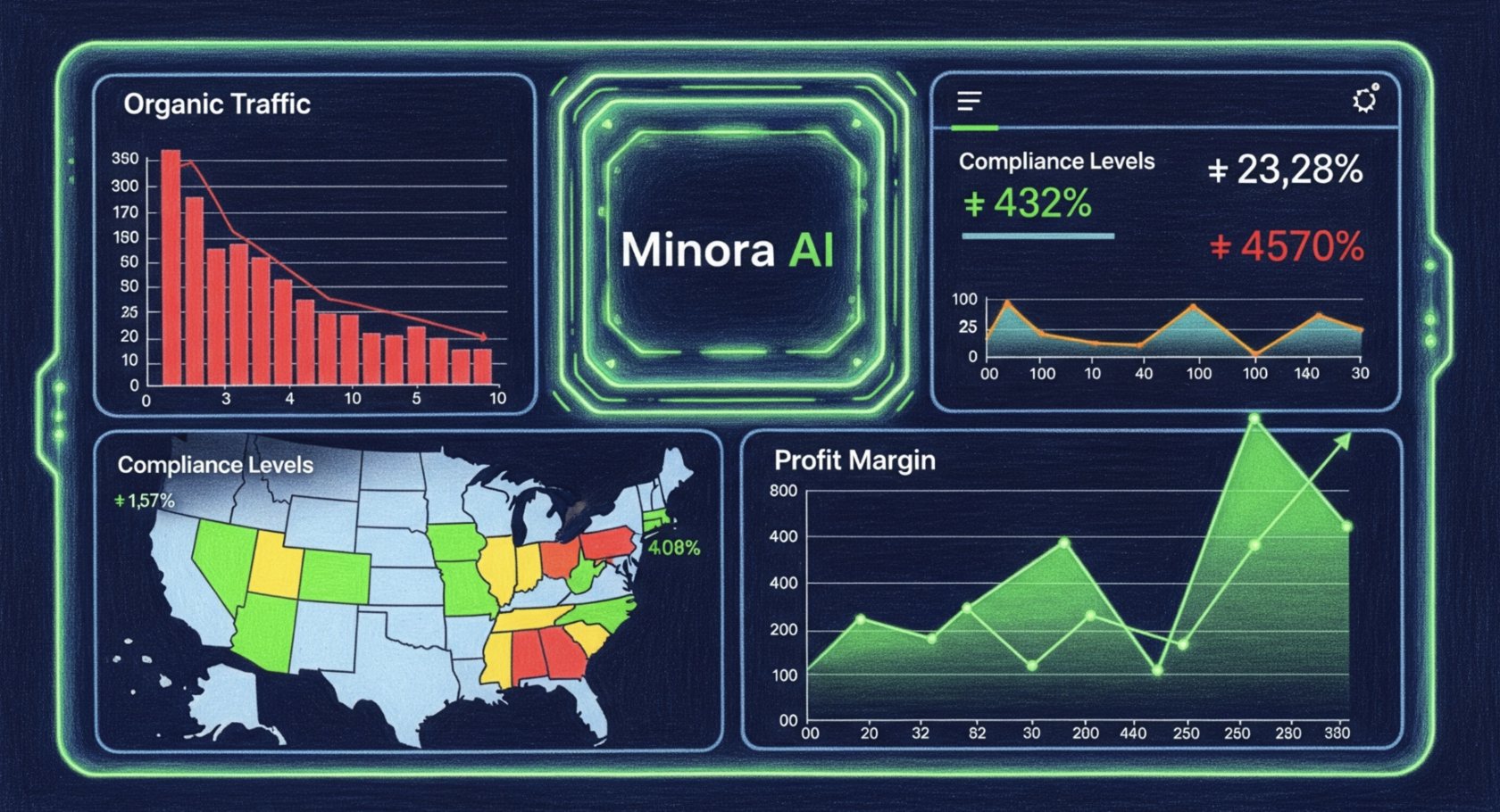
Executive Summary: The Operational Reality of the US Agency in 2025
The trajectory of the United States digital marketing sector in 2025 is defined not merely by technological iteration, but by a fundamental restructuring of how agencies and marketing departments create value. We have exited the era of purely transactional search and entered the age of the "Answer Engine," where visibility is binary: you are either the answer, or you are invisible. Simultaneously, the operational substrate of the industry is fracturing under the weight of manual inefficiencies, creating a bifurcation between agencies that have automated their strategic architecture and those drowning in what industry analysts term "Excel fatigue".
For US marketing managers and agency directors, the landscape is characterized by three convergent pressures. First, the collapse of traditional organic traffic due to AI Overviews (formerly SGE) necessitates a pivot from SEO to Answer Engine Optimization (AEO) and Generative Engine Optimization (GEO). Second, the "General Market" fallacy has finally been dismantled by data; the US is now understood as a complex aggregation of multicultural micro-markets, requiring state-level and culturally fluent intelligence that manual planning cannot scale to address. Third, the regulatory environment has splintered into a patchwork of state-specific privacy laws, making compliance a geographic challenge rather than a blanket policy.
This report provides an exhaustive, expert-level analysis of the tools, strategies, and operational frameworks required to navigate this new reality. It moves beyond superficial feature lists to examine the strategic utility of the 2025 marketing stack, focusing on how these technologies enable the "30-minute strategic launch" and protect agency profit margins. It concludes with a critical examination of Minora AI, a platform that exemplifies the shift from manual aggregation to algorithmic strategy generation.
Section 1: The Traffic Crisis and the Rise of Answer Engine Optimization (AEO)
The most immediate threat to US agency revenue models in 2025 is the decoupling of "search volume" from "referral traffic." For two decades, the agency value proposition relied on the correlation that ranking highly on Google equaled traffic to a client's site. The widespread deployment of AI Overviews and the dominance of Large Language Models (LLMs) like ChatGPT, Claude, and Perplexity as primary discovery engines have severed this link.
1.1 The Mechanics of the "Zero-Click" Economy
Data from early 2025 presents a stark reality: search queries that trigger AI Overviews result in a click-through rate (CTR) drop of approximately 47% compared to traditional organic results. This phenomenon, often termed the "Great Decoupling," means that for informational queries—the bread and butter of content marketing—users are consuming the synthesis provided by the AI without ever visiting the source publisher.
The implication for US agencies is profound. The traditional metric of "traffic" is becoming a vanity metric for many sectors. The new currency is "Citation" and "Answer Inclusion." If a brand's content is not structured to be ingested, understood, and synthesized by an LLM, it effectively does not exist in the modern discovery funnel. This shift demands a migration from Search Engine Optimization (SEO) to Answer Engine Optimization (AEO).
The Core Distinction:
- SEO (Legacy): Optimizes for a ranking position on a list of blue links. Success is measured in clicks.
- AEO (Current): Optimizes for the direct answer box or voice response. Success is measured in "Position Zero" visibility and brand authority.
- GEO (Emerging): Optimizes for inclusion in generative responses. Success is measured by the LLM citing the brand as a primary source in a conversational output.
1.2 Strategic Content Architecture for GEO
To survive the traffic crisis, US marketing managers must implement a "Hybrid Optimization Strategy" that serves both traditional crawlers and generative models. The content architecture must be modular, entity-rich, and explicitly structured.
The Modular Content Framework
LLMs process information in "chunks" or tokens. They struggle to extract definitive answers from dense, narrative-heavy paragraphs that bury the lead. The 2025 standard for high-performance content is modularity.
- The 75-300 Word Rule: Content should be segmented into focused blocks, each addressing a single, specific user intent or question. These blocks should range between 75 and 300 words—the optimal length for an LLM to digest and regurgitate as a complete thought.
- The "TL;DR" Protocol: Every major section of content must begin with a 40-60 word direct answer. This "front-loading" of the answer increases the probability of extraction for Google's AI Overviews and featured snippets. It signals to the engine: "Here is the concise answer you are looking for".
- Conversational Headers: H2 and H3 tags must mirror the natural language queries users speak into voice assistants or type into chatbots. Instead of a header reading "Benefits," use "What are the benefits of marketing automation for small businesses?".
Entity-Based Optimization and Schema
In the era of GEO, keywords are secondary to Entities. An entity is a distinct, well-defined concept (a person, place, brand, or thing) that the AI understands through a Knowledge Graph. If a client's brand is not established as a recognized entity, the AI cannot confidently cite it.
Agencies must aggressively implement structured data (Schema.org) to define these entities. Specifically, FAQPage, HowTo, and Organization schema provide a direct, machine-readable layer that tells the AI exactly what the content represents. This is the "direct line" to the AI's processing logic.
1.3 The AEO/GEO Tool Stack
The transition to AEO requires a retooling of the agency stack. Traditional rank trackers are insufficient for monitoring performance in a generative environment.
Section 2: Multicultural Intelligence and the Death of the "General Market"
A critical strategic failure in many US national campaigns is the reliance on the "General Market" concept—a monolithic view of the American consumer that assumes a white, suburban default. In 2025, this model is not just outdated; it is mathematically unsound. The multicultural market now drives the vast majority of US expenditure growth, and the "minority-majority" shift is well underway in key states like California, Texas, and Florida.
2.1 The Imperative of Cultural Fluency
Marketing to the US multicultural population requires more than translation; it requires Cultural Fluency. This is the ability to navigate the nuances of values, humor, visual codes, and purchasing drivers that differ radically between groups.
- The Hispanic Market: This is not a single block. It is segmented by country of origin (Mexican, Puerto Rican, Cuban, etc.) and, crucially, by Acculturation Level.
- Unacculturated: Spanish-dominant, relies heavily on Spanish-language media.
- Bi-Cultural: The fastest-growing segment. They may consume English media but retain deep cultural ties to Latino values. Marketing to this group requires "Spanglish" or "code-switching" creative strategies that acknowledge their dual identity.
- Digital Behavior: Hispanics have the highest digital video penetration rate in the US (81.3%). Platforms like TikTok and YouTube are not just entertainment channels; they are primary search engines for this demographic.
- The Asian-American Market: The most affluent and digitally connected demographic in the US, yet often the most ignored. This group is highly fragmented by language (Mandarin, Tagalog, Vietnamese, Korean).
- Streaming & Sports: Recent Nielsen data indicates a massive surge in sports streaming among Asian Americans, driven by the prominence of Asian athletes in US leagues (e.g., MLB). This presents a high-value, under-utilized channel for premium brand placement.
2.2 Tools for Multicultural Audience Intelligence
To execute on cultural fluency, agencies must abandon generic census data in favor of granular, real-time cultural intelligence platforms.
Claritas (CultureCode)
Claritas remains the gold standard for US demographic segmentation. Its CultureCode product allows agencies to segment audiences not just by race, but by acculturation level, language preference (English-dominant, Spanish-dominant, Bilingual), and country of origin.
Agency Use Case
A CPG brand wants to launch a product in Miami versus Los Angeles. Claritas can differentiate between the Cuban-heavy demographic of Miami and the Mexican-heavy demographic of LA, adjusting the creative strategy to match the specific cultural codes of each group.
Collage Group
While Claritas provides the "who" and "where," Collage Group provides the "why." Their Cultural Intelligence Engine offers deep psychographic data on the values and beliefs driving multicultural consumers.
Agency Use Case
Understanding why a sustainability message might resonate differently with a Black consumer versus a Gen Z Asian consumer. Collage Group provides the insights needed to tailor the emotional hook of the campaign.
StatSocial
For digital-first agencies, StatSocial offers the ability to map social audiences to verified identities. It can identify the specific influencers, memes, and content creators that resonate with niche cultural segments.
Agency Use Case
Identifying micro-influencers who have high credibility within the "Bi-cultural Latina Mom" segment, rather than wasting budget on macro-influencers with diluted engagement.
2.3 The 50-State Localization Strategy
The US market is effectively 50 different countries bound by a common currency. A campaign optimized for the weather patterns, holidays, and cultural attitudes of the Northeast will fail in the Deep South.
The Manual Failure:
Historically, creating 50 different media plans was impossible due to the sheer volume of work ("Excel Fatigue").
The Automated Solution:
Tools like Minora AI (discussed in Section 7) leverage AI to automatically calibrate media plans for 50-state nuances, adjusting for local holidays, weather, and cultural moments without requiring 50x the labor.
Historically, creating 50 different media plans was impossible due to the sheer volume of work ("Excel Fatigue").
The Automated Solution:
Tools like Minora AI (discussed in Section 7) leverage AI to automatically calibrate media plans for 50-state nuances, adjusting for local holidays, weather, and cultural moments without requiring 50x the labor.
Section 3: The Operational Crisis: Excel Fatigue and the Agency Bottom Line
Behind the scenes, US agencies are facing an operational crisis. The complexity of modern omnichannel marketing has outpaced the manual workflows used to manage it. This phenomenon, known as "Excel Fatigue," refers to the excessive time highly paid strategists spend manually aggregating data, formatting spreadsheets, and fixing broken formulas.
3.1 The Financial Impact of Manual Workflows
The cost of manual data entry and reporting is a silent killer of agency margins.
- Direct Cost: It is estimated that manual data tasks cost US companies an average of $28,500 per employee annually. For a mid-sized agency with 50 employees, this represents over $1.4 million in wasted labor capacity.
- Opportunity Cost: Every hour a strategist spends copying data from Facebook Ads Manager into Excel is an hour they are not spending on high-value creative strategy or client relationship building. This leads to the commoditization of the agency's service.
- Burnout and Churn: The "grind" of manual reporting is a primary driver of employee burnout. Surveys indicate that 68% of employees feel they have too much work to handle, leading to high turnover rates that disrupt client continuity.
3.2 The Profit Margin Squeeze
The financial health of US agencies varies drastically based on their operational efficiency.
- 7-Figure Agencies: typically average profit margins of 18-22%. These agencies often rely on manual workflows and struggle to scale.
- 8-Figure Agencies: Establish "Superagency" efficiency with margins of 25-32%. They achieve this by investing heavily in automation and training ($7,500/year per employee), allowing them to retain clients at a rate of 92% annually.
3.3 The Automated Agency Stack
To break the cycle of Excel fatigue, agencies must adopt a "Modern Data Stack" that automates the flow of information from platform to dashboard.
Reporting & Visualization: AgencyAnalytics
For reporting, AgencyAnalytics has become the industry standard for US agencies. It integrates with over 80 platforms (Google, Meta, LinkedIn, HubSpot, CallRail) to pull data into a centralized, white-labeled dashboard.
Impact:
Agencies report saving an average of 137 billable hours per month by switching from manual Excel reporting to AgencyAnalytics. This time can be directly reinvested into billable strategy work.
Data Integration: Funnel.io and Coupler.io
For agencies that need more custom data manipulation (e.g., blending data from a CRM with ad spend data to calculate ROAS), middleware tools like Funnel.io and Coupler.io are essential.
Function
These tools act as a pipeline, automatically extracting data from marketing platforms, normalizing it (cleaning up currency differences, date formats), and loading it into a destination like Google Sheets, Looker Studio, or a data warehouse (BigQuery).
Workflow Automation: Gumloop and Make
Beyond data, workflow automation is critical. Gumloop is emerging as a powerful tool for "AI chaining." It allows agencies to build drag-and-drop workflows that combine LLMs with other tools.
Use Case
A "Competitor Analysis" workflow that scrapes a competitor's blog, summarizes their content strategy using GPT-4, and posts a report to the agency's Slack channel—all automatically.
Section 4: The Fragmented US Privacy Landscape and Compliance Tooling
Unlike the European Union, which benefits from the unified regulatory framework of GDPR, the United States presents a complex, fragmented privacy landscape. In 2025, there is no single federal data privacy law. Instead, agencies must navigate a patchwork of state-level regulations, including the California Consumer Privacy Act (CCPA/CPRA), the Virginia Consumer Data Protection Act (VCDPA), the Colorado Privacy Act (CPA), and emerging laws in states like Utah and Connecticut.
4.1 The Compliance Challenge: Geography as a Variable
This fragmentation means that a user in San Francisco has fundamentally different rights (e.g., the right to opt-out of the "sharing" of data for cross-context behavioral advertising) than a user in Miami. For national campaigns, this creates a massive compliance burden. A "one-size-fits-all" privacy policy is no longer legally defensible.
Furthermore, the deprecation of third-party cookies and the rise of "signal-based" marketing means that agencies must rely on Consent Management Platforms (CMPs) to legally collect the first-party data that fuels their campaigns.
4.2 The Compliance Tech Stack
Agencies must deploy tools that are "geo-aware," automatically detecting a user's location and serving the appropriate consent banner and rights management workflow.
OneTrust
OneTrust remains the enterprise leader, offering the most comprehensive database of global and state-level laws.
Key Feature
Its "Cookie Auto-Blocking" and "Geo-Targeting" features ensure that a visitor from California sees a "Do Not Sell My Personal Information" link, while a visitor from Europe sees a GDPR-compliant opt-in banner. It automates the complex logic of multi-jurisdictional compliance.
Osano
Osano has gained significant traction among mid-sized agencies for its focus on simplicity and its "No Fines, No Penalties" pledge.
Key Feature
Data Lineage Visualization. Osano maps exactly where data flows after it is collected (e.g., from the website -> HubSpot -> Salesforce). This is critical for responding to Data Subject Access Requests (DSARs), where a user asks to know what data an agency holds on them.
Usercentrics
For agencies with a heavy focus on mobile apps, Usercentrics offers robust SDKs that handle consent within the app environment, ensuring that tracking on iOS and Android complies with both state laws and platform policies (like Apple's ATT).
4.3 The Pivot to First-Party Data Infrastructure
With privacy laws restricting the flow of third-party data, the value of First-Party Data (data the client owns) has skyrocketed. The agency stack must now include tools to activate this data.
Reverse ETL: Census
Census is a critical tool for the modern agency data stack. It solves the "Reverse ETL" (Extract, Transform, Load) problem.
- The Problem: Client data sits in a data warehouse (like Snowflake) or a database, disconnected from marketing tools.
- The Solution: Census syncs this trusted data out of the warehouse and into operational tools like Facebook Ads (for lookalike audiences), HubSpot (for personalization), or Marketo. This allows agencies to run campaigns based on actual customer lifetime value (LTV) rather than generic pixel data.
CRM as the Source of Truth: HubSpot & Salesforce
The CRM is no longer just a sales tool; it is the marketing system of record.
Integration
Both platforms now offer "Data Clean Rooms" and server-side tracking (Conversions API) integrations that allow agencies to measure campaign performance without relying on browser-based cookies, bypassing ad blockers and privacy restrictions.
Section 5: The AI Creative Revolution: Scaling Production
While strategy and operations are being streamlined, the production of creative assets is undergoing an AI-driven explosion. The goal of AI in creative is not to replace human ingenuity but to solve the Volume and Velocity problem. To feed the algorithms of TikTok, Meta, and YouTube Shorts, brands need exponentially more creative variations than human teams can manually produce.
5.1 Generative Copy and Strategy
Jasper & Copy.ai
These tools have evolved beyond simple text generation. In 2025, they offer "Brand Voice" features that analyze a client's existing content to build a custom style guide. This allows them to generate blog posts, ad copy, and email sequences that sound indistinguishable from the brand's human copywriters, but at infinite scale.
5.2 Visual and Video Automation
- AdCreative.ai: This tool focuses specifically on performance marketing. It uses historical data from millions of successful ads to generate high-conversion display and social creatives. For agencies managing hundreds of SKUs or location-based variants, this automation is the only way to maintain performance velocity.
- Synthesia: A game-changer for multicultural marketing. Synthesia allows agencies to create training videos, explainers, or social content using AI avatars. Crucially, it enables Video Localization: a single video recorded in English can be instantly translated into Spanish, French, or Mandarin, with the avatar's lip movements automatically synchronized to the new language. This enables true multicultural personalization at a fraction of the cost of re-shooting.
Section 6: Future-Proofing the Agency Model: Value-Based Pricing
The widespread adoption of these tools forces a re-evaluation of the agency business model. When tools like Minora AI (Section 7) can reduce 40 hours of planning to 30 minutes, billing by the hour becomes a path to bankruptcy.
6.1 The Shift to Strategic Value
Agencies must pivot to Value-Based Pricing. Clients do not pay for the hours spent moving data around; they pay for the outcome of that data. The value proposition must shift from "We work hard" to "We deliver speed and precision."
The "Superagency"
These technologies enable the rise of the "Superagency"—lean organizations with high profit margins (25%+) that use AI to handle the execution layer while senior strategists focus on high-level consulting and creative direction.
Section 7: The Solution: Minora AI and the 30-Minute Strategic Launch
In the context of the fragmented, high-velocity, and complex US market described above, Minora AI emerges not just as a tool, but as a central operating system for the modern agency. It directly addresses the core inefficiencies of manual planning and the "Excel fatigue" that plagues the industry.
7.1 The Problem: The 8-Week Loop
The traditional media planning cycle in the US is broken. It typically involves:
- Week 1-2: Aggregating research from disparate sources (Comscore, Nielsen, Census, Social listening).
- Week 3-4: Manual data entry into massive Excel sheets to model budgets and reach.
- Week 5-6: "Versioning" hell—updating slides and spreadsheets as client budgets shift.
- Week 7-8: Final approval.
- By the time the plan is approved, the cultural moment has passed. This latency is fatal in the 2025 attention economy.
7.2 The Solution: Minora AI’s "Cursor for Marketing"
Minora AI positions itself as the "Strategy Engine" that compresses this 8-week cycle into a 30-minute launch. It automates the intellectual grunt work of strategy, allowing teams to act as architects rather than bricklayers.
Core Capabilities Adapted for the US Market:
1. The 30-Minute Strategic Architecture
Minora transforms a simple 12-minute "Smart Brief" intake into a comprehensive strategic output. Within 30 minutes, the AI generates:
- A Strategic Roadmap detailing the "Why" and "How."
- A Media Investment Model (XLS) with fully calculated budget allocations, frequency caps, and channel mixes.
- A Boardroom-Ready Executive Deck (PPT) that explains the strategy to stakeholders.
- This capability alone allows agencies to bypass the "billable hours" trap and deliver immediate value.
2. Built-in 50-State & Multicultural Intelligence
Minora directly addresses the multicultural challenge. It includes built-in market intelligence spanning all 50 US states and diverse demographic segments.
- Contextual Intelligence: It automatically aligns campaigns with key US cultural moments (Super Bowl, Black Friday, local holidays) to ensure relevance.
- Relevance Scoring: It scores creative concepts against target demographics to predict "Cultural Fit" before media dollars are committed, mitigating the risk of PR disasters.
3. Unbiased, Data-Backed Planning
Unlike agency trading desks that may be incentivized to push high-commission inventory, Minora takes zero cut of media spend. Its channel recommendations—spanning 450+ digital and physical touchpoints—are based purely on performance data and algorithmic precision.
7.3 How to Use Minora AI for Effectiveness
To maximize the impact of Minora AI, marketing managers and agency directors should integrate it into three specific phases of their operation:
Phase 1: The "Pre-Pitch" Weapon (New Business)
- Action: Before a pitch meeting, run the prospect's goals through Minora's Smart Brief.
- Outcome: Walk into the first meeting not with a generic capabilities deck, but with a fully costed, 50-state localized strategy. This demonstrates a velocity and strategic depth that manual competitors cannot match, significantly increasing win rates.
Phase 2: The "Retainer" Engine (Client Growth)
- Action: Use Minora's "Contextual Intelligence" to proactively pitch campaigns around upcoming cultural moments.
- Outcome: Instead of waiting for the client to ask "What should we do for Black Friday?", you present a fully architected plan months in advance, proving ongoing strategic value and justifying retainer fees.
Phase 3: The "Profitability" Shield (Operations)
- Action: Shift junior analysts away from manual Excel aggregation. Let Minora handle the math of CPMs and budget logic.
- Outcome: Redeploy your human talent to high-value tasks like creative strategy and client relationship management. This reduces burnout, improves retention, and protects the agency's profit margins from the inefficiencies of manual labor.
Conclusion and Call to Action
The digital marketing ecosystem of 2025 is unforgiving to inefficiency. The combination of AEO reducing organic traffic, privacy laws fragmenting data, and clients demanding "more for less" creates a perfect storm. However, for agencies equipped with the right stack, it is an era of unprecedented opportunity.
By leveraging AEO tools to dominate AI answers, multicultural intelligence to unlock diverse growth, and automation to eliminate low-value labor, US agencies can secure their future. The era of the 8-week planning cycle is over. The era of the strategic architect has begun.
Don't let manual workflows and outdated planning cycles hold your agency back.
Use Minora AI to transform your strategic process.
- Generate comprehensive US media strategies in 30 minutes, not 8 weeks.
- Access built-in intelligence for 50 states and multicultural segments.
- Reclaim 80+ hours of team time per campaign.
Start your 30-minute launch today at brief.minora.ai and experience the power of the Strategy Engine.
