

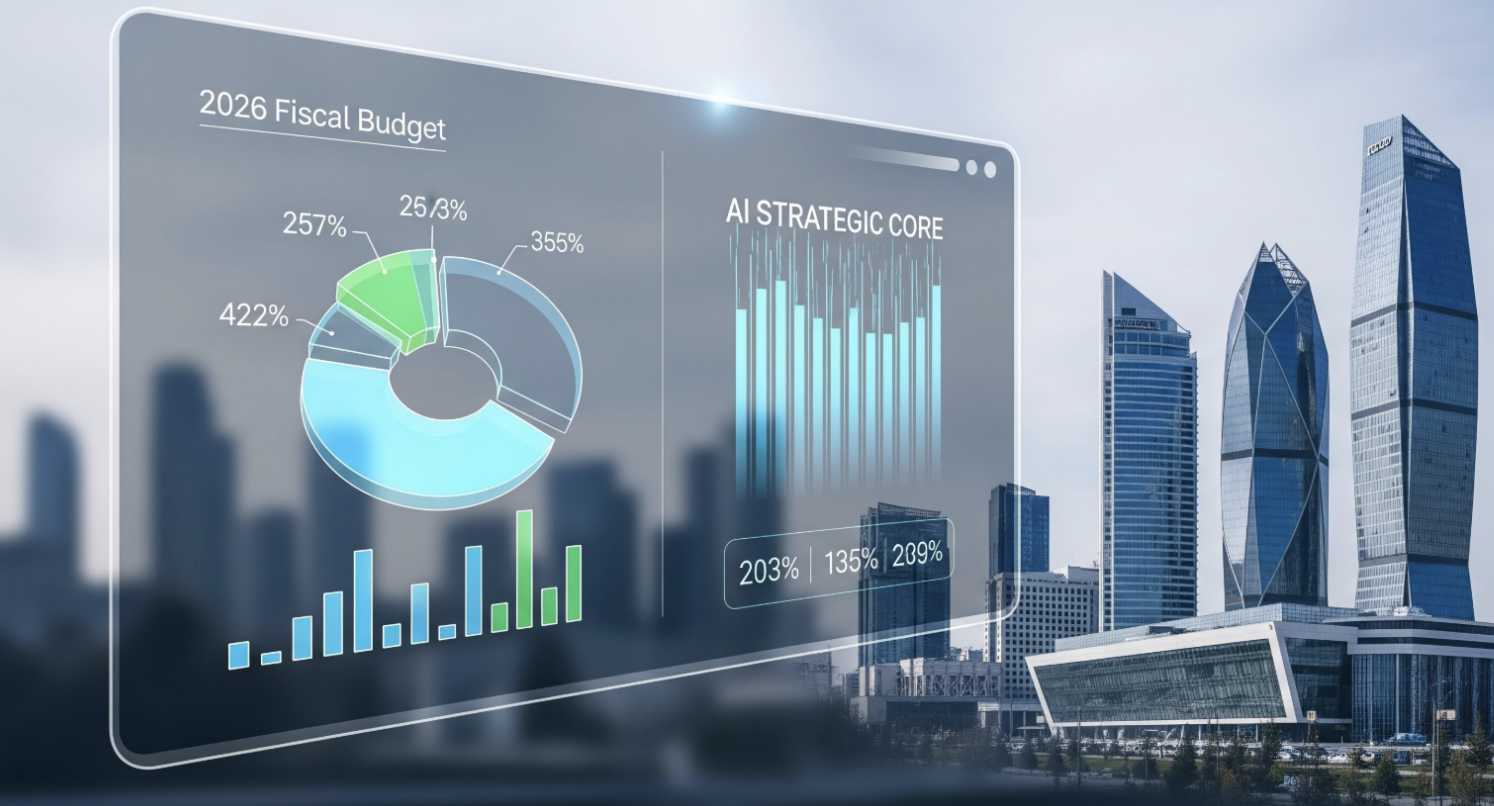
The defining anxiety for the 2026 Enterprise CMO is no longer about "if" AI should be used, but the paralyzing fear of falling behind the technological curve. As market leaders transition from simple content generators to sophisticated Autonomous Marketing Entities, the window to secure a competitive edge is closing. Brands still tethered to fragmented, manual "Excel-routine" strategies are watching their market share erode in real-time as AI-native competitors optimize budgets with mathematical precision.
Context or Strategy
In Central Asia, the 2026 landscape is a digital battlefield. With marketplaces like Uzum and Kaspi becoming dominant ecosystems, global brands are reallocating up to 25% of their regional budgets specifically into "Strategic Core" AI. This isn't just about efficiency; it's about cultural survival in a market where localized, agentic responsiveness is now the baseline for consumer trust.
Practical Framework: Reallocating for the Agentic Era
To maintain a competitive edge, 2026 budgets must shift from "Content Volume" to "Strategic Intelligence."
The 20/50/30 Budget Partition
Leading enterprises are adopting a three-tiered allocation model to de-risk their technological transition.
The Operational Foundation (20%)
A fixed portion of the budget is now dedicated to the "Agentic Layer"—tools that handle autonomous negotiation, inventory-aware media buying, and real-time cross-channel allocation. This replaces the traditional high headcount of junior planners and manual account managers.
The Strategic Core (50%)
The largest share is allocated to the "Insight Engine." This involves deep data ingestion from CRMs, POS systems, and external market trends. By investing in a "Unified Customer Map," CMOs ensure that every subsequent dollar spent on media is guided by causal AI rather than historical "gut feeling."
The Experimental Delta (30%)
High-growth brands reserve 30% for high-velocity experimentation. This includes generating 1,000+ personalized video variants weekly or seeding native content in emerging Telegram niche folders. The goal here is "Rapid Failure" and "Exponential Success" driven by AI's ability to iterate at scale.
From Generative Copilots to Autonomous Entities
Budgeting for 2026 means moving beyond Jasper or Copy.ai toward systems that execute.
Neuro-Symbolic Compliance
Enterprises are allocating significant funds to AI guardrails. In regions like Central Asia, these systems ensure that every AI-generated creative adheres to both the global brand-book and local cultural codes (e.g., Halal standards or national holidays) automatically, removing the human error bottleneck.
Predictive ROI Forensics
Million-dollar media plans now include "Predictive Auditing." CMOs are spending on AI that simulates a campaign’s performance before launch. This reduces budget leakage by identifying bot-heavy channels and low-intent audiences in the planning phase, not in the post-campaign report.
Reclaiming the "Strategy Gap"
The most valuable budget reallocation is the one that buys back time.
Time-to-Strategy Compression
Traditional agencies bill for "hours worked," often taking 2–3 weeks to produce a media plan. 2026 leaders are moving toward platforms that offer "Automated Synthesis." By compressing the 30-hour research phase into 30 minutes, teams can pivot strategies weekly rather than quarterly, maintaining a state of "Constant Market Fit."
Metrics & ROI: The New Standard of Success
The Efficiency Multiplier
Traditional KPIs like CPM and CPC are being replaced by "Efficiency Ratios."
Strategy Synthesis Speed (SSS)
Measure how fast your team can move from a business problem to a ready-to-launch media plan. In 2026, a high SSS is a direct indicator of a brand’s ability to capture transient market opportunities before competitors can react.
Reclaimed Creative Margin
By automating the "Excel-routine," calculate the percentage of your team's time that has been reallocated to high-level creative and business development. Successful AI integration should yield a >100% increase in senior talent output.
Performance Indicators
Risk-Adjusted Return (RAR)
In 2026, the CFO demands a RAR score. This metric accounts for the probability of human error, bot fraud, and cultural misalignment. AI-driven plans typically provide a 20% higher RAR than manual plans by eliminating the "Invisible Leakage" inherent in fragmented spreadsheets.
Causal Growth Attribution
Move beyond "Last-Click" data. 2026 budgets are monitored by causal AI that identifies which AI-driven touchpoints actually caused a sale, allowing for a liquid budget that flows toward real growth drivers in real-time.
Conclusion: Securing the Competitive Edge
The transition to AI-driven marketing in 2026 is no longer a technical upgrade; it is a strategic imperative. The "Fear of Falling Behind" is a rational response to a market moving at the speed of light. By reallocating budgets toward a "Strategic Core" that automates research, planning, and cultural adaptation, CMOs can transform their departments from cost centers into high-velocity growth engines. Minora AI facilitates this evolution, turning the 30-hour manual planning struggle into a 30-minute strategic triumph.
Ready to grow? Don't let your 2026 strategy be written in 2024. Get your ready-made, AI-powered marketing strategy and localized media plan in just 30 minutes.
FAQ
1. What is the average percentage of marketing budget spent on AI in 2026?
Enterprise leaders are allocating between 15% and 25% of their total marketing budget to AI infrastructure, specifically focusing on agentic automation and predictive analytics.
2. How does AI help me stay ahead of my competitors?
AI allows you to move from "Quarterly Planning" to "Real-Time Synthesis." You can react to market shifts, competitor moves, and cultural trends in 30 minutes rather than weeks.
3. Is spending on AI just about cutting staff?
No. It is about "Staff Augmentation." It removes the 30 hours of manual "Excel-routine," allowing your senior talent to focus on high-level creative strategy and business growth.
4. How does Minora AI handle the specific cultural nuances of Central Asia?
Our AI is built with a localized "Knowledge Graph" that accounts for the traditions, languages, and cultural codes of 5 Central Asian countries, ensuring 100% regional relevance.
5. Can AI really predict my ROI before I spend a dollar?
Yes. Using predictive media mix modeling and historical data ingestion, our system can forecast reach, frequency, and conversion probability with high statistical confidence.
6. What is "Agentic AI" in marketing?
Agentic AI refers to systems that don't just generate text, but take actions—such as autonomous negotiation with influencers or real-time budget reallocation across platforms.
7. How do I justify the AI spend to my CFO?
Minora AI generates "CFO-ready" reports that explain the "Why" behind every dollar spent, focusing on risk reduction and incremental ROI lift.
8. Can I use AI for my offline/OOH planning as well?
Yes. In 2026, the most effective strategies are "Omni-Budget," integrating digital data with OOH and BTL metrics for a unified view of the market.
9. How fast can Minora AI produce a full enterprise strategy?
From a 12-minute online brief to a 5–10 page strategy, media plan, and presentation in exactly 30 minutes.
10. What is the main risk of not investing in AI by 2026?
The main risk is "Structural Irrelevance." Competitors using AI will have lower CAC, higher ROAS, and the ability to out-maneuver manual brands in every digital channel.
