


Every Q1, the same conversation happens in boardrooms from Tashkent to London. The CFO asks what customer acquisition is going to cost this quarter. The marketing director gives a range. The CFO wants a number. Nobody has one. Budget gets approved based on last year's data, category benchmarks, and a degree of hope that nobody will admit to. This article is about why that dynamic exists — and what it takes to actually solve it, not just manage around it.
Why CPA Can't Be Calculated After the Fact Anymore
The traditional excuse was that marketing was inherently unpredictable. You spend, you measure, you optimize. That was a reasonable position in 2015 when channels were fewer and attribution was simpler. It does not hold in 2026.
Enterprise media budgets now span 300+ consumer touchpoints. Your ICP might convert through a Telegram channel in Uzbekistan, a LinkedIn retargeting ad in Dubai, or an OOH placement at a Tashkent transit hub — as happened in a KoronaPay campaign where Minora AI's Research Agent identified transport infrastructure as a high-trust conversion environment that human analysts had overlooked entirely. The fragmentation of the modern consumer journey has made post-hoc CPA measurement a lagging indicator, not a management tool.
The deeper problem is what the CMO Product Deck from Minora AI calls "frozen budgets" — capital that gets trapped in underperforming channels because you're waiting for month-end reports to confirm what the data already knows. By the time you see the numbers, the spend is gone. The campaign post-mortem is genuinely too late.

Need to bring predictive CPA to your next budget review? Book a strategy call with Minora AI — we work with enterprise marketing teams across Central Asia and beyond.
How Predictive CPA Actually Works
The core insight is straightforward: if you have enough historical spend data and a model trained on real performance signals — not category averages — you can forecast CPA before a dollar goes out the door. The word "predictive" gets misused in MarTech constantly. Here's what it actually requires.
The Data Foundation
Historical Spend Quality, Not Just Volume
Predictive CPA models are only as good as the training data behind them. Minora AI's model is trained on $30M+ in actual managed ad spend — real campaign outcomes, real channel performance, real audience response data. That's materially different from a benchmarking tool that shows you industry averages. Averages tell you what other companies paid for customers that aren't yours.
ICP-Specific Signal Inputs
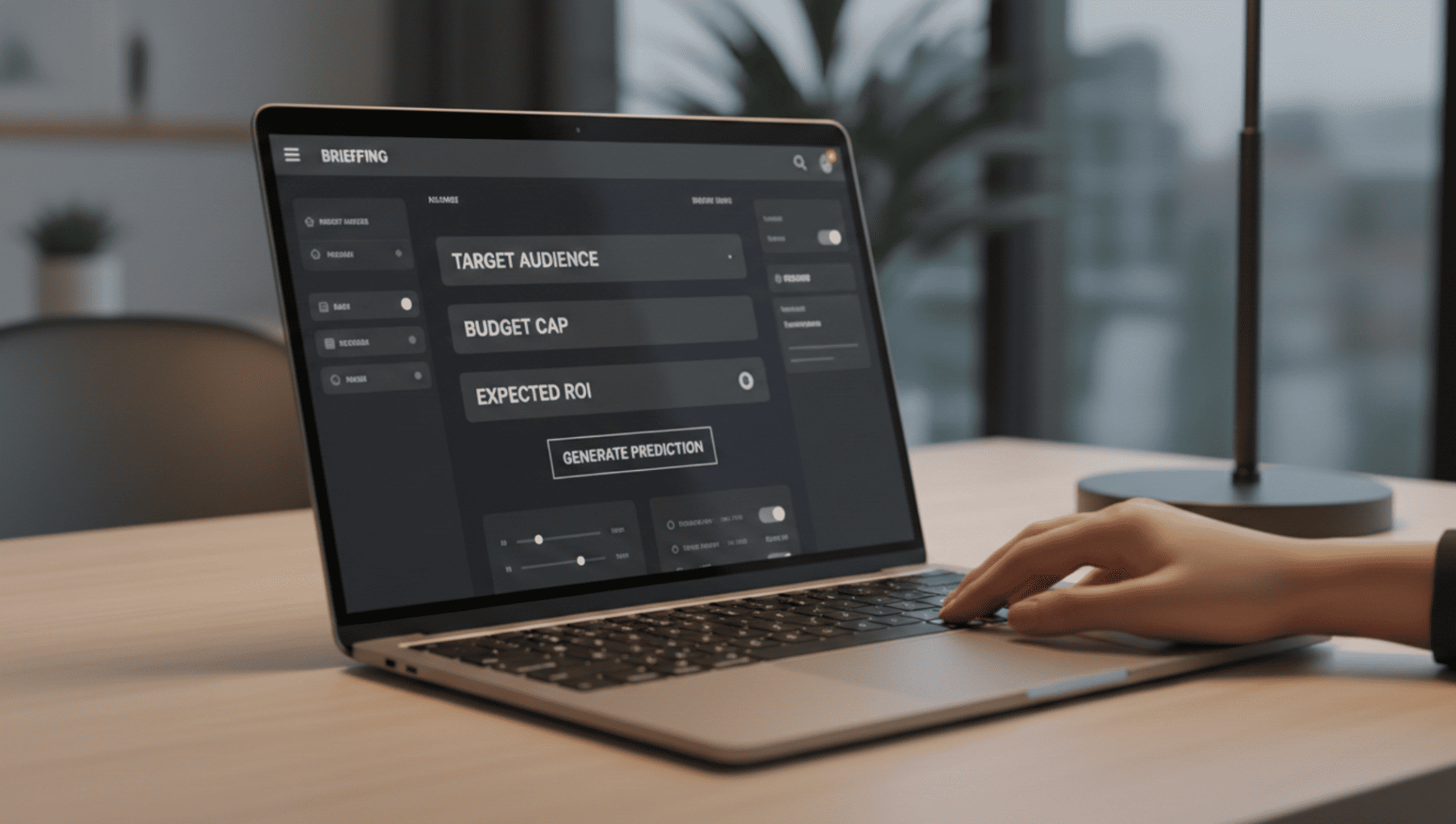
Your ideal customer profile changes what a realistic CPA looks like. A B2B SaaS CMO targeting procurement directors in Kazakhstan has a completely different acquisition cost structure than a fintech brand targeting urban mobile users in Tashkent. Minora AI's Strategy Personalization Agent takes your ICP parameters, budget cap, and target channels, then runs a Reach/CPA/ROI forecast before you commit any spend. The output isn't a range. It's a number with a confidence interval — the kind of thing you can actually show a CFO.
The Forecasting Mechanism
Pre-Launch Budget Modeling
The Minora AI briefing interface works like this: you define the budget and campaign objectives, the Strategy Personalization Agent models the spend against historical performance data from comparable campaigns, and you get a projected CPA output before launch. The onboarding-to-first-forecast timeline is 30 minutes. That's not a marketing claim — it's the documented workflow from initial market scan to strategy generation.
Real-Time Reallocation as the CPA Protection Layer
Forecasting CPA is half the problem. Protecting it once the campaign is live is the other half. Minora AI's Optimization Agent monitors 450+ channels and reallocates budget toward top performers continuously — not at week-end, not at month-end, but in real time, 24/7. If a channel's cost-per-click deteriorates on a Tuesday afternoon, the budget moves. Your CPA forecast doesn't drift because you're not waiting on a human to notice and act.
What This Changes for the CFO Conversation
This is where the practical value lands. The CFO question — "what will customer acquisition cost us?" — has historically been unanswerable before a campaign runs. That's not because CMOs are incompetent. It's because the tools available were measurement tools, not forecasting tools. There's a structural difference.
KPIs to Track
Pre-Launch CPA Forecast Accuracy
Track the delta between your pre-launch CPA forecast and actual post-campaign CPA. This is the metric that tells you whether your model is calibrated to your specific market. A well-trained predictive CPA tool should get within 15–20% of actual results by the third campaign iteration. If it's not converging, the training data isn't representative enough.
Frozen Budget Rate
Measure what percentage of your weekly ad spend is sitting in channels that have underperformed for 72+ hours without reallocation. In teams using manual optimization, this figure is often 30–40% of total spend — capital that could be moving to better-performing placements but isn't because the reporting cadence is too slow. Real-time budget reallocation directly attacks this number.
CFO Budget Justification Score
This is softer, but track it anyway. After implementing predictive CPA modeling, run a simple internal survey: how confident is your finance team in approving the marketing budget? The shift from "we're guessing" to "we have a model" changes the internal negotiation entirely. Marketing ROI accountability becomes something you can demonstrate proactively, not defend retroactively.
How Minora AI Reports on These Metrics
Minora AI's executive dashboard surfaces CPA projections alongside live campaign performance, with real-time budget allocation breakdowns visible to the CMO without requiring an analyst to pull and format data. The ROI Trend Analysis view shows projected versus actual performance in the same interface. Teams using the platform report reclaiming approximately 80 hours per week that were previously spent on manual reporting — roughly $150K per year in strategic talent time that can be redirected to actual decision-making.
Conclusion
The CFO question isn't going away. If anything, budget scrutiny in 2026 is tighter — Gartner's data shows that 59% of CMOs are operating under budget constraints, and the demand to justify every line item before it's spent is now a baseline expectation, not an exceptional circumstance. Marketing teams that can walk into that conversation with a model-backed CPA forecast — not a benchmark range, not last year's actuals — are in a fundamentally different position than those who can't.
Minora AI exists for exactly this gap. The combination of a predictive CPA model trained on $30M+ in real ad spend, a Strategy Personalization Agent that outputs forecasts before launch, and an Optimization Agent that protects those forecasts in real time is the closest thing currently available to a mathematically justifiable marketing budget. The era of approving spend "on gut feeling" is over for teams that choose to move past it.
Ready to give your CFO a real answer on CPA? Minora AI forecasts your cost per acquisition before the first dollar is spent — using a model trained on $30M+ in real campaign data, not industry benchmarks. Enterprise marketing teams across Central Asia and global markets use it to turn budget conversations from guesswork into math.
FAQ
Q1: What is predictive CPA and how is it different from measuring CPA after a campaign? A: Predictive CPA is a pre-launch forecast of what customer acquisition will cost, based on historical performance data and AI modeling. Standard CPA measurement tells you what you paid after the budget is spent — predictive CPA tells you what you're likely to pay before you commit. For enterprise marketing teams, the difference is the ability to present a defensible number to finance leadership before a campaign goes live, rather than reporting outcomes after the fact.
Q2: How accurate are AI-based CPA forecasts before launch? A: Accuracy depends heavily on the quality and relevance of the training data. Minora AI's predictive model is trained on $30M+ in actual managed ad spend, which means forecasts are calibrated against real campaign outcomes rather than category averages. For teams running their third or fourth AI-assisted campaign, forecast accuracy typically converges within 15–20% of actual results — accurate enough to justify budget allocation decisions at the executive level.
Q3: How does real-time budget reallocation protect CPA targets once a campaign is live? A: Once a CPA forecast is set, the Optimization Agent monitors performance across 450+ channels continuously and shifts budget away from underperforming placements in real time — not at the end of the week or month. If a channel's acquisition cost rises above the target threshold on a Tuesday afternoon, capital moves immediately. This prevents the "frozen budget" problem where money stays locked in bad channels because reporting cycles are too slow to catch the drift.
Q4: Can predictive CPA modeling work for B2B enterprise campaigns in Central Asia? A: Yes, and Central Asian markets — particularly Uzbekistan and Kazakhstan — have specific dynamics that generic Western benchmarks don't account for: Telegram as a dominant engagement channel, Android-first device behavior, and platform attribution patterns that differ significantly from European or North American norms. Minora AI's Research Agent incorporates cultural and regional context into its market scans, which is why it identified transport hub placements as high-trust touchpoints for KoronaPay in Uzbekistan — an insight that category-level benchmarks would have missed entirely.
Q5: What data do I need to provide to generate a pre-launch CPA forecast? A: The starting point is your target audience definition (ICP), budget cap, and campaign objectives. From there, Minora AI's Strategy Personalization Agent pulls relevant historical performance signals and runs its forecast model. Full data integration takes approximately one minute; the first market scan and strategy generation takes around 30 minutes. You don't need to supply years of historical data yourself — the model draws on its own training base while personalizing the forecast to your inputs.
Q6: How is this different from using Google's Smart Bidding or Performance Max forecasts? A: Google's automated bidding systems optimize for Google's inventory. They have no visibility into performance on Telegram, programmatic networks, local platforms, or the 400+ other channels that may be part of an enterprise multi-channel strategy. Predictive CPA tools like Minora AI's operate across the full media mix, not a single platform's walled garden — and the forecast is produced before launch, not as a by-product of live bidding. Performance Max in particular has been widely criticized for opacity in spend allocation, which is the opposite of what CFO-level budget accountability requires.
Q7: What's the ROI case for implementing predictive CPA modeling at the enterprise level? A: There are two direct ROI drivers. First, labor savings: manual reporting and optimization typically costs enterprise teams 80+ hours per week — roughly $150K per year in strategic talent time that could be spent on actual strategy. Second, waste reduction: eliminating budget frozen in underperforming channels without real-time reallocation can increase ROAS by approximately 20%, according to Minora AI's internal model analysis. On a $500K quarterly budget, a 20% ROAS improvement is a material number that justifies the platform cost quickly — the documented break-even point is under 60 days.
Q8: How does predictive CPA help with marketing budget justification to the CFO or finance team? A: The core shift is from retrospective reporting to prospective modeling. When you can walk into a budget review and say "based on our model trained on $30M in campaign data, we're forecasting a CPA of X for this campaign at this budget level," the conversation changes. Finance teams can assess risk against a forecast rather than approving a budget based on last year's actuals and hoping for the best. Marketing budget justification becomes a quantitative exercise rather than an advocacy exercise.
Q9: What's the difference between reducing CPA and improving ROAS — aren't they the same thing? A: They're related but not identical. CPA measures what you pay to acquire a customer; ROAS measures revenue generated per dollar of ad spend. You can improve ROAS without reducing CPA if average order values go up. You can reduce CPA without improving ROAS if the customers you're acquiring spend less. For enterprise marketing, both matter — but predictive CPA modeling is particularly valuable for customer acquisition cost accountability, while ROAS optimization is more relevant for channel-level spend efficiency. Minora AI's platform addresses both: the forecast layer handles CPA planning, and the Optimization Agent protects ROAS by continuously reallocating to better-performing channels.
Q10: How long does it take to go from signing up with Minora AI to having a live predictive CPA model running? A: The documented onboarding timeline is: data integration and team access in one minute; first AI market scan and strategy generation in 30 minutes; pilot campaign launch within 48 hours; full algorithmic optimization active from 48 hours onward. The platform is designed as a plug-and-play strategy engine — no complex IT overhaul, no months-long implementation project. For enterprise teams used to six-week agency planning cycles, the speed differential is significant.
