


You walk into the board meeting with a strategy that could actually move the number. Thirty slides. Solid channel logic. A clear ICP. And within the first ten minutes, someone asks: "What was the ROI on last year's spend?" The meeting is now about the past, not the future. According to Gartner's 2025 CMO Spend Survey, 59% of chief marketing officers say their current budget is insufficient to fully execute their marketing strategy — and that number hasn't meaningfully improved in three years. Marketing budget optimization becomes impossible when the baseline conversation is always backward-looking. This is the budget trap, and most CMOs are caught in it.
The 7.7% Problem — Why Budgets Aren't Growing With Ambition
Marketing spend as a share of company revenue sits at 7.7% — the same figure as the year before. On the surface that sounds stable. In practice, it means marketing is being treated as a cost center on autopilot while sales targets climb. The CMO's mandate gets larger. The headcount stays flat. The channels multiply.

This isn't a finance department failure. It's a proof problem. CMOs who can't show clean attribution between spend and pipeline make the CFO's job easy: freeze the budget, demand accountability, revisit next cycle. The result is what Minora AI calls a "frozen budget" — money that sits in historically approved channels not because those channels are performing, but because nobody has the data to justify moving it.
💡 Running this same conversation every quarter? Book a strategy call with Minora AI — we work with enterprise marketing teams across Central Asia and beyond to build the kind of attribution that wins board rooms.
How to Break the Proof Cycle: A Practical Framework
The CFO's question — "prove last year's ROI" — is actually reasonable. The problem is that most enterprise marketing teams can't answer it quickly, cleanly, or specifically enough. They arrive with a range. A blended ROAS. A qualified estimate. That's not a defense; that's an opening for skepticism.
Breaking the cycle requires two structural changes: pre-launch ROI forecasting and real-time budget tracking that doesn't require end-of-month aggregation to reveal waste.
Pre-Launch Forecasting — Know Your CPA Before You Spend
Why Gut-Check Budgeting Fails at Scale
Most enterprise media plans are built on historical averages and category benchmarks. That's fine for steady-state markets. In a fragmented media environment — where a single consumer journey now spans 300+ touchpoints — averages mask channel-level variance that kills actual performance. A blended CPA of $45 can hide one channel at $12 and another bleeding at $180.
Predictive CPA as a Board-Ready Metric
Minora AI's Strategy Personalization Agent changes the pre-launch conversation entirely. Before a single dollar is committed, the system forecasts Reach, CPA, and projected ROI based on the model trained on $30M+ in historical ad spend. That number isn't a guess — it's a commitment. And a commitment is something you can take into a board meeting. The CFO doesn't want a range. She wants a number with a rationale.
Real-Time Reallocation — Stop Waiting for the Post-Mortem
The "Approve Once, Spend Blindly" Problem
Traditional campaign management works on a quarterly logic. Set the budget in March, review the wreckage in June. By the time the data is aggregated and reviewed, the poor-performing channels have consumed two months of budget that could have fed the winners. This is the "Manual Tax" — the organizational cost of having humans aggregate CSVs while the market moves.
24/7 Budget Optimization Without the Headcount Cost
Minora AI's Optimization Agent monitors performance across 450+ channels and reallocates budget to top performers continuously — not on a monthly reporting cycle. The math here is straightforward: eliminating frozen budgets in underperforming channels can increase ROAS by approximately 20%, per Minora's internal client data. That's not a marketing efficiency story. That's a CFO story. Reclaiming 80+ hours per week in manual reporting work translates to roughly $150K per year in recovered strategic talent time. Both numbers belong in the next budget justification presentation.
Metrics That Win Budget Conversations
The CMO who wins the budget argument isn't the one with the best strategy deck. It's the one who walks in with three clean numbers: what was spent, what it produced, and what it would have produced with more. Everything else is decoration.
KPIs to Track
Cost Per Acquisition vs. Predicted CPA
Track actual CPA by channel against the pre-launch forecast. A variance under 15% means your model is reliable. That reliability is the single most persuasive argument for increasing budget — not past performance, but predicted performance you can prove you can deliver.
ROAS by Channel, Not Blended
Blended ROAS is a political number. It makes weak channels invisible. Reporting ROAS at the channel level forces the conversation about where money is actually working. B2B marketing ROI benchmarks for 2026 vary significantly by vertical — SaaS lead generation benchmarks run 3–5x ROAS while fintech performance campaigns regularly hit 6–8x in Central Asian markets when channels are properly isolated.
Marketing Spend Accountability Rate
What percentage of your budget can you trace to a pipeline outcome within a defined attribution window? Enterprise teams operating below 60% traceability have a data infrastructure problem, not a strategy problem. Fixing the former is the fastest path to unlocking the latter.
How Minora AI Reports on These Metrics
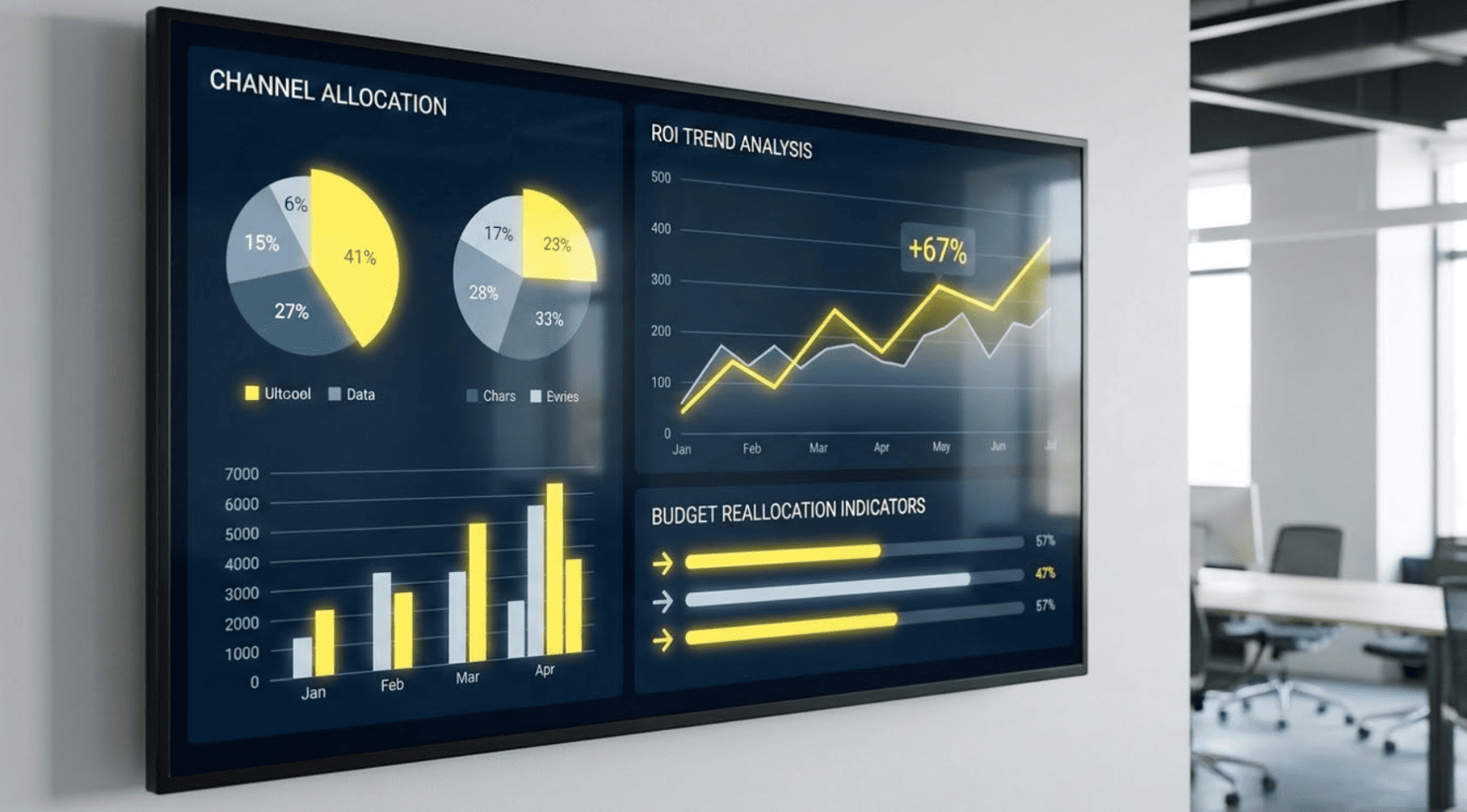
Minora AI's executive dashboard surfaces all three metrics in a single view — actual vs. predicted CPA, channel-level ROAS, and a real-time budget allocation map showing where spend is actively flowing. The Research Agent runs competitive scans in parallel, so the CMO can frame performance not just against internal targets but against category benchmarks. For enterprise teams in Uzbekistan and across Central Asia, where market data has historically been difficult to surface, this competitive context is the difference between a budget conversation and a budget win.

Conclusion
The budget constraint most CMOs face isn't really about money. It's about credibility. The CFO will fund a marketing function that can demonstrate predictable, traceable returns — and will freeze one that cannot. The 59% figure from Gartner isn't a finance problem; it's a measurement problem wearing a budget problem's clothes. Teams that solve attribution first — that can say "we predicted $42 CPA and delivered $39" — stop having the ROI conversation and start having the investment conversation. Minora AI exists for exactly this: to give enterprise marketing teams the pre-launch forecasting and real-time reallocation infrastructure that makes that credibility possible.
Ready to walk into your next board meeting with numbers, not estimates? Minora AI's predictive CPA engine and 24/7 optimization agents give enterprise CMOs the attribution data that justifies budget growth — before the spend happens. Stop defending last year. Start forecasting next quarter.
FAQ
Q1: Why do most CMOs struggle to justify their marketing budget to the CFO?
A: The core issue is attribution, not strategy. Most marketing teams can show what they spent but can't cleanly connect that spend to pipeline or revenue at a channel level. CFOs respond to that ambiguity by freezing budgets rather than growing them. The fix is measurement infrastructure — specifically, pre-launch CPA forecasting and real-time channel performance tracking — not more creative presentations.
A: The core issue is attribution, not strategy. Most marketing teams can show what they spent but can't cleanly connect that spend to pipeline or revenue at a channel level. CFOs respond to that ambiguity by freezing budgets rather than growing them. The fix is measurement infrastructure — specifically, pre-launch CPA forecasting and real-time channel performance tracking — not more creative presentations.
Q2: What does Gartner's 2025 CMO Spend Survey actually say about marketing budgets?
A: Gartner found that 59% of CMOs report having insufficient budget to fully execute their marketing strategy. Marketing spend as a percentage of total company revenue has held at 7.7% for two consecutive years — flat, while revenue targets and channel complexity continue to grow. It's a structural tension that isn't resolving on its own.
A: Gartner found that 59% of CMOs report having insufficient budget to fully execute their marketing strategy. Marketing spend as a percentage of total company revenue has held at 7.7% for two consecutive years — flat, while revenue targets and channel complexity continue to grow. It's a structural tension that isn't resolving on its own.
Q3: What is a "frozen budget" in marketing, and how does it happen?
A: A frozen budget is capital trapped in underperforming channels because the team lacks real-time data to justify reallocation. It typically happens when performance reporting runs on monthly cycles — by the time bad channels are identified, they've consumed weeks of spend. Minora AI's Optimization Agent addresses this directly with 24/7 budget reallocation across 450+ channels.
A: A frozen budget is capital trapped in underperforming channels because the team lacks real-time data to justify reallocation. It typically happens when performance reporting runs on monthly cycles — by the time bad channels are identified, they've consumed weeks of spend. Minora AI's Optimization Agent addresses this directly with 24/7 budget reallocation across 450+ channels.
Q4: How can AI help with marketing budget optimization in enterprise companies?
A: AI helps at two stages: before launch, by forecasting CPA and projected ROI so teams can commit to numbers rather than ranges; and during campaigns, by continuously reallocating budget from underperformers to top channels without waiting for end-of-month reports. The combination reduces wasted marketing spend and improves ROAS — both of which are CFO-level arguments for increasing the marketing budget.
A: AI helps at two stages: before launch, by forecasting CPA and projected ROI so teams can commit to numbers rather than ranges; and during campaigns, by continuously reallocating budget from underperformers to top channels without waiting for end-of-month reports. The combination reduces wasted marketing spend and improves ROAS — both of which are CFO-level arguments for increasing the marketing budget.
Q5: What is a realistic ROAS improvement from switching to AI-driven media buying?
A: Based on Minora AI's client data, eliminating frozen budgets in underperforming channels produces approximately a 20% ROAS improvement. The exact figure varies by vertical and baseline efficiency, but the mechanism is consistent: moving budget out of channels where it's stagnant and into top performers in real time, rather than at post-mortem.
A: Based on Minora AI's client data, eliminating frozen budgets in underperforming channels produces approximately a 20% ROAS improvement. The exact figure varies by vertical and baseline efficiency, but the mechanism is consistent: moving budget out of channels where it's stagnant and into top performers in real time, rather than at post-mortem.
Q6: How do you prove marketing ROI to a CFO who doesn't trust marketing data?
A: The fastest path is to stop defending historical spend and start presenting predictive commitments. If you can say "our model forecast $45 CPA and we delivered $41," that's a different conversation than presenting a quarterly blended average. Tools like Minora AI's Strategy Personalization Agent generate pre-launch forecasts trained on $30M+ in historical ad data — the kind of number a CFO can hold marketing accountable to.
A: The fastest path is to stop defending historical spend and start presenting predictive commitments. If you can say "our model forecast $45 CPA and we delivered $41," that's a different conversation than presenting a quarterly blended average. Tools like Minora AI's Strategy Personalization Agent generate pre-launch forecasts trained on $30M+ in historical ad data — the kind of number a CFO can hold marketing accountable to.
Q7: What marketing efficiency metrics matter most to enterprise CMOs in 2026?
A: Three metrics carry the most weight in budget conversations: channel-level ROAS (not blended), actual vs. predicted CPA variance, and marketing spend accountability rate — the share of budget traceable to a pipeline outcome within a defined attribution window. Teams that can report these clearly have fewer budget fights.
A: Three metrics carry the most weight in budget conversations: channel-level ROAS (not blended), actual vs. predicted CPA variance, and marketing spend accountability rate — the share of budget traceable to a pipeline outcome within a defined attribution window. Teams that can report these clearly have fewer budget fights.
Q8: Is marketing automation actually worth the investment for enterprise teams?
A: The ROI case is straightforward when framed correctly. Reclaiming 80+ hours per week in manual reporting and data aggregation work recovers roughly $150K per year in strategic talent time. Add a 20% ROAS improvement from real-time budget reallocation, and the break-even on a platform like Minora AI is typically under 60 days. The harder question is whether the organization is ready to act on the data the platform surfaces.
A: The ROI case is straightforward when framed correctly. Reclaiming 80+ hours per week in manual reporting and data aggregation work recovers roughly $150K per year in strategic talent time. Add a 20% ROAS improvement from real-time budget reallocation, and the break-even on a platform like Minora AI is typically under 60 days. The harder question is whether the organization is ready to act on the data the platform surfaces.
Q9: How are Central Asian enterprise marketing teams handling the budget justification challenge differently from Western markets?
A: The challenge is structurally the same, but the data infrastructure is less mature. In Uzbekistan and Kazakhstan, reliable channel-level benchmarks are harder to source, and market research is more expensive and slower to produce. AI marketing platforms that include competitive intelligence — like Minora AI's Research Agent, which scans market and competitor context automatically — close that gap faster than building an in-house data team.
A: The challenge is structurally the same, but the data infrastructure is less mature. In Uzbekistan and Kazakhstan, reliable channel-level benchmarks are harder to source, and market research is more expensive and slower to produce. AI marketing platforms that include competitive intelligence — like Minora AI's Research Agent, which scans market and competitor context automatically — close that gap faster than building an in-house data team.
Q10: What is the difference between marketing ROI and marketing ROAS, and which one should CMOs report to the board?
A: ROAS measures revenue generated per dollar of ad spend — a channel efficiency metric. ROI is broader, accounting for all marketing costs against business outcomes. For board-level budget justification, ROI is the right framework because it connects marketing investment to company growth. ROAS belongs in the operational conversation about which channels to fund. Both matter; they answer different questions.
A: ROAS measures revenue generated per dollar of ad spend — a channel efficiency metric. ROI is broader, accounting for all marketing costs against business outcomes. For board-level budget justification, ROI is the right framework because it connects marketing investment to company growth. ROAS belongs in the operational conversation about which channels to fund. Both matter; they answer different questions.
