
For the Enterprise CMO, the greatest hurdle in the digital transformation journey isn't the software—it is the psychology of the workforce. When you introduce autonomous systems, the immediate reaction from your staff is often employee resistance and a deep-seated fear of AI-driven layoffs. This anxiety creates a "Strategic Friction" that can stall even the most well-funded media plans. Your team views AI as a replacement for their livelihoods rather than a liberation from the mundane, repetitive tasks that currently consume their cognitive bandwidth.
Context or Strategy
In the Central Asian theatre, particularly within the maturing markets of Uzbekistan and Kazakhstan, the "Strategy Gap" is often filled by over-relying on junior talent for manual data entry. As international competition enters the region, local firms cannot afford to stay trapped in this "Excel-routine." CMOs must pivot their human capital toward high-level creative and strategic synthesis to maintain a competitive edge.
Practical Framework: The 90-Day Synergy Protocol
To move from fear to "Creative Sovereignty," you must implement a structured transition that reframes AI as a "Force Multiplier" for human expertise.
Phase 1: Days 1-30 – Psychological Safety and Literacy
The first month is about de-risking the technology and establishing a "Human-First" AI policy.
Establishing the "Augmentation, Not Displacement" Charter
Transparency is the antidote to resistance. CMOs should explicitly communicate that AI is being introduced to eliminate the "grunt work"—the 30 hours of manual research and fragmented data collection. By framing the shift as a move toward "Strategic Sovereignty," you empower your team to focus on the high-level vision and "Master Prompting" that AI cannot replicate.
Baseline Generative Literacy
Begin with low-stakes integration. Train the team on basic generative tools to handle initial drafts and administrative tasks. The goal is to show the team how much "Excel-routine" they can offload immediately. When an employee sees an AI agent handle 4 hours of report formatting in 4 minutes, the narrative shifts from "it’s replacing me" to "it’s helping me."
Phase 2: Days 31-60 – Operationalizing the Strategic Core
The second month focuses on moving from content generation to "Strategic Synthesis" using advanced platforms like Minora AI.
The Transition to Agentic Workflows
In this stage, you introduce your team to "Agentic AI"—systems that don't just write text but take responsibility for execution. Train your senior planners to use AI for "Unified Customer Mapping" and "Predictive Media Modeling." By teaching them to manage an "Autonomous Marketing Entity," you are upskilling them into "Strategic Architects" who oversee million-dollar media plans with mathematical precision.
Neuro-Symbolic Compliance Training
Safety is a core concern for enterprise brands. Upskill your team on how to set "Neuro-Symbolic Guardrails"—hard business rules that the AI cannot break. This gives your staff the role of "Governance Officers," ensuring that every AI-driven creative variant is 100% compliant with the digital brand-book and regional cultural codes.
Phase 3: Days 61-90 – Scaling and Creative Sovereignty
The final month is about reclaiming the strategic margin and measuring the velocity of growth.
Reallocating the Strategic Margin
With 40% of their time reclaimed from routine tasks, the team must now pivot to high-level "Market Sensing" and creative experimentation. They become the "Senior Editors" of the AI’s output. Instead of spending 30 hours on a media plan, they spend 30 minutes reviewing the AI-synthesized strategy and then use their freed-up time to refine the "Cultural Delta" of the campaign.
The Rise of the "AI-Native" Strategist
By Day 90, your team should be comfortable with "Causal AI" models. They should be able to present "CFO-ready" rationales for budget reallocations based on the AI's predictive forensics. This transformation turns your marketing department from a cost center into a high-velocity growth engine, where every human decision is backed by audited, agentic intelligence.
Metrics & ROI: Measuring Upskilling Success
Operational Efficiency Metrics
Success is measured by the decoupling of revenue from manual labor hours.
Strategy Synthesis Speed (SSS)
Track the time taken to move from a brief to a ready-to-launch media plan. A successful 90-day plan should see this drop from weeks to under 60 minutes. This speed allows the brand to capture transient market opportunities that manual competitors will miss.
Reclaimed Strategic Time (RST)
Measure the percentage of the team's week spent on "Strategic Oversight" versus "Manual Coordination." Your target should be a 100% increase in senior talent output by the end of the 90-day cycle.
Performance Accountability
Risk-Adjusted Return (RAR)
As the team learns to use AI-driven auditing, track the reduction in "Budget Leakage" caused by human mathematical errors in Excel sheets. A team trained on Minora AI should deliver a higher RAR by identifying bot fraud and junk placements before the spend occurs.
Conclusion: The New Mandate for Leadership
The 90-day roadmap is not just a technical training schedule; it is a cultural reset. The CMOs who succeed in 2026 will be those who recognize that their greatest asset is a human team empowered by autonomous technology. By moving away from "administrative fatigue" and embracing "Strategic Sovereignty," you eliminate the fear of layoffs and replace it with a passion for scaling. Minora AI facilitates this evolution by turning 30 hours of manual struggle into 30 minutes of strategic triumph, ensuring your team remains the heart of your brand’s success.
Ready to grow? Stop letting fear hold back your team’s potential and start architecting your autonomous future today. Scale your strategic intelligence and get your ready-made marketing strategy in just 30 minutes.
FAQ
1. How do I stop my team from fearing AI layoffs?
Be transparent. Frame AI as a tool to remove the "grunt work" (Excel-routine) and communicate that the goal is to upskill them into "Strategic Architects" who manage the technology.
2. What is "Agentic AI" in this roadmap?
Unlike Generative AI (which just writes), Agentic AI takes action—it can negotiate with influencers, manage budgets, and perform deep market research autonomously.
3. Does my team need technical coding skills?
No. Platforms like Minora AI are designed for marketers, not programmers. The "upskilling" focuses on strategic oversight, prompting, and governance.
4. How does the 90-day plan handle the Central Asian market?
The plan includes training on regional "Knowledge Graphs" and "Cultural Codes," ensuring your team knows how to use AI to respect local traditions and languages in Uzbekistan and Kazakhstan.
5. What is the "Strategy Synthesis Speed" (SSS) metric?
It is the measure of how fast your team can go from a business problem to a full, data-backed media plan and strategy using AI tools.
6. Can AI really do the work of a Senior Planner?
AI does the "research" part of a Senior Planner's job (30 hours) in 30 minutes. The human planner then provides the "final 10%" of creative and cultural nuance.
7. How do I measure the ROI of upskilling?
By tracking the "Reclaimed Strategic Time" (RST) and the increase in "Risk-Adjusted Return" (RAR) on your media campaigns.
8. Is 90 days enough for a complete transition?
90 days is the industry standard for a "Phase 1" transition, moving the team from basic literacy to autonomous strategic management.
9. How does Minora AI support this transition?
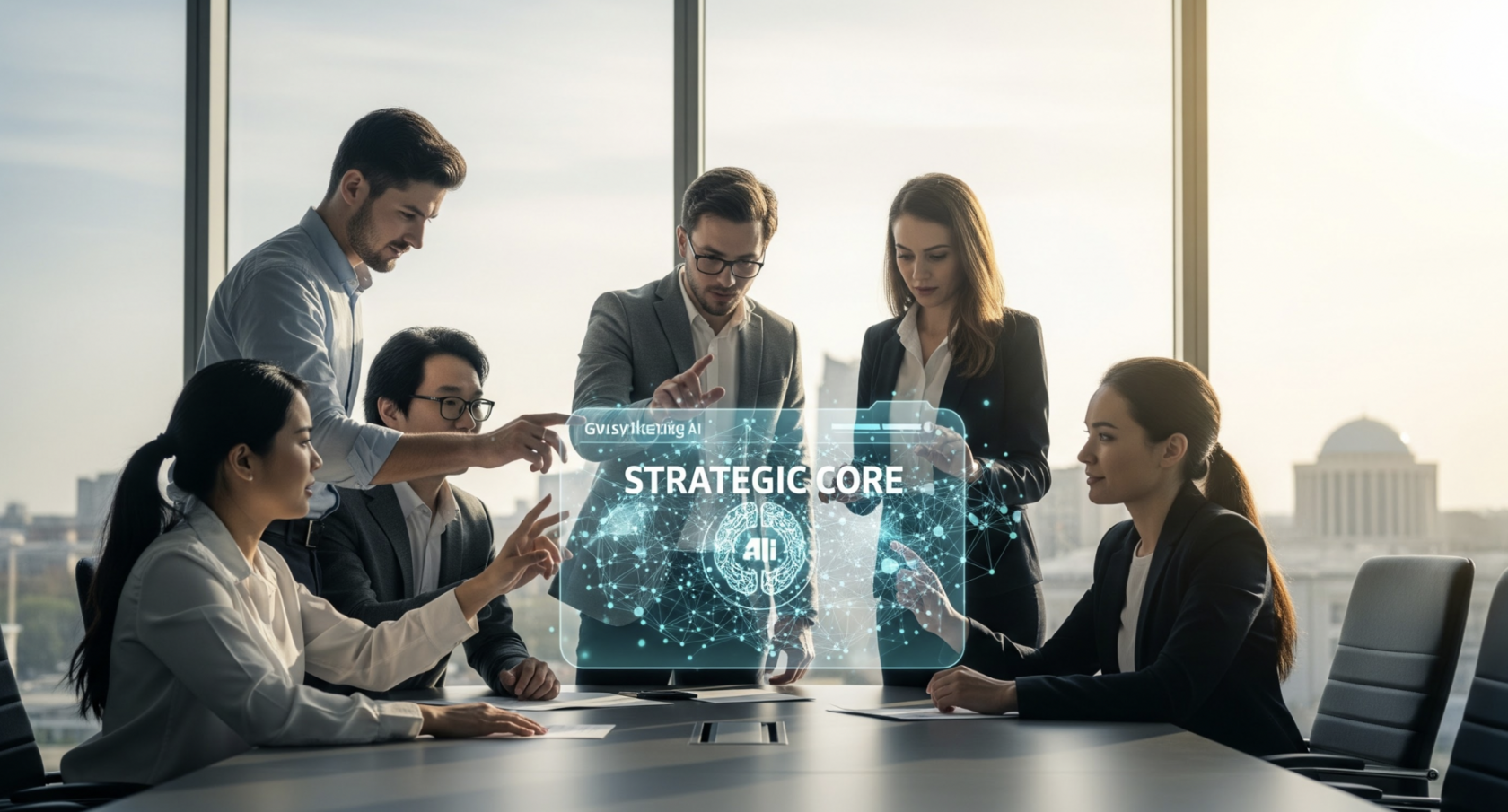
Minora AI acts as the "Strategic Core," providing the automated research and planning tools that demonstrate immediate value to the team.
10. How quickly can I get a strategy for my first "upskilling" campaign?
From a 12-minute brief, Minora AI synthesizes a full strategy, media plan, and roadmap in exactly 30 minutes.
