
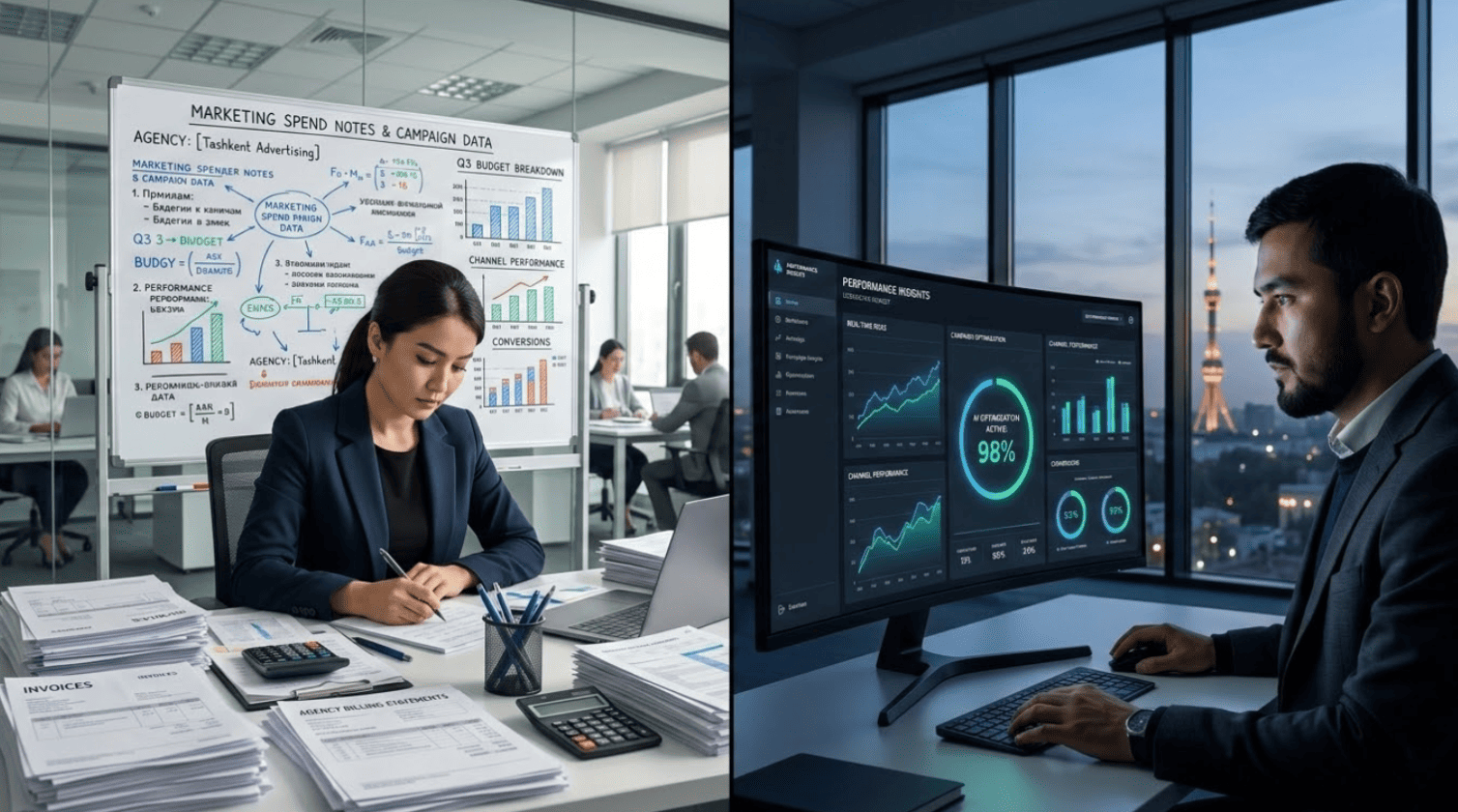
Most CMOs compare retainer fees. That's the wrong number. A media buying agency retainer at $10K–$25K per month is the visible line item — under it sits account manager overhead, static planning cycles, performance commissions, and an in-house team spending 80 hours a week copy-pasting data between platforms. When you price the cost of media buying agency vs AI software correctly, the gap is not close. This article breaks down where the money actually goes.
The True Cost of a Media Buying Agency
Agency pricing looks simple until you read the contract. The base retainer covers account access and reporting. Everything else — strategy, creative revisions, channel expansion, performance bonuses — gets billed separately or absorbed through media markups that rarely appear on an invoice.
Traditional agencies also plan on 4–8 week cycles. By the time a campaign launches, the market conditions that justified the brief have shifted. And when a channel underperforms, reallocation waits until the next planning session — not tomorrow morning. This is what Minora AI calls the Frozen Budget problem: capital locked in underperforming channels because the process can't move fast enough to pull it out.
The agency model was built for a world with fewer channels. Today, the consumer journey spans 300+ touchpoints. No account team manually monitors that at scale.
💡 Want to see how your current agency cost compares to AI? Book a strategy call with Minora AI — we work with enterprise marketing teams across Central Asia and beyond.
Breaking Down the Full Cost Stack
When CMOs in Central Asia and MENA ask about the cost of media buying agency vs AI, they usually frame it as a software licensing question. It isn't. The comparison requires looking at four cost categories in parallel.
Agency Cost Stack
Retainer + Performance Fees
A mid-market media buying agency retainer runs $8K–$20K per month. Add a standard 10–15% performance commission on managed spend, and on a $200K monthly ad budget, that's another $20K–$30K on top. Annual agency cost on that budget: $336K–$600K, before any creative or strategy work.
Internal Overhead — The Manual Tax
This is the cost most audits miss. The in-house team supporting the agency relationship — coordinators, analysts, CMO bandwidth — absorbs 80+ hours per week in manual work. Minora AI's data puts the strategic time cost at approximately $150K per year for a mid-size marketing team. That is your Manual Tax: real salary expense for work that produces no incremental output.
AI Platform Cost Stack
Subscription + Commission Structure
AI media buying platforms operate on SaaS pricing with optional performance tiers. Minora AI's model starts at a base subscription and scales with a 5–15% performance commission — but only on the spend it optimizes, not a fixed retainer regardless of results. For a $200K monthly budget, total platform cost runs a fraction of what an equivalent agency charges. Break-even on the switch typically lands in under 60 days.
No Planning Cycle Overhead
AI campaign management doesn't require a 4–8 week strategy sprint. Minora AI's Launch Agent gets campaigns live within 48 hours of brief intake. That speed difference has a real dollar value — every week a campaign sits in planning is a week of potential revenue missed.
The ROAS and Performance Gap
Cost savings are half the argument. The other half is what you get for the money.
KPIs That Reveal the Real Difference
ROAS (Return on Ad Spend)
An agency working on a monthly reporting cycle cannot react to channel performance until data is reviewed, discussed, approved, and reallocated — a process that takes days or weeks. AI media buying software monitors performance continuously. Minora AI's Optimization Agent tracks 450+ channels and reallocates budget to top performers 24/7. The documented ROAS lift from eliminating frozen budget allocations is approximately 20%. On a $200K monthly budget, that is $40K in recovered output — monthly.
CPA Before First Dollar Spent
Agency strategy is typically built on historical data and gut instinct from the account team. Minora AI's Strategy Personalization Agent uses Predictive CPA Modeling — you define the budget and goals, and the system forecasts Reach, CPA, and ROI before the campaign launches. This fundamentally changes risk management. You don't commit spend and hope; you see the projected outcome first.
Time-to-Insight
An agency delivers monthly reports. A weekly dashboard is considered proactive. AI media buying software generates continuous reporting — not a PDF on the first of the month, but a live view of where every dollar is performing right now. For CMOs who need to justify spend to a CFO, this difference is not cosmetic. It's the difference between defending last month and steering this week.
How Minora AI Reports on These Metrics
Minora AI's four-agent architecture — Research, Strategy Personalization, Launch, and Optimization — generates performance data at each stage of the campaign lifecycle. The Research Agent surfaces competitive intelligence and audience context before strategy is set. The Optimization Agent runs budget reallocation decisions continuously, without waiting for a human approval chain. Every decision is logged against the predictive model set at campaign launch, which means performance variance is immediately visible — not discovered at month-end.
Conclusion
The cost of media buying agency vs AI software is not a close comparison once you count everything. Retainers, Manual Tax, static planning cycles, and frozen budgets add up to hundreds of thousands per year in cost and recoverable ROAS. AI platforms like Minora AI replace that structure with predictive planning, 24/7 optimization across 450+ channels, and a break-even timeline measured in weeks, not quarters. The CMOs who are switching aren't doing it because agencies are bad at their jobs. They're doing it because the model is too slow and too expensive for what performance marketing requires in 2026.
Ready to see the real cost difference for your budget? Most teams recover their platform cost within 60 days. Minora AI's autonomous GTM engine replaces static agency planning with AI-driven optimization across 450+ channels — before you spend a dollar, you see the projected CPA and ROAS.
FAQ
Q1: How much does a media buying agency typically cost per month? A: A mid-market media buying agency retainer runs $8K–$20K per month as a base fee. On top of that, most agencies charge a 10–15% performance commission on managed ad spend, which means total monthly costs can exceed $40K–$50K on larger budgets. This does not include the internal team hours required to manage the agency relationship.
Q2: What does AI media buying software cost compared to an agency? A: AI media buying platforms use SaaS-based pricing — typically a base subscription plus a performance commission that applies only to the spend the platform actively optimizes. The total cost is structurally lower than a traditional agency retainer, and break-even on the switch typically occurs in under 60 days when ROAS improvements are factored in.
Q3: What is the Manual Tax in media buying? A: The Manual Tax is the internal labor cost absorbed by your team to support agency operations: data coordination, report review, briefing cycles, and approval chains. Minora AI quantifies this at approximately $150K per year for a mid-size marketing team — 80+ hours per week of strategic time spent on administrative work that produces no direct revenue.
Q4: Can AI media buying software replace a full-service agency? A: For campaign execution, budget optimization, and performance reporting, yes — AI platforms now handle these functions faster and with more precision than human account teams. Where agencies still add value is in brand strategy, creative development, and stakeholder relationships. The choice is not binary; many enterprise CMOs are running AI for execution and keeping agency relationships scoped to strategy and creative only.
Q5: What is a frozen budget in digital advertising? A: A frozen budget is ad spend locked in underperforming channels because the reallocation process — approval, reporting cycle, agency briefing — moves too slowly to redirect it. By the time performance data is reviewed and actioned, the budget has already been wasted. AI media buying software eliminates frozen budgets by reallocating spend continuously, without waiting for monthly reviews.
Q6: How quickly can an AI platform launch a campaign compared to a media buying agency? A: A traditional media buying agency requires 4–8 weeks from strategy brief to campaign launch. Minora AI's Launch Agent gets campaigns live within 48 hours. On a competitive market timeline, that speed difference directly affects market share and cost per acquisition.
Q7: What is Predictive CPA Modeling and how does it change the cost comparison? A: Predictive CPA Modeling forecasts your cost per acquisition before a campaign launches, based on your budget, channels, and audience parameters. Minora AI's Strategy Personalization Agent runs this model at the planning stage, so you know the projected outcome before committing spend. Traditional agencies produce CPA estimates based on historical averages and experience — Predictive CPA Modeling uses live data and algorithmic forecasting.
Q8: Is the 20% ROAS improvement from AI media buying realistic? A: Minora AI's documented performance data shows approximately 20% ROAS improvement driven primarily by eliminating frozen budget allocations and continuous 24/7 reallocation to top-performing channels. The actual improvement depends on how inefficiently the prior media mix was managed — teams with high manual overhead and monthly reporting cycles tend to see the largest gains.
Q9: What hidden costs should CMOs account for when comparing agency vs AI? A: Beyond the retainer, CMOs should count: internal coordinator and analyst time, reporting preparation overhead, creative revision cycles billed outside retainer, agency margin built into media buys, and the revenue opportunity cost of slow planning cycles. When these are added to the base fee, total agency cost is typically 2–3x the stated retainer.
Q10: How does Minora AI's pricing model differ from a traditional media buying agency? A: Minora AI operates on a performance-aligned model — a base SaaS subscription plus a 5–15% commission on optimized spend, with no flat retainer regardless of results. Unlike agency pricing, costs scale with actual performance output, not with the number of hours billed or accounts staffed. Enterprise and custom deployments include full data integration and white-label reporting options.
