

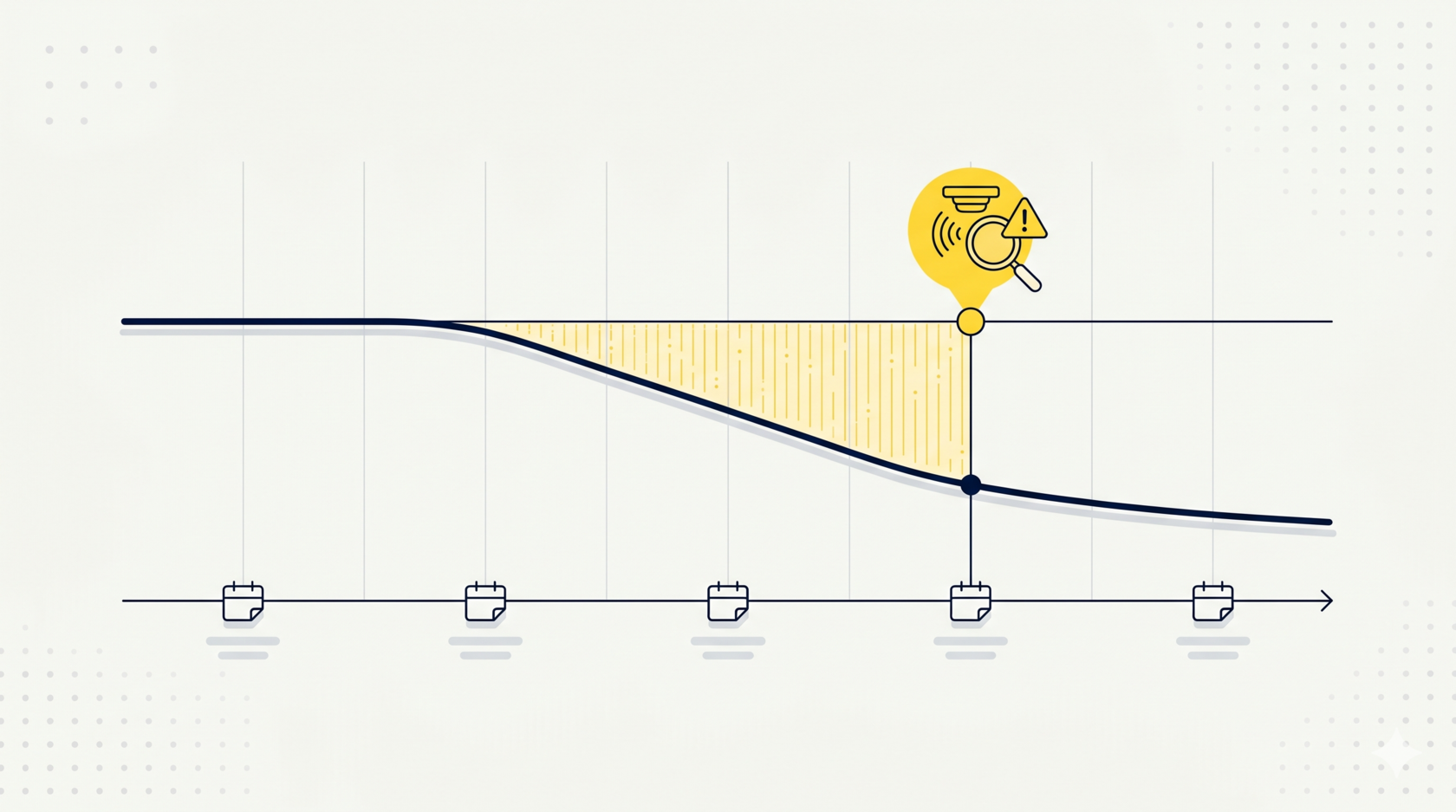
A playable ad for a mobile strategy game achieves a 2.1% conversion rate in its first week. By day 10, it is at 1.4%. By day 14, it has dropped to 0.8%. The CPI has inflated 62% from its peak performance. The UA manager notices the decline during their Wednesday afternoon dashboard review, six days after the degradation began. They flag the creative for replacement. The design team begins production. A new asset deploys 9 to 12 days later.
Between the onset of fatigue and the deployment of a replacement, the studio has spent 11 to 18 days running an asset that progressively wastes more budget with every impression. At $200K monthly UA spend, that detection gap costs $30,000 to $50,000 per cycle. With the average gaming studio cycling 15 to 25 creatives per month, the annual cost of delayed fatigue detection exceeds $360,000 for a single title.
Creative fatigue is not a creative problem. It is a detection infrastructure problem. And most gaming studios are solving it with the wrong tools.
What Creative Fatigue Actually Is (And Is Not)
Creative fatigue is commonly misunderstood as “audiences getting bored of the ad.” This description is technically accurate but operationally useless. Understanding the mechanics of fatigue at the signal level is the prerequisite for building effective detection systems.
The audience exhaustion mechanics
Every creative asset has a finite addressable audience within each ad network’s targeting parameters. When the asset has been shown to a sufficient percentage of that audience, three measurable signals appear simultaneously:
1) Frequency increase.
The average number of times each user sees the ad rises, because the network is running out of new users to show it to.
2) Click-through rate (CTR) decline.
Users who have already seen the ad once or twice are less likely to engage with subsequent impressions.
3) Cost-per-click (CPC) inflation.
As CTR declines, the network’s auction mechanics increase the price per click to maintain delivery volume.
These three signals always appear together. They always appear in this order. And they always appear before the downstream metric (CPI) shows degradation. The detection gap exists because most UA teams monitor CPI as their primary alert metric, which lags the actual fatigue signals by 3 to 5 days.
Why platform alerts fail
Ad networks provide automated alerts for creative performance decline. These alerts are calibrated for average advertisers, not gaming studios running high-volume UA. Platform alerts typically trigger after a 20% to 30% CPI increase, which in gaming UA represents 3 to 5 days of post-peak degradation. By the time the alert fires, the studio has already wasted thousands on an asset whose audience pool was exhausted days earlier.
“Creative fatigue is not an event. It is a process. It begins with frequency creep, progresses through CTR erosion, and ends with CPI inflation. If you are detecting fatigue at the CPI stage, you are detecting it at the wrong layer.”
The Detection Architecture That Closes the Gap
Closing the 5-day detection gap requires monitoring the leading indicators of fatigue (frequency, CTR, CPC) rather than the lagging indicator (CPI).
Multi-signal fatigue scoring
Effective fatigue detection does not rely on a single threshold. It monitors the relationship between three signals simultaneously:
- Frequency velocity. Not just the absolute frequency number, but the rate at which it is increasing. A creative at 2.1 frequency that was at 1.4 three days ago is decaying faster than one at 2.5 that has been stable for a week.
- CTR trend slope. The 3-day rolling average CTR compared to the 7-day baseline. A CTR decline of 0.1% per day is normal variance. A CTR decline of 0.3% per day is fatigue onset.
- CPC divergence. The gap between current CPC and the 14-day moving average. When CPC exceeds the moving average by 15%+, the network is compensating for declining engagement.
When all three signals cross their thresholds simultaneously, the creative is entering fatigue. Detection at this stage gives the studio a 3 to 5 day head start before CPI inflation becomes visible in standard reporting.
Network-creative-geo specificity
A critical failure of manual fatigue detection is treating creative performance as uniform across networks. The same video ad fatigues at different rates on different networks because each network serves different audience pools. A rewarded video creative that has exhausted its Unity Ads audience may still have significant headroom on AppLovin’s inventory.
Effective detection systems evaluate fatigue at the intersection of three dimensions: creative ID, network, and geographic market. This prevents premature global pausing of assets that are still performing in specific network-geo combinations.
The Creative Fatigue Lifecycle: A Timeline Comparison
Creative Fatigue FAQ
1) How long does a gaming ad creative typically last before fatigue?
Creative lifespan varies by format and audience size. Playable ads typically last 7 to 14 days. Video ads last 10 to 21 days. Static banners last 5 to 10 days. These ranges depend on audience pool size, frequency capping settings, and geographic market. High-volume UA campaigns exhaust creative pools faster than low-volume campaigns.
2) Can you prevent creative fatigue entirely?
No. Creative fatigue is an inherent property of fixed-audience advertising. Every creative asset will eventually exhaust its addressable audience. The goal is not prevention but management: detecting fatigue at the earliest possible signal, pausing the asset before waste accumulates, and having replacement assets ready to deploy.
3) How many creatives should a gaming studio produce per month?
Studios running $100K+ monthly UA typically need 20 to 40 new creative variations per month to maintain performance. This includes full new concepts (3 to 5 per month) and iterative variations on proven formats (15 to 35 per month). The production velocity must match the fatigue rate across all active networks.
4) Does creative fatigue affect all ad networks equally?
No. Each network serves different user pools with different saturation rates. A creative that has exhausted Unity Ads’ audience may still perform well on AppLovin or Meta. Effective fatigue management evaluates performance at the network-creative-geo level, pausing only the specific combinations that have decayed.
The Production Pipeline Problem
Creative fatigue detection solves only half the equation. Detection without a corresponding increase in creative production capacity just means you pause fatigued assets faster and run fewer ads. The complete solution requires a feedback loop: detection triggers production, production feeds rotation, rotation extends campaign lifespan.
Studios that close the detection gap and accelerate their production pipeline see two compounding benefits. First, they recover the 15% to 25% of budget currently wasted on fatigued assets. Second, they increase the total addressable audience per dollar spent by continuously presenting fresh creative signals to network algorithms. The algorithms reward creative freshness with lower CPMs and broader distribution. The studios that produce and rotate fastest get the cheapest inventory. The ones that rotate slowest pay the fatigue tax on every impression.
The question is not whether creative fatigue is costing your studio money. It is. The question is whether you continue absorbing that cost as a “normal” operating expense, or whether you build the detection and production infrastructure to eliminate it.
