

The average D2C brand spends $50,000 or more per month on paid media across Meta, Google, and TikTok. Their agency checks those campaigns twice a day. The math collapses immediately: 4 to 6 hours of human attention per week managing capital that requires 168 hours of continuous optimization. The result is a 28% efficiency gap between what that ad spend could deliver and what it actually delivers.
AI media buying closes that gap. Not by generating better ad copy or automating A/B tests, but by replacing periodic human check-ins with continuous algorithmic optimization across every channel, every second. The brands deploying this infrastructure are seeing blended CAC reductions of 35% within 90 days. Here is the exact execution model.
The $50K Problem: Why Manual Campaign Management Fails at Scale
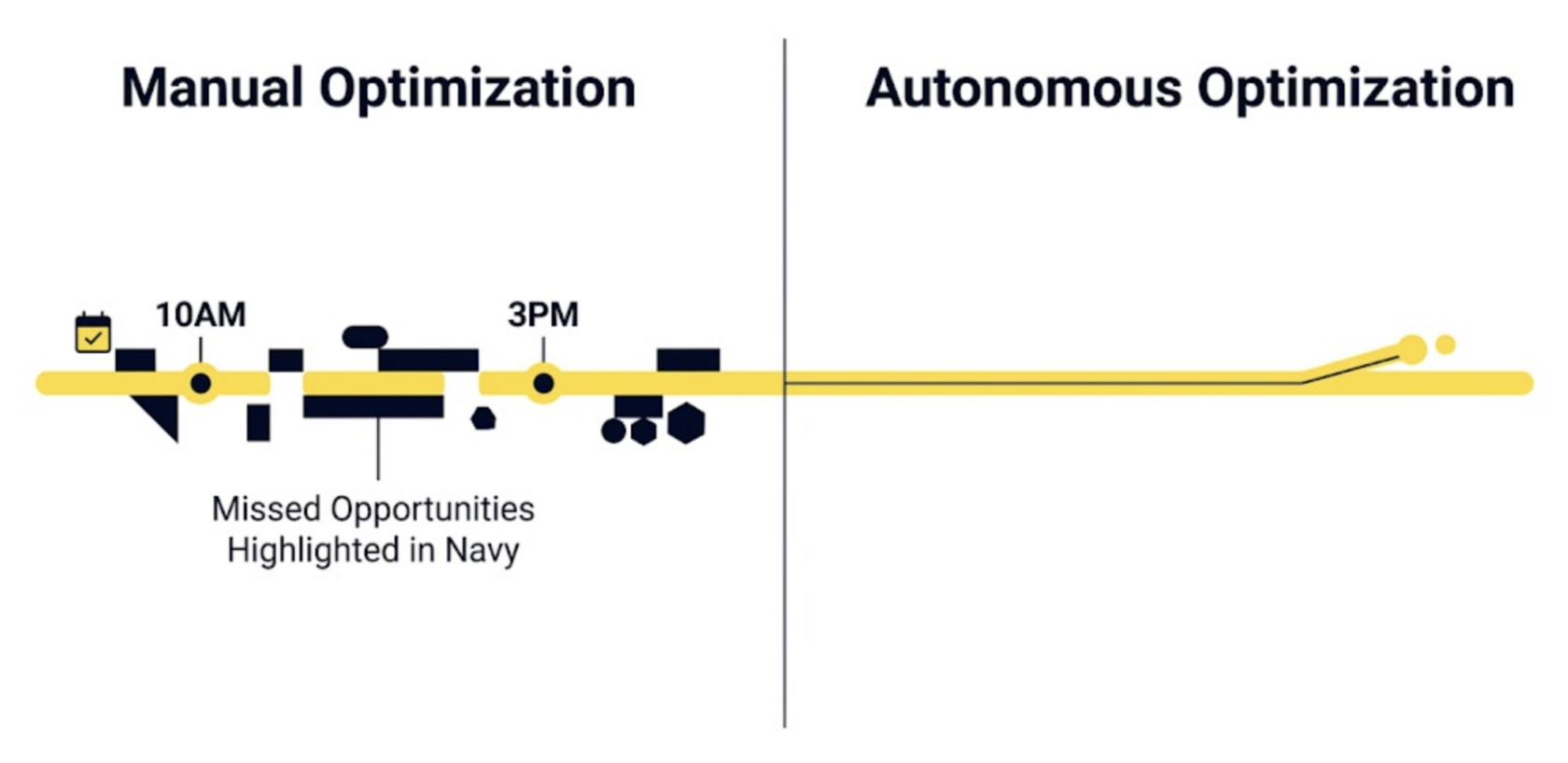
Manual campaign management fails D2C brands at scale because human attention does not scale with ad spend. A media buyer managing eight accounts checks your dashboard at 10 AM and 3 PM. Between those check-ins, Meta CPMs spike 40%, TikTok discovers a new audience pocket with 2x conversion rates, and a competitor launches a flash sale that changes Google Shopping dynamics. Nobody notices until the next morning standup.
The structural problem is deeper than missed opportunities. Agencies silo budgets by platform. Your Meta team manages Meta. Your Google team manages Google. Nobody owns the cross-platform allocation decision. When your Google Shopping CPA drops to $18 while your Meta CPA climbs to $34, the rational move is to shift capital immediately. But that reallocation requires a meeting, a proposal, client approval, and manual execution. By the time the budget moves, the window has closed.
A 2025 Forrester analysis found that D2C brands managing $100K+ monthly across three or more platforms experience an average of 23% budget misallocation due to delayed cross-channel rebalancing. That is not a rounding error. On a $100K monthly spend, that is $23,000 per month lighting itself on fire while your agency sends you a weekly PDF.
"The brands scaling profitably in 2026 aren't spending more. They're spending differently. They replaced weekly optimization cycles with millisecond-level budget reallocation."
The Execution Model: How AI Media Buying Actually Works
AI media buying is not a dashboard upgrade. It is a structural replacement of the human optimization loop with an autonomous system that perceives, decides, and acts at machine speed.
Map attribution windows to actual purchase cycles
Most D2C brands run Meta on a 7-day click, 1-day view attribution window because that is the platform default. But if your product has a 14-day consideration cycle (common in wellness, premium apparel, and home goods), you are systematically undervaluing the campaigns that initiate purchase intent. A wellness brand spending $120K/month on Meta discovered that 38% of their conversions occurred between day 8 and day 14. Their “worst performing” campaigns were actually their best. Autonomous systems trained on Shopify-native revenue data identify these patterns and adjust allocation accordingly, rather than trusting platform-reported ROAS. This is where predictive budget allocation for D2C brands eliminates attribution blindness.
Deploy equimarginal budget allocation across platforms
The equimarginal principle is straightforward: every dollar should generate the same marginal return regardless of which platform it sits on. If your last dollar on Meta generates $2.40 in revenue while your last dollar on Google generates $3.80, you are misallocating capital. Human media buyers cannot perform this calculation in real time across 450+ channels. Autonomous systems can. They monitor cost curves across every active channel simultaneously and redistribute capital to wherever the marginal CPA is mathematically lowest. Minora AI’s Optimization Agent executes this rebalancing every second, 168 hours per week, compared to the 4 to 6 hours a human team dedicates weekly.
Predict CPA before deploying capital
The most expensive lesson in D2C media buying is the “test and learn” tax: spending $15,000 to $25,000 to discover whether a new campaign will perform. Predictive CPA modeling eliminates this waste. By analyzing patterns across $30M+ in historical ad spend data, autonomous systems forecast expected CPA for specific audience segments, creative formats, and platform combinations before a single dollar is spent. Capital deploys only when the unit economics are validated. A direct-to-consumer apparel brand used this approach to reduce new campaign failure rates by 60%, saving $42,000 in quarterly test budgets.
Detect creative fatigue 3 to 5 days before platforms flag it
Creative fatigue is a budget problem, not a design problem. When an ad creative exhausts its audience pool, CPMs inflate and conversion rates collapse. Meta’s native alerts detect this after the damage is done, typically 5 to 7 days into the decline. Autonomous creative fatigue detection systems identify the early signals: frequency increases, click-through rate decay, and cost-per-click inflation. They flag declining creatives 3 to 5 days before platform alerts trigger, giving your team time to rotate assets before wasted spend accumulates.
AI Media Buying vs. Agency vs. Manual: The Execution Gap
D2C AI Media Buying FAQ
1) How much ad spend do I need for AI media buying to work?
AI media buying delivers measurable impact for D2C brands spending $50K or more per month across two or more platforms. Below that threshold, the data volume is insufficient for predictive models to identify statistically significant patterns. Minora AI requires this minimum to generate reliable CPA forecasts before deploying capital.
2) Does AI media buying replace my creative team?
No. AI media buying optimizes where and when your ads run, not what they say. You still need strong creative assets. What changes is how quickly underperforming creatives get detected and paused. Autonomous systems flag creative fatigue 3 to 5 days before platform alerts, giving your team a head start on asset rotation.
3) How does AI attribution differ from Meta’s reported ROAS?
Platform-reported ROAS counts conversions that the platform claims credit for, which often includes conversions that would have happened organically. AI attribution systems like Minora use Shopify-native revenue data as the source of truth, measuring actual incremental revenue generated by each campaign rather than inflated platform estimates.
4) Can AI media buying work with my existing agency?
Yes, but it changes the relationship. The agency focuses on strategy, creative production, and brand positioning. The AI handles execution: bid management, budget reallocation, and performance monitoring. This eliminates the 400+ hours per quarter your agency currently spends on manual campaign management and redirects their expertise toward higher-value work.
5) What platforms does AI media buying optimize across?
Autonomous systems orchestrate spend across Meta (Facebook and Instagram), Google (Search, Shopping, Display, YouTube), TikTok, Snapchat, and 450+ additional channels simultaneously. The critical advantage is cross-platform visibility: the system identifies which platform delivers the lowest marginal CPA at any given moment and shifts capital accordingly.
The Compound Advantage of Autonomous Allocation
The brands that will own the next 24 months of D2C growth are not the ones with the biggest ad budgets. They are the ones who eliminated the human bottleneck between data and action. Every hour your campaigns run without autonomous optimization is an hour of compounding waste: missed arbitrage windows, undetected creative fatigue, and capital sitting on underperforming platforms because nobody scheduled the reallocation meeting.
The transition from manual media buying to autonomous AI media buying is not a technology upgrade. It is an operational restructuring that compounds over time. The system gets smarter with every dollar it deploys. Your agency’s institutional knowledge walks out the door every time an account manager leaves. Choose which model you want compounding for you.
