

Attribution blindness is the systemic failure of enterprise marketing measurement caused by black-box algorithms grading their own homework. When ad networks like Google Performance Max and Meta Advantage+ operate without independent oversight, they aggressively claim credit for naturally occurring organic sales. This engineered reality obscures your true Customer Acquisition Cost and forces your marketing budget to bleed into redundant placements.
The digital advertising ecosystem has undergone a structural transformation over the past five years. Control has shifted away from deterministic, marketer-controlled manual bidding. It has moved entirely toward opaque, algorithmic black boxes.
Self-attributing networks now hold absolute control over audience targeting, real-time bid pacing, and dynamic creative rotation. This creates a critical financial vulnerability for enterprise brands.
This dynamic disproportionately damages high-consideration Direct-to-Consumer brands. Digitally native companies in the Bay Area face long consideration cycles for premium subscriptions or sustainable apparel. In these environments, platform-reported Return on Ad Spend is mathematically incompatible with true incremental revenue generation.
The Anatomy of the Signal Loss Pathology
Attribution blindness is not merely a passive gap in data collection. It is an engineered reality designed to maximize platform yield. The pathology of this signal loss manifests in three distinct phases of data degradation.
First is the phenomenon of credit usurpation. Ad networks utilize overly broad attribution windows to intercept users who already possess high brand affinity. When a returning customer searches for your brand organically, algorithmic ad placements inevitably intercept the journey.
The platform claims total credit for the conversion value. It does this despite contributing zero incremental lift to the final purchase decision.
Second is the multi-touch illusion. This fractures reporting integrity in cross-channel environments. A single conversion is frequently claimed by every platform that managed to interact with the user prior to checkout.
If a user clicks a Meta ad on Monday, interacts with a Google Discovery ad on Wednesday, and converts via a direct website visit on Friday, both platforms report an independent success. This systemic double-counting inflates aggregated platform metrics far beyond actual gross revenue.
Following the iOS 14.5 privacy updates, deterministic attribution accuracy plummeted to 60%. Platform ROAS metrics now routinely deviate from actual ledger revenue by 20% to 40%.
Third is the high-consideration disconnect. Complex subscription services and premium D2C products often feature research phases lasting several weeks. Platform tracking pixels rely on fragmented browser cookies that decay rapidly.
Consequently, a high-cost top-of-funnel touchpoint is rarely mathematically connected to the final revenue recorded in your backend system weeks later. This creates an artificially inflated perceived acquisition cost. It leads capital allocators to prematurely terminate highly viable discovery campaigns.
The Self-Attributing Network Monopoly
The architectural flaw in contemporary digital advertising is a profound conflict of interest. Major technology platforms function simultaneously as the media vendor selling the inventory, the bidding auctioneer setting the clearing price, and the referee determining who won the conversion.
No experienced capital allocator relies on platform-reported metrics to be strictly accurate when executing multi-million-dollar budget decisions. The systems are structurally biased to clear their own auction inventory.
These systems inherently optimize for their own corporate yield. They utilize built-in machine learning models designed to maximize impression clearance and ad-spend consumption. They do not optimize for pure enterprise profitability.
This forces D2C brands to rely on a bloated hierarchy of junior agency media buyers to manually untangle the data. These human operators pull fragmented reports and attempt to manually reconcile overlapping attribution windows. This manual process introduces massive latency and costs thousands of dollars in monthly retainer fees.

The Automated Cannibalization Trap
The rollout of Google Performance Max and Meta Advantage+ campaigns represents a massive paradigm shift. These tools are engineered to generate maximum liquidity and scale across disparate channels. However, a hazardous trap exists beneath the veneer of machine learning efficiency.
Algorithms deployed in bidding environments naturally gravitate toward users who already exhibit maximum conversion probability. They rarely seek out net-new, highly incremental audiences unless strictly constrained.
In Google Performance Max, this tendency manifests as extreme brand cannibalization. Unless explicit exclusions are deployed, the system systematically ingests branded search traffic. Branded search queries possess exceptionally high conversion rates at very low costs. The algorithm funnels disproportionate budget into these queries to blend down the overall campaign cost.
The result is a highly deceptive reporting dashboard. The automated campaign displays spectacular returns. Agencies subsequently allocate more budget to the black box. However, when an incrementality test is applied to pause the automation, total business revenue remains entirely flat. The conversions were already guaranteed via organic search or email marketing.
Stop Funding the Multi-Touch Illusion.
Your agency reports a 4.0x ROAS, but your backend revenue tells a different story. Minora AI’s autonomous agents bypass platform bias to identify true incremental growth.
Uncover Your True Acquisition Cost Today →
Real-World Scenario: The D2C Cross-Platform Collision
To comprehend the full financial impact of attribution blindness, we must examine the friction generated when two distinct algorithms compete for the identical conversion event. Consider a heavily funded wellness startup in San Francisco deploying a massive monthly budget across Meta and Google.
The core of the overlap crisis stems from inherently incompatible lookback periods. Google operates on an extended 30-day attribution window. Meta relies predominantly on a truncated 7-day attribution window.
Because Google maintains a significantly broader temporal net, it inevitably intercepts conversions that were primarily driven by social discovery.
Day 1:
A prospective user discovers the brand via a broad Google Search ad. They browse the site but do not convert immediately. Google begins a 30-day tracking countdown.
Day 12:
The same user is heavily retargeted on Instagram via a Meta Advantage+ campaign. The user clicks the ad to refresh their intent. Meta begins a 7-day tracking countdown.
Day 14:
The user directly navigates to the website via a bookmark and completes a $250 subscription purchase.
In this exceedingly common scenario, both Google and Meta claim total credit for the $250 conversion within their respective dashboards. The enterprise marketing team aggregates these reports and believes they generated $500 in revenue. The actual financial ledger only reflects $250.
Mathematical Auction Cannibalization
This systemic double-counting leads to a destructive financial phenomenon known as auction cannibalization. When two ad sets target overlapping audiences, they inadvertently bid against each other in real-time.
Internal competition inflates your cost per impression significantly. If an enterprise allocates budget without strict audience exclusion parameters, the financial bleed compounds rapidly. A CMO might look at the inflated platform data, assume Google is outperforming Meta, and shift capital incorrectly.
Removing the Meta budget subsequently starves the Google campaign of high-intent discovery traffic. Total enterprise revenue collapses because the decision was based entirely on attribution blindness.
Escaping the Illusion via Agentic Orchestration
To escape this trap, enterprise media buyers must transition away from asking who claimed the click. The new operational mandate is calculating the causal reality of incremental impact.
The definitive antidote to the black-box trap is the deployment of autonomous multi-agent systems. This is the foundation of Agentic Marketing Mix Modeling.
Agentic systems combine econometric rigor with continuous execution capabilities. Instead of relying on a single junior media buyer to update a spreadsheet, a network of specialized AI agents collaborates concurrently.
A planner agent simulates thousands of budget scenarios to find the optimal distribution of capital. An experimental agent continuously designs micro-holdout tests to establish a baseline of organic sales. Finally, an execution agent translates this strategy directly into the ad platforms.
Deploying Agentic Marketing Mix Modeling typically improves true enterprise ROAS by 15% to 25% while simultaneously reducing total tactical labor costs.
Decentralized Capital Allocation
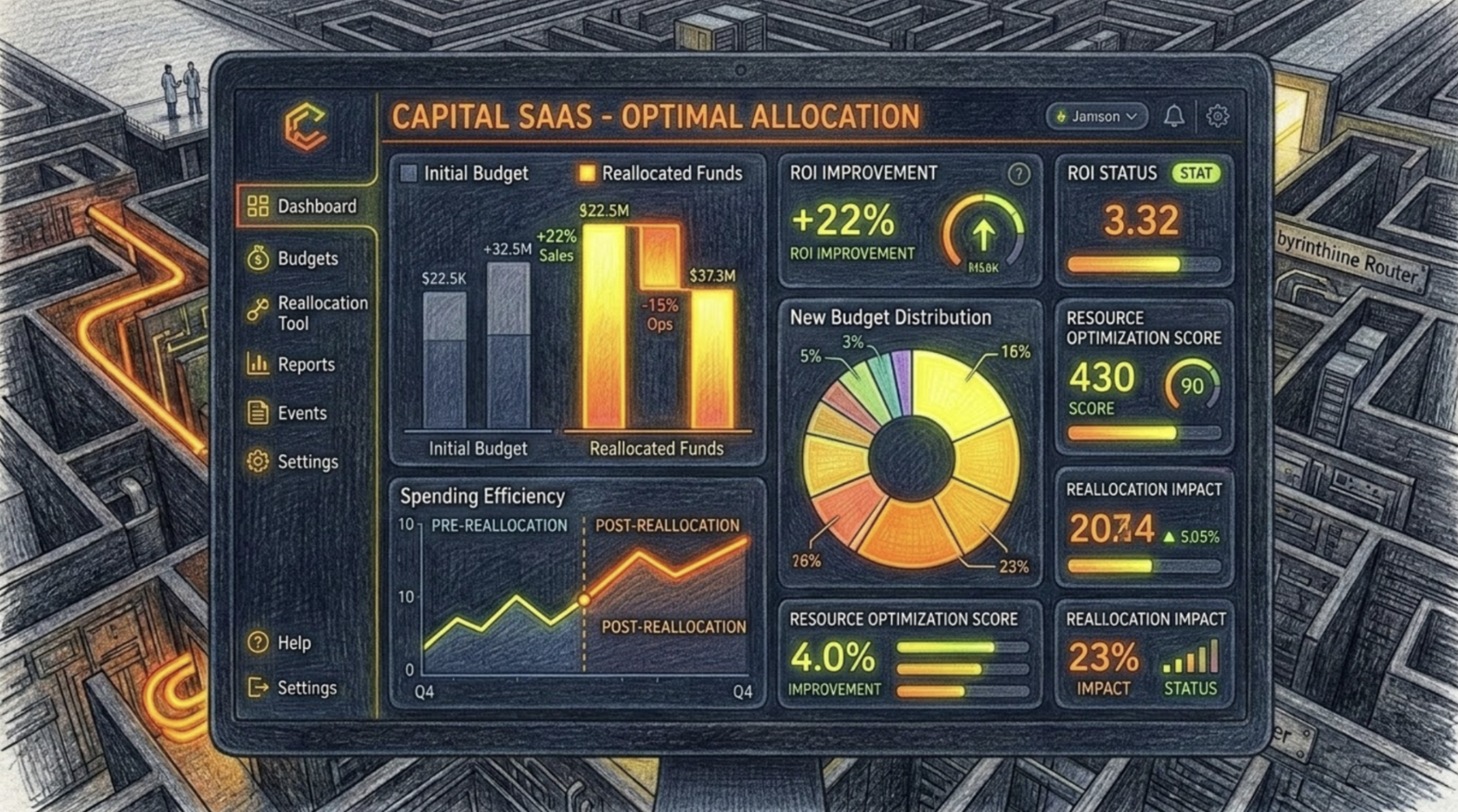
These autonomous agents coordinate their actions mathematically through autonomous budget negotiation. The task of marketing budget allocation is executed as a continuous, high-speed decentralized auction.
An overarching orchestrator agent broadcasts a tranche of capital available for top-of-funnel acquisition. The channel-specific sub-agents evaluate their real-time auction elasticity and historical incrementality scores. They then submit competitive bids proposing the exact incremental return they guarantee to generate.
The orchestrator evaluates these bids based on strict cost constraints. It awards the capital to the most efficient agent instantly. This dynamic ensures budget naturally flows to the highest-efficiency channel second-by-second. It neutralizes the static overlap and recency bias inherent in manual human budget reviews.
Dynamic Spend Pacing Constraints
The execution of these awarded contracts relies on sophisticated dynamic spend pacing. The winning AI agent learns how to deploy the fixed budget smoothly over a specific timeframe to win the most valuable ad impressions.
This prevents premature budget exhaustion. It also ensures the agent does not under-deliver during peak conversion hours. By transitioning from basic forecasting to probabilistic modeling, the agent extracts maximum value from the ad network while strictly adhering to the incrementality targets established by your finance team.
A critical requirement for implementing this architecture is balancing probabilistic prediction with non-negotiable financial compliance. Probabilistic models detect complex consumer patterns that human analysts miss. However, deterministic rules must execute the final transaction. A hard-coded rule guaranteeing that Meta spend cannot exceed a specific daily limit ensures consistent, auditable, and risk-free scaling.
Actionable Guide: Dismantling Platform Defaults
Transitioning an enterprise from a state of attribution blindness to one of causal incrementality requires an aggressive operational roadmap. Follow these exact phases to regain algorithmic accountability.
- Disengagement and Boundary Mapping: You must immediately halt algorithmic cannibalization. Enforce strict brand exclusions to prevent systems from harvesting guaranteed organic conversions. Restructure campaigns to prevent internal auction cannibalization by separating new acquisition audiences from retargeting pools.
- Standardize Temporal Boundaries: Harmonize attribution windows across all platforms before calculating any baseline returns. A blended return metric derived from mismatched 30-day and 7-day windows is statistically invalid.
- Deploy Server-Side Truth Layers: Bypass browser-level ad blockers by implementing the Conversions API. Establish a highly accurate stream of first-party conversion data directly from your Shopify backend to the ad platform.
- Inject Deep-Funnel Margin Signals: Black-box algorithms optimize relentlessly toward the data they receive. Shift conversion tracking toward high-margin events. Inject actual Customer Lifetime Value and product contribution margins directly into the bidding algorithm.
- Engage Multi-Agent Orchestration: Turn off active media in select regions to establish a mathematically pure baseline of organic sales. Utilize this data to calibrate an autonomous multi-agent system. Allow the AI to autonomously bid for and reallocate budget capital intraday based purely on true incremental yield.
Frequently Asked Questions
1. What exactly is attribution blindness?
It is the inability to measure the true financial impact of marketing because ad platforms grade their own homework. Networks claim credit for organic sales and overlap with each other, obscuring your actual acquisition cost.
2. How does Performance Max cannibalize my brand?
Unless strictly constrained, PMax targets users searching for your exact brand name because those clicks convert easily. It claims these guaranteed sales to make the campaign's overall performance look artificially inflated.
3. Why do Meta and Google report more revenue than I actually made?
They operate on different tracking windows and do not communicate with each other. If a user clicks a Meta ad and later clicks a Google ad before buying, both platforms report 100% of the revenue.
4. What is Agentic Marketing Mix Modeling?
It is an autonomous AI framework that uses distinct agent personas to plan budgets, run holdout tests, and execute bids. It replaces biased platform reporting with mathematical calculations of true incremental profit.
5. How do autonomous agents prevent budget bleed?
Agents participate in a continuous internal auction to prove which channel will generate the highest incremental return for the next dollar spent. This ensures capital is dynamically routed away from fatiguing campaigns instantly.
Are you ready to stop subsidizing ad networks and uncover your true incremental profit? Your competitors are already replacing manual agency guesswork with multi-agent architecture. Do not let another budget cycle bleed into the black box.
Book Your Minora AI Architecture Demo Today
