

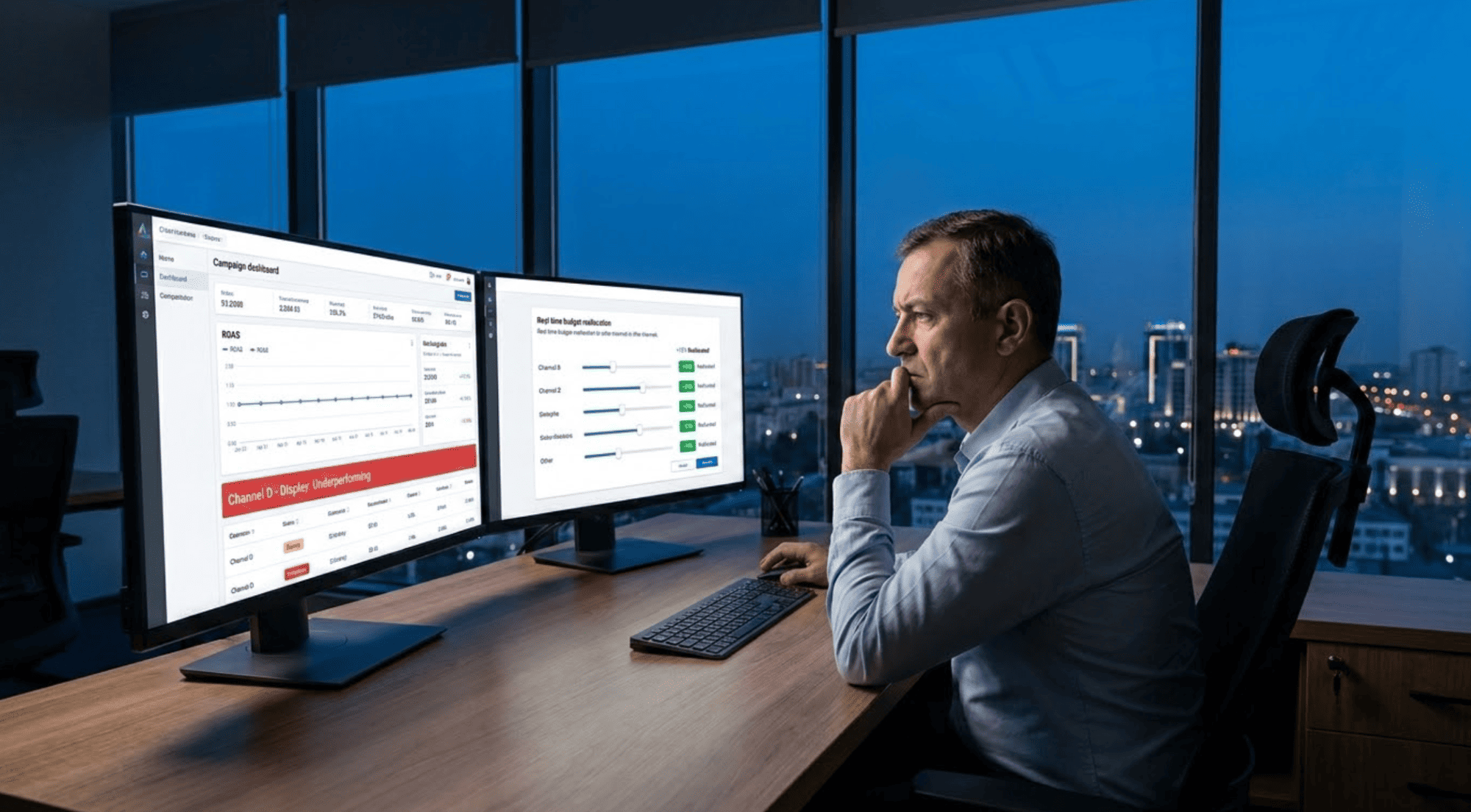
The campaign launched on schedule. Budgets were approved, channels assigned, targeting set. Then everyone moved on to the next thing — and nobody touched the settings for three weeks. The problem is that one of those channels stopped converting on day nine. The budget kept running anyway. You found out at the post-mortem. This is the frozen budget problem, and it costs enterprise marketing teams far more than they account for when measuring wasted marketing spend.
Why Budgets Freeze — and Why It Happens to Everyone
The standard enterprise media buying workflow has a design flaw. Budgets are approved once, distributed across channels, and then treated as settled — right up until the reporting cycle closes. The assumption embedded in this model is that channel performance stays roughly stable across a campaign flight. It doesn't.
Consumer behavior shifts. Competitor bids change. Inventory prices spike. A creative that performed well in week one starts fatiguing by week two. None of these changes show up in your planning spreadsheet, because the spreadsheet was built before the campaign launched. According to Minora AI's own product data, marketing teams lose an estimated 80 hours per week managing campaigns manually — and most of that time goes into retroactive reporting rather than proactive adjustment.
The result is capital trapped in underperforming channels. Static planning — approve once, spend blindly — is the direct cause of the frozen budget problem. It's not a human failure; it's a structural one. The workflow doesn't give anyone the tools to fix bad spending in real time.
In Central Asian markets, this compounds. Enterprise teams running campaigns across Uzbekistan and Kazakhstan often manage channels that behave very differently from Western platforms — Telegram-heavy audiences, Android-dominant device splits, regional payment behaviors. A channel mix optimized for Almaty rarely performs identically in Tashkent. When budget is frozen and can't respond to these local dynamics, the waste isn't just financial. You lose market-specific learning that you can't get back.

💡 Seeing this in your own campaigns? Book a strategy call with Minora AI — we work with enterprise marketing teams across Central Asia and global markets to diagnose exactly where frozen budgets are costing you.
How to Build a Budget That Moves
The fix isn't more reporting. Weekly check-ins don't solve a problem that compounds daily. What enterprise teams need is a reallocation framework that operates on the same timescale as campaign performance — which means continuously, not monthly.
Define Reallocation Triggers Before Launch
Set Performance Floors, Not Just Goals
Every channel in your media plan needs a minimum acceptable performance threshold defined before the campaign starts. If a channel drops below your CPA floor or ROAS protection threshold for 48 consecutive hours, reallocation kicks in automatically. Most teams set goals but never define the floor — which means nobody has the authority to pull budget mid-flight without going back through approvals.
Assign a Reallocation Reserve
Structure your media budget so that 15–20% sits unallocated at launch, reserved for channels that outperform. This isn't budget waste — it's optionality. When your best-performing channel has headroom, you can scale into it without cutting a channel that might still be useful. Minora AI's Strategy Personalization Agent builds this reserve into the initial budget model as standard.
Run Continuous Channel Monitoring
Move Beyond End-of-Day Reporting
Daily reporting is too slow for performance decisions. If a channel burns its daily budget in four hours and produces zero conversions, you need to know at hour five — not at 9am the next morning. The Minora AI Optimization Agent monitors 450+ channels in real time and reallocates budget to top performers 24/7. This is the structural difference between a system that reacts and a system that compounds losses until the post-mortem.
Cross-Channel Attribution Without the Lag
Frozen budgets get worse when attribution is delayed. When you can't see which touchpoint drove a conversion until three days after it happened, you're making reallocation decisions on stale data. Minora AI's model — trained on $30M+ in historical ad spend — uses predictive CPA signals to identify underperformance before the conversion data catches up. You don't wait for the evidence; you act on the leading indicators.
What Frozen Budgets Actually Cost
Most CMOs underestimate the total cost because they only measure direct ad spend waste. The real number includes three separate losses that compound each other.
KPIs to Track
ROAS Degradation Rate
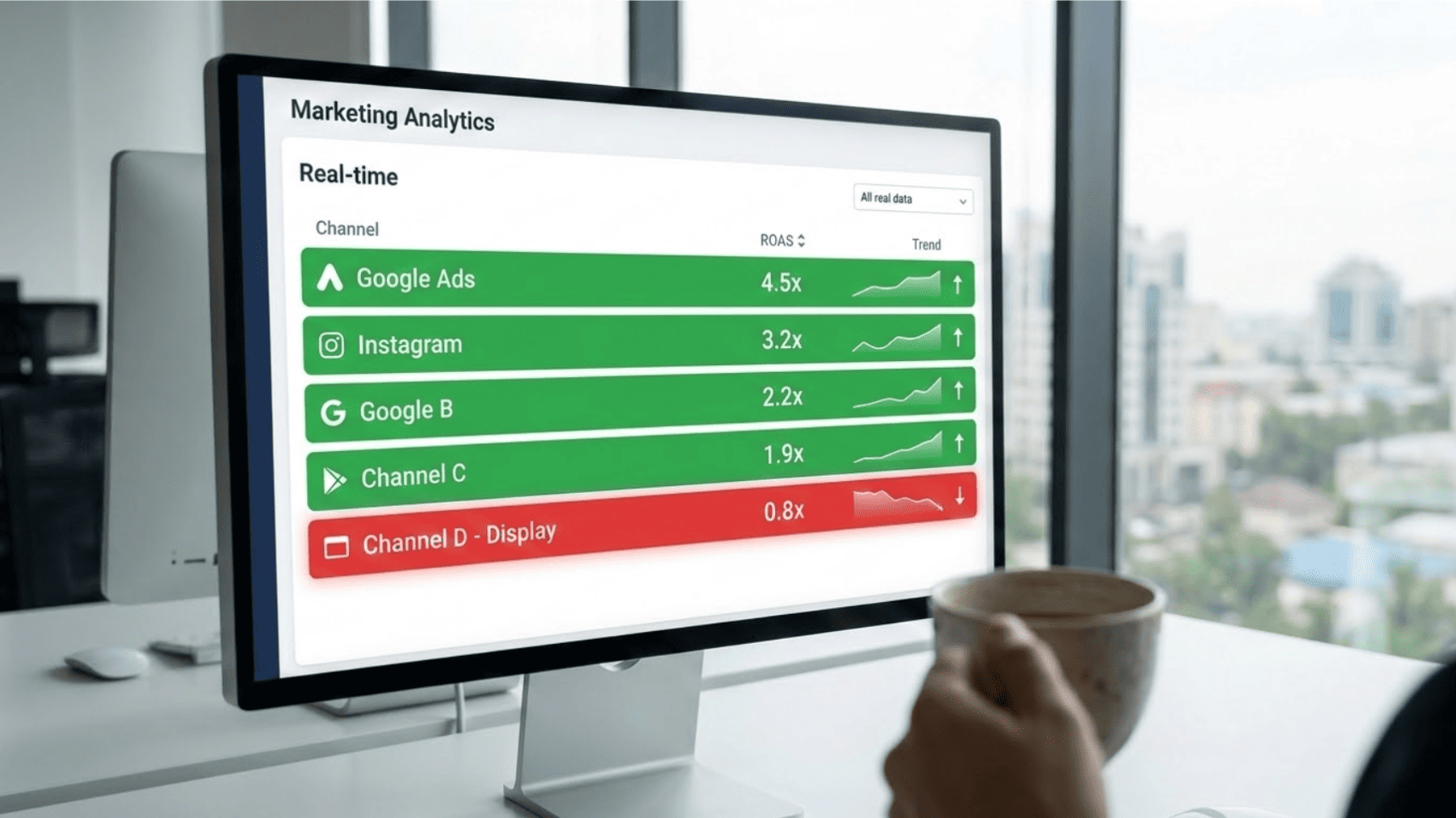
This is the speed at which a channel's return on ad spend drops after peak performance. Most campaigns see ROAS decline sharply by day 10–14 as creative fatigues and audience saturation sets in. If your budget doesn't respond to this decline, you're paying peak rates for sub-peak returns. A ROAS protection threshold — flagging any channel that drops more than 25% below its 7-day average — gives you an actionable signal before the damage compounds.
Opportunity Cost of Frozen Capital
Money locked in an underperforming channel is money not available to scale what's working. If your top-performing channel has available inventory and you're hitting your frequency caps there because budget is sitting idle in a dead channel, you're leaving revenue on the table. Minora AI's ROI model estimates that eliminating frozen budgets increases effective ROAS by approximately 20% — not by improving the channels themselves, but by redirecting capital to channels already outperforming.
Labor Cost of Manual Campaign Monitoring
Reclaiming the 80 hours per week that enterprise teams spend on manual reporting and campaign management is worth roughly $150K per year in strategic talent time. That's senior-level people copy-pasting data between platforms instead of making decisions. This is what Minora AI's product deck calls the "Excel Ceiling" — you can't scale manual work, and the cost of trying isn't just time, it's accuracy.
How Minora AI Reports on These Metrics
The Executive Performance Dashboard surfaces all three loss categories in a single view: real-time ROAS by channel, budget allocation vs. performance, and projected ROI for the remainder of the flight. There's no waiting for the weekly export. When the Optimization Agent reallocates budget, the dashboard updates immediately — so the CMO can see not just what happened, but what the system did about it and why. For enterprise teams running campaigns across multiple markets simultaneously, this visibility is what separates informed decision-making from post-mortem regret.

Conclusion
Frozen budgets aren't a budgeting failure — they're a timing failure. The money was allocated correctly at the start. The problem is that campaign performance doesn't stay static, and most enterprise workflows aren't built to respond when it changes. By the time the post-mortem report lands, the spend is gone and the learning is theoretical. Minora AI was built specifically for this gap: real-time budget reallocation that runs 24/7, predictive CPA signals that surface underperformance before conversion data catches up, and a dashboard that makes the whole picture visible without waiting for the reporting cycle to close. The enterprise teams getting the most out of their media budgets in 2026 aren't the ones with better spreadsheets — they're the ones who stopped using spreadsheets to make decisions that require live data.
Ready to unfreeze your ad budget? Frozen budgets compound every day you don't act. Minora AI's Optimization Agent monitors 450+ channels in real time and reallocates spend to top performers 24/7 — so your budget responds to performance, not to the reporting calendar. Schedule a 30-minute demo and see exactly where your current campaigns are losing money.
FAQ
Q1: What is a frozen budget in marketing, and why does it happen?
A: A frozen budget occurs when media spend is allocated to channels at campaign launch and then left unchanged throughout the flight, regardless of how those channels perform. It happens because most enterprise approval workflows treat budget as a fixed plan rather than a live variable — and nobody has the authority or tooling to reallocate mid-campaign without going back through approvals.
A: A frozen budget occurs when media spend is allocated to channels at campaign launch and then left unchanged throughout the flight, regardless of how those channels perform. It happens because most enterprise approval workflows treat budget as a fixed plan rather than a live variable — and nobody has the authority or tooling to reallocate mid-campaign without going back through approvals.
Q2: How much ad spend waste comes from frozen budgets?
A: The direct waste varies by campaign structure, but Minora AI's ROI model estimates that eliminating frozen budgets — capital locked in underperforming channels — can improve effective ROAS by approximately 20%. The indirect cost is higher: 80 hours per week in manual monitoring labor, roughly $150K per year in strategic talent time that gets spent on retroactive reporting instead of decision-making.
A: The direct waste varies by campaign structure, but Minora AI's ROI model estimates that eliminating frozen budgets — capital locked in underperforming channels — can improve effective ROAS by approximately 20%. The indirect cost is higher: 80 hours per week in manual monitoring labor, roughly $150K per year in strategic talent time that gets spent on retroactive reporting instead of decision-making.
Q3: What's the difference between budget optimization and real-time budget reallocation?
A: Budget optimization usually refers to adjustments made during planning or between campaign flights. Real-time reallocation happens during the live campaign — budget moves from underperforming channels to top performers continuously, based on live performance signals, without waiting for a reporting cycle to close. The Minora AI Optimization Agent does this across 450+ channels, 24/7.
A: Budget optimization usually refers to adjustments made during planning or between campaign flights. Real-time reallocation happens during the live campaign — budget moves from underperforming channels to top performers continuously, based on live performance signals, without waiting for a reporting cycle to close. The Minora AI Optimization Agent does this across 450+ channels, 24/7.
Q4: Can AI really predict when a channel will underperform before conversion data arrives?
A: Yes, through leading performance indicators rather than lagging conversion data. Minora AI's model — trained on $30M+ in ad spend — uses signals like CTR decay, impression-to-click ratios, and bid competition changes to flag channel deterioration before the conversion lag catches up. This is the predictive CPA capability: you know your likely cost per acquisition before you've spent the budget.
A: Yes, through leading performance indicators rather than lagging conversion data. Minora AI's model — trained on $30M+ in ad spend — uses signals like CTR decay, impression-to-click ratios, and bid competition changes to flag channel deterioration before the conversion lag catches up. This is the predictive CPA capability: you know your likely cost per acquisition before you've spent the budget.
Q5: How do frozen budgets affect ROAS specifically?
A: ROAS degrades when budget continues flowing to a channel after creative fatigue or audience saturation sets in. The channel is still running, still spending, but conversion rates have dropped — so your effective return per dollar falls. If you set a ROAS protection threshold (for example, flagging any channel that drops 25% below its 7-day average), you can trigger reallocation before the degradation compounds into a meaningful loss.
A: ROAS degrades when budget continues flowing to a channel after creative fatigue or audience saturation sets in. The channel is still running, still spending, but conversion rates have dropped — so your effective return per dollar falls. If you set a ROAS protection threshold (for example, flagging any channel that drops 25% below its 7-day average), you can trigger reallocation before the degradation compounds into a meaningful loss.
Q6: Is this problem specific to large enterprise teams or does it affect mid-market too?
A: It affects any organization where budget approval is separated from campaign execution by more than a day or two. Mid-market teams with smaller budgets often have less tolerance for waste, which makes frozen budgets proportionally more damaging. The structural cause — static planning, delayed reporting — is the same regardless of team size.
A: It affects any organization where budget approval is separated from campaign execution by more than a day or two. Mid-market teams with smaller budgets often have less tolerance for waste, which makes frozen budgets proportionally more damaging. The structural cause — static planning, delayed reporting — is the same regardless of team size.
Q7: How does Central Asian market fragmentation make frozen budgets worse?
A: In markets like Uzbekistan and Kazakhstan, channel behavior is less predictable than in Western markets with longer performance histories. Telegram dominates in ways that don't map to global benchmarks. Android-first audiences behave differently than iOS-heavy markets. A channel mix that performs in week one may shift significantly by week two. Without real-time reallocation, teams running campaigns in Tashkent or Almaty are working with planning assumptions that go stale faster than their reporting cycle.
A: In markets like Uzbekistan and Kazakhstan, channel behavior is less predictable than in Western markets with longer performance histories. Telegram dominates in ways that don't map to global benchmarks. Android-first audiences behave differently than iOS-heavy markets. A channel mix that performs in week one may shift significantly by week two. Without real-time reallocation, teams running campaigns in Tashkent or Almaty are working with planning assumptions that go stale faster than their reporting cycle.
Q8: What's the fastest way to diagnose whether frozen budgets are hurting my campaigns right now?
A: Pull your channel-level ROAS for the last 30 days and map it against your budget allocation by week. If you see channels where spend held steady or increased while ROAS declined week-over-week, that's frozen budget waste. Minora AI's Research Agent can run this diagnostic automatically across your active campaigns and flag the specific channels and time windows where reallocation would have improved outcomes.
A: Pull your channel-level ROAS for the last 30 days and map it against your budget allocation by week. If you see channels where spend held steady or increased while ROAS declined week-over-week, that's frozen budget waste. Minora AI's Research Agent can run this diagnostic automatically across your active campaigns and flag the specific channels and time windows where reallocation would have improved outcomes.
Q9: How long does it take to implement real-time budget reallocation with Minora AI?
A: Data integration and team access take approximately one minute. The first AI market scan and strategy generation runs in 30 minutes. A pilot campaign can launch within 48 hours, with full algorithmic optimization active from that point forward. There's no complex IT overhaul required — Minora AI is designed as a plug-and-play strategy engine that sits on top of your existing channel infrastructure.
A: Data integration and team access take approximately one minute. The first AI market scan and strategy generation runs in 30 minutes. A pilot campaign can launch within 48 hours, with full algorithmic optimization active from that point forward. There's no complex IT overhaul required — Minora AI is designed as a plug-and-play strategy engine that sits on top of your existing channel infrastructure.
Q10: Is Minora AI a replacement for human media buyers, or does it work alongside them?
A: It works alongside them. Minora AI handles the continuous monitoring and mechanical reallocation that currently consumes 80 hours per week of analyst time. That frees media buyers to focus on strategy, creative decisions, and market interpretation — work that requires judgment rather than data aggregation. The platform gives human decision-makers better information faster; it doesn't replace the decisions themselves.
A: It works alongside them. Minora AI handles the continuous monitoring and mechanical reallocation that currently consumes 80 hours per week of analyst time. That frees media buyers to focus on strategy, creative decisions, and market interpretation — work that requires judgment rather than data aggregation. The platform gives human decision-makers better information faster; it doesn't replace the decisions themselves.
