

Every quarter, the same conversation happens. A CMO walks into a CFO meeting with last quarter's ROAS number and a gut feeling about where to put next quarter's money. That is not forecasting — it is guessing with a spreadsheet in front of it. The real problem is structural: most marketing teams have no way to model what their CPA will be before they spend. This article lays out a practical framework for how to forecast ad spend ROI accurately, using predictive modeling instead of backward-looking averages.
Why Most Ad Spend Forecasts Fail Before Launch
Enterprise marketing teams are not short on data. They are short on the right data at the right moment. The standard approach — pull last quarter's numbers, apply a growth coefficient, allocate by channel based on historical share — looks rigorous. It is not.
The core flaw: historical averages assume stable market conditions. They do not account for competitive pressure shifts, audience saturation on specific platforms, or seasonal CPA inflation on channels like Meta or Google PMax. A Q3 CPA of $14 on a B2B SaaS campaign means very little for Q1 planning if your category saw a 30% CPM increase in the intervening period (a pattern observed across performance marketing teams in MENA and CIS markets in 2025 — estimated based on aggregated platform cost data).
The second flaw is timing. Most marketing teams get performance data at end-of-month or weekly at best. By the time a frozen budget problem — money sitting in underperforming channels — becomes visible in a report, it has already cost real money. The industry calls this the Manual Tax: the cost of waiting for reports before acting on bad spend.
Minora AI's Optimization Agent addresses this directly. It monitors performance across 450+ channels and reallocates budget in real time, 24/7 — without waiting for a human to pull a CSV and spot the anomaly.
💡 Still building forecasts from last quarter's data? Book a strategy call with Minora AI — we work with enterprise marketing teams across Central Asia, MENA, and beyond to replace guesswork with predictive models.
A Practical Framework for Predictive ROI Forecasting
Learning how to forecast ad spend ROI accurately requires three inputs most teams already have — and one they usually do not: a model that runs before spend, not after. Here is how to structure it.
Step 1 — Build Your Pre-Launch CPA Model
Define the Forecast Unit
Before any modeling begins, agree on what you are forecasting. CPA per channel? Blended ROAS across the full mix? Marginal CPA at budget increments? The answer changes the model. For most enterprise teams running multi-channel campaigns, blended ROAS is the CFO-facing metric, but channel-level CPA is where you actually make decisions.
Run the Inputs Through Historical Decay Curves
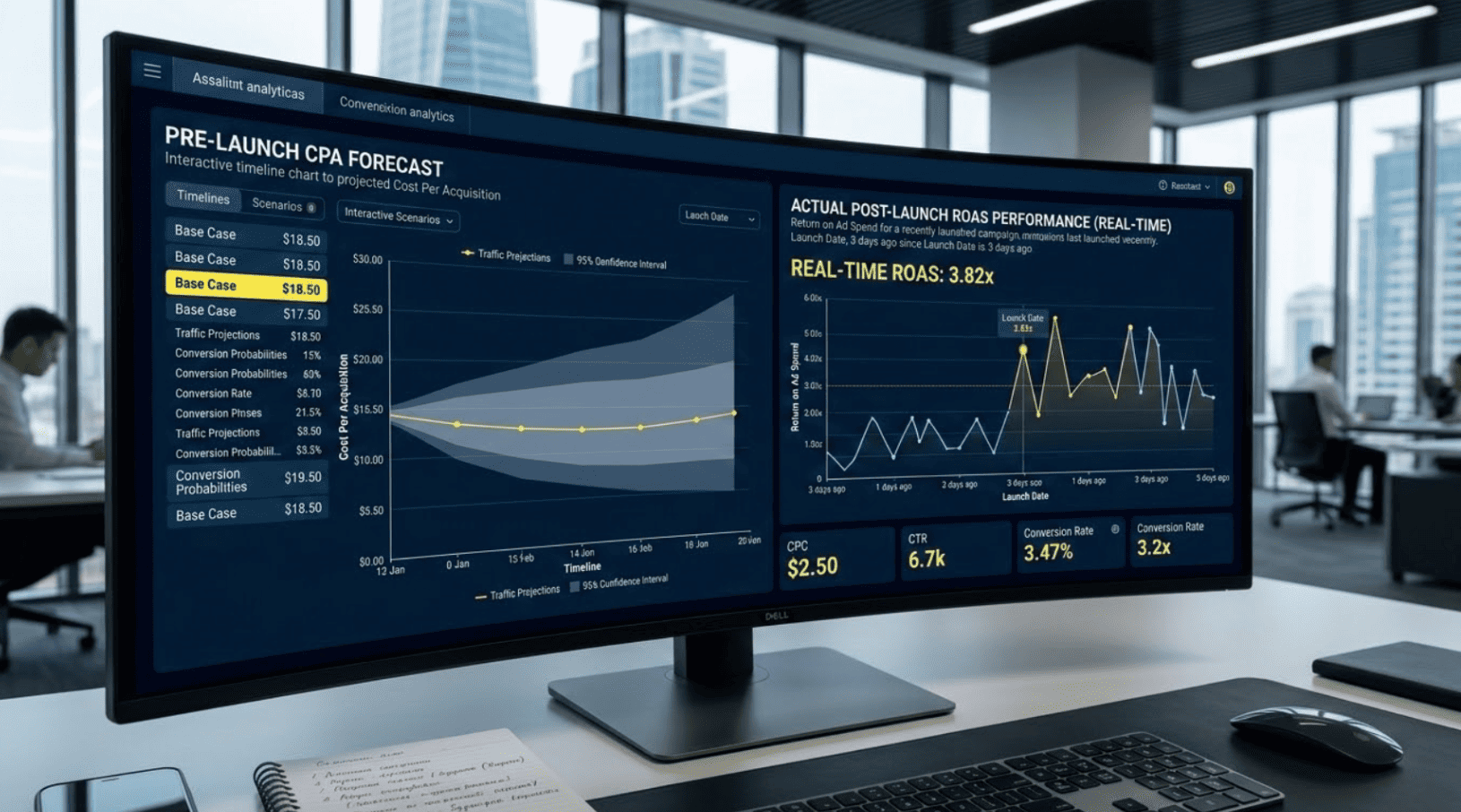
Raw historical averages overestimate future performance. Apply a decay factor — typically 10–20% for channels with 6+ months of run history — to account for audience fatigue and competitive bid pressure. This gives you a conservative CPA baseline to forecast against. Minora AI's Strategy Personalization Agent does this automatically: you define the budget and goals, and the system forecasts reach, CPA, and ROI before launch — based on a model trained on $30M+ in ad spend data.
Step 2 — Stress-Test With Scenarios, Not Single Points
Build Three Budget Scenarios
Single-point forecasts are a liability. Any honest CMO knows the actual number will land somewhere between optimistic and worst-case. Build three scenarios — conservative (90% of baseline CPA), base (100%), and aggressive (115%) — and present the range to finance. This is not hedging; it is accuracy. Ranges communicate real uncertainty, which builds more CFO trust than a precise number that turns out to be wrong.
Model Channel-Level Sensitivity
Not all channels respond to budget increases linearly. Search tends to have hard impression share caps — adding 40% budget after you hit 80% impression share returns diminishing ROAS. Social platforms have their own saturation curves. A proper sensitivity model maps expected CPA change per $10K increment per channel. This is where ad spend waste reduction actually happens: by finding the point where marginal CPA exceeds acceptable thresholds before you spend, not after.
Step 3 — Create a Real-Time Reallocation Trigger System
Set Performance Gates, Not Static Allocations
Static monthly budgets are the definition of a frozen budget problem. Set performance gates instead: if channel X hits CPA > $N within the first 7 days, automatically trigger a reallocation review. This keeps spend concentrated in what is working. Teams using real-time budget reallocation see materially better ROAS outcomes because they stop funding underperformance for a full month before the report catches up.
Define Who Controls the Gates
Automation handles execution; humans should define the thresholds. The mistake most teams make is setting performance gates too loosely (catching problems too late) or too tightly (triggering false positives on normal early-campaign variance). A good rule of thumb: use a 5–7 day stabilization window before any reallocation trigger fires. Minora AI's Optimization Agent applies exactly this logic — monitoring continuously, but reacting to statistically meaningful signals rather than noise.

The Metrics That Make Forecasts Defensible
Knowing how to forecast ad spend ROI accurately is not just a modeling exercise — it is a finance conversation. These are the three metrics that matter most when you need to prove marketing ROI to a CFO.
KPIs to Track
Predicted vs. Actual CPA Delta
This measures how close your pre-launch CPA forecast was to the realized number. A delta under 15% indicates a reliable model. Over 25% and your input assumptions need revisiting — usually audience segmentation or bid environment assumptions are off. Track this every campaign cycle, not just quarterly. It makes your forecasting model sharper over time.
Budget Utilization Rate by Channel
What percentage of allocated budget was actually deployed to each channel — and at what performance level? Low utilization in a "priority" channel usually signals either a targeting problem or an audience size constraint. High utilization with poor CPA signals a bid strategy problem. Either way, you want to know before month-end, not at month-end.
ROAS Variance vs. Forecast
The gap between forecast ROAS and actual ROAS is the single most useful number in a post-campaign review. Break it down by channel and by week. Where did ROAS deteriorate fastest? Was it audience saturation, creative fatigue, or platform algorithm shifts? The answers drive the next forecast. Teams that track ROAS variance rigorously tend to narrow their forecast error substantially within 3–4 campaign cycles.
How Minora AI Reports on These Metrics
Minora AI's reporting is built around pre-launch and post-launch comparison. The Strategy Personalization Agent produces a forecast before spend starts. The Optimization Agent tracks actual performance against that forecast in real time. The result is a continuous accountability loop — not a monthly PowerPoint — so marketing budget justification to the CFO is always grounded in live data, not reconstructed after the fact. The enterprise ROI model is straightforward: the break-even on Minora AI comes in under 60 days, driven by eliminating frozen budget waste and recovering approximately $150K/year in strategic team time that was previously spent on manual reporting.
Conclusion
The companies getting ad spend forecasting right in 2026 are not using better spreadsheets. They are using models that run before the campaign starts, trigger reallocation automatically when performance drifts, and produce a continuous data record that makes budget justification straightforward. The shift from backward-looking averages to pre-launch predictive CPA modeling is the operational change that actually moves the needle. Minora AI's Strategy Personalization Agent was built precisely for this: you set the budget and goals, the system models reach, CPA, and ROI before a dollar goes out. In markets where CPM inflation and audience fragmentation are accelerating — Central Asia, MENA, CIS — the cost of forecasting badly keeps going up. The teams that fix this first will hold a real structural advantage.
Ready to forecast your ad ROI before you spend — not after? Minora AI's predictive CPA model runs on $30M+ in real ad spend data and tells you your expected CPA before launch. Stop reconstructing performance. Start modeling it.
FAQ
Q1: What does it mean to forecast ad spend ROI accurately? A: Forecasting ad spend ROI accurately means modeling your expected return — typically expressed as ROAS or CPA — before a campaign launches, not after. Accurate forecasting uses historical performance data with decay adjustments, channel-level sensitivity curves, and scenario ranges rather than single-point estimates. The goal is to enter each campaign cycle with a defensible prediction, not a retrospective justification.
Q2: What is predictive CPA modeling and how does it work? A: Predictive CPA modeling estimates your cost per acquisition before budget deployment by analyzing historical campaign data, audience size, competitive bid pressure, and channel saturation. A model trained on sufficient ad spend data — Minora AI's uses $30M+ — can produce CPA forecasts with confidence intervals, allowing CMOs to allocate budgets with quantified risk rather than intuition.
Q3: How do I prove marketing ROI to my CFO before the campaign runs? A: Build a three-scenario forecast — conservative, base, and aggressive — with channel-level CPA projections and sensitivity analysis. Present the range, not a single number. CFOs distrust precision that later turns out to be wrong; they respond to honest ranges paired with a clear reallocation trigger plan. Pre-launch modeling tools like Minora AI's Strategy Personalization Agent generate this forecast automatically before spend starts.
Q4: What is the difference between ROAS and ROI in ad forecasting? A: ROAS (Return on Ad Spend) measures revenue generated per dollar spent on advertising — it excludes costs like production, platform fees, and team time. ROI (Return on Investment) factors in all costs. In media planning, ROAS is the operational metric; ROI is the finance metric. Both need to be forecasted separately because a campaign can hit ROAS targets while still delivering negative ROI once all costs are included.
Q5: How much wasted ad spend can predictive forecasting prevent? A: Industry estimates suggest 20–40% of paid media budgets are deployed to underperforming placements and channels before the data catches up (flagged for third-party sourcing). Real-time budget reallocation — triggered by performance gates rather than end-of-month reports — addresses the timing problem. Minora AI's data shows that eliminating frozen budget from low-performing channels typically improves ROAS by approximately 20%.
Q6: What is a frozen budget and why does it hurt ROI forecasting accuracy? A: A frozen budget is money allocated to a channel or campaign that is underperforming but continues to receive spend because no reallocation trigger has fired — usually because performance data arrives too slowly. It corrupts ROI forecasting by creating a false "cost baseline" in historical data. The next cycle's forecast inherits this waste, compounding the inaccuracy.
Q7: How often should CMOs update their ad spend forecasts? A: At minimum, weekly — daily if budgets are large and channel mix is volatile. Monthly reporting cycles are too slow to be useful for active campaign management. The more useful structure is a pre-launch forecast paired with a real-time variance tracker that flags deviations above a defined threshold (typically 15% CPA delta) automatically.
Q8: What data inputs do I need to build a reliable ad spend ROI forecast? A: You need channel-level historical CPA and ROAS by time period, audience size and saturation estimates, platform CPM benchmarks for your target period, and your target CPA or ROAS threshold. Apply decay factors to historical averages (10–20% for channels with 6+ months of data) to account for performance erosion. The more granular the historical data — by week, by creative type, by audience segment — the more reliable the forecast.
Q9: Can AI marketing platforms improve ad spend forecast accuracy? A: Yes — specifically platforms that run forecasting before budget deployment rather than optimizing only during or after. Minora AI's Strategy Personalization Agent models reach, CPA, and ROI pre-launch. Its Optimization Agent then tracks actual performance against that forecast in real time, creating a feedback loop that makes each subsequent forecast more accurate as the data compounds.
Q10: What is a realistic break-even period when switching to AI-powered ad forecasting? A: For enterprise marketing teams, the operational break-even on AI-powered campaign management typically comes in under 60 days. The two main drivers are recovered labor time — eliminating manual reporting saves approximately 80 hours per week, equivalent to roughly $150K/year in strategic team capacity — and ROAS improvement from removing frozen budget and enabling real-time reallocation. Both savings materialize faster than most teams expect.
