

The traditional digital marketing agency is structurally flawed. The business model relies on a linear relationship between revenue growth and human payroll. As you acquire new clients, your fixed overhead inevitably rises.
In 2026, building proprietary AI from scratch is a $180,000+ per year mistake. Outsourcing AI workflows to fragmented freelancers results in knowledge loss and operational chaos. I’ve seen independent agencies completely transform their Profit & Loss statements by deploying white label AI marketing solutions.
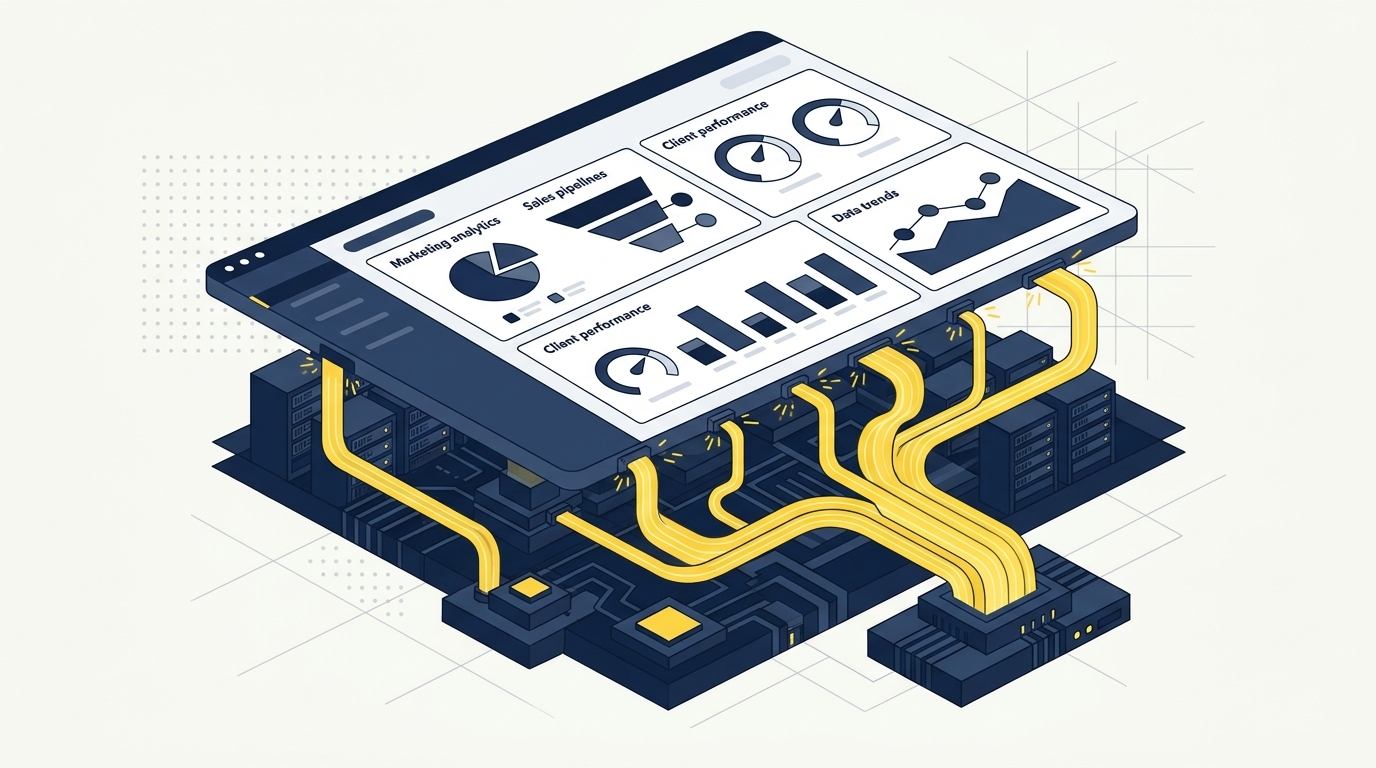
This isn’t just reselling a basic chatbot. It is licensing enterprise-grade, autonomous infrastructure and rebranding it as your own proprietary Marketing OS. Here is how modern operators are scaling revenue without scaling headcount.
The Economic Reality of Agency Survival
By 2025, the AI marketing technology sector crossed $107 billion. Traditional agencies operating on 12% net margins are getting crushed by the efficiency of automated systems.
To survive, you must decouple revenue from human labor hours. Agencies that aggressively productize white label AI services report gross margins ranging from 60% to 85%. You convert massive fixed capital expenditures into variable operating expenses.
“We stopped selling our time and started selling access to our autonomous infrastructure. We went from managing 10 clients manually to 150 clients programmatically, without hiring a single new account manager.”
The Tactical Core: Architecting Your Branded Automation
Define the White Label Paradigm
Traditional software reselling limits you to an affiliate commission while the vendor retains brand equity. White label AI operates differently. The underlying infrastructure is maintained by a specialized provider, but the client-facing experience belongs entirely to your agency. You control the pricing architecture. You curate all client communications. The technology operates silently in the background.
Deploy Multi-Tenant Infrastructures
You cannot scale if client data cross-contaminates. Enterprise-grade solutions rely on strict multi-tenant environments. Hundreds of your clients share the same cloud computing resources, but their proprietary data and customized AI models remain cryptographically isolated. You manage the expansive portfolio through a singular administrative dashboard. Minora AI utilizes this exact philosophy to deploy secure, autonomous allocation for D2C brands.
Avoid Proprietary Model Lock-In
The AI landscape shifts rapidly. Do not lock your agency into a single LLM provider. The most resilient white label platforms offer agnostic, multi-model access. You route creative copywriting to one model and complex data analysis to another. This neutralizes pricing risk and ensures optimal output quality across diverse marketing tasks.
Transition to Productized Service Models
Move away from billing arbitrary human hours. Offer clients direct, self-serve access to your branded AI portal. Set your own subscription tiers with a 2x markup over your wholesale costs. If you pay a white label provider $1,200/month for an infrastructure supporting 10 clients, and bill those clients $1,000/month each, you generate $10,000 in recurring revenue against fixed software costs.
Implement Zero-Touch Client Onboarding
Client churn kills agency growth. Stop paying account managers to perform manual check-ins. Deploy intelligent conversational AI routing. When a client triggers a new sub-account, an automated 14-day workflow dispatches personalized tutorial videos. If a client fails to log in, the system autonomously triggers a re-engagement sequence.
The Delivery Layer: Comparing Scaling Economics
Frequently Asked Questions About White Label Agency Models
1) How does white label AI integrate with existing agency tools?
Enterprise white label solutions rely heavily on robust REST APIs and webhooks. You programmatically push data to CRM databases like HubSpot or e-commerce backends like Shopify without deploying complex middleware.
2) What are the compliance risks of white label AI?
If you deploy a high-risk AI system on a white-labeled basis, regulators may reclassify your agency from a “deployer” to a “provider” under the EU AI Act. You must demand pre-engineered compliance architecture from your vendor to navigate stringent data privacy legislation.
3) How do you price white label AI services for clients?
Successful agencies utilize tiered, outcome-based packaging. You might charge $500/month for an automated content engine, or $3,000/month for end-to-end autonomous media buying across omni-channel campaigns. You sell the guaranteed business outcome, not the software feature.
4) Can white label AI replace media buyers?
Yes. You deploy custom systems to connect platforms directly. Minora AI operates as an autonomous multi-agent system that reallocates budget 24/7 across Meta, Google, and TikTok. It reduces daily campaign management from hours of manual labor to minutes of executive review.
Transitioning to Agentic Strategy
The traditional agency retainer model is collapsing. The future belongs to organizations that transition from manual service providers into automated software architects. By deploying white label AI infrastructure, you instantly eliminate the operational bottlenecks that cripple independent growth. Stop fighting the machines. Rebrand them, deploy them, and let data move your money.
