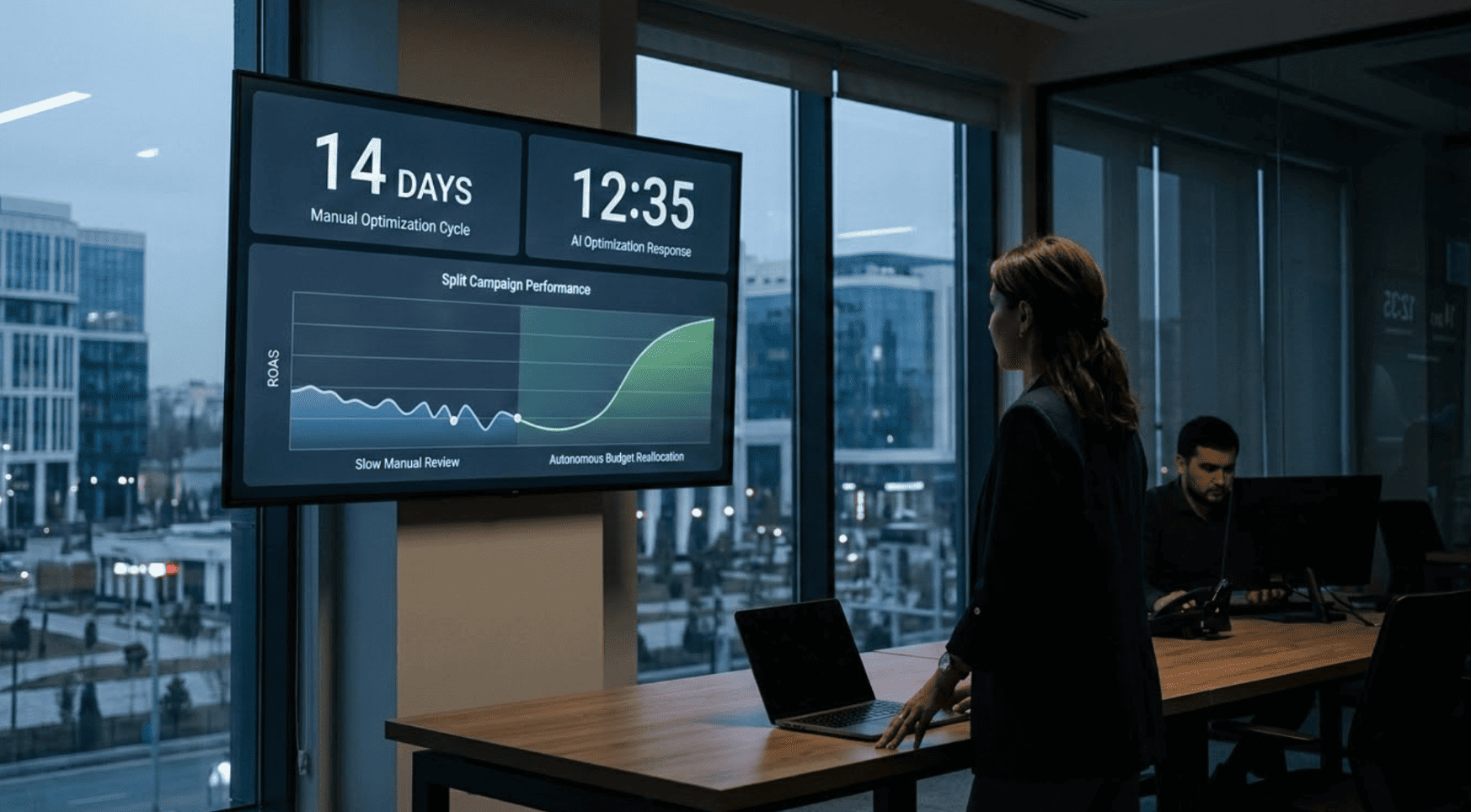
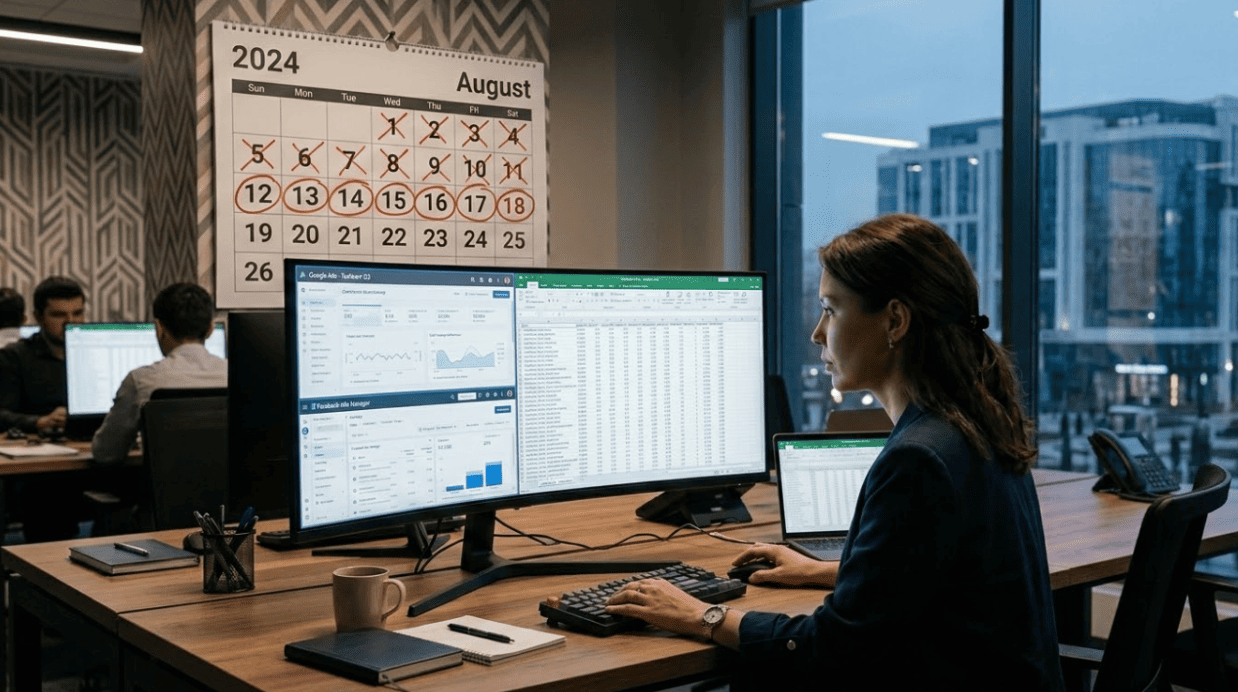
The optimization cycle most marketing teams run looks like this: pull data on Monday, reconcile platform reports by Wednesday, get analysis reviewed by Thursday, brief the media buyer, adjust bids by Friday — and that's for a team that moves fast. Traditional agency timelines run 14 days between performance signals and budget action. In a market where AI campaign optimization acts in minutes, that lag has a direct dollar cost. Brands that reallocate budgets within a 48-hour window see an 18% improvement in ROI — a velocity that manual vs AI campaign optimization time comparisons make clear is no longer a competitive advantage. It's now the baseline expectation.
How Long Manual Optimization Actually Takes
Most CMOs underestimate the latency in their current optimization workflow. The bottleneck isn't the decision — it's everything that has to happen before a human can make one. Data has to be pulled from multiple platforms, cleaned, combined into a coherent view, analyzed against benchmarks, and then translated into a specific bid or budget adjustment. Only then does the actual optimization action happen.
The timeline, mapped honestly: traditional agencies run a 4-8 week planning cycle followed by a 14-day optimization response window. In-house teams move faster — manual in-house optimization runs 2+ weeks per planning cycle — but they still operate on spreadsheets built from data that's days old by the time it reaches the analyst. "Speed is the new currency," as Minora AI's product framework puts it directly. "If it takes a month to plan, you're already behind."
The formal cost of this lag is the Manual Tax: every day budget stays allocated to an underperforming channel because no one has acted on the performance signal yet. On a $50K/month ad budget, even a 10% misallocation running for two weeks before correction costs $2,500 in recoverable spend. Multiply that across a full campaign quarter and the cumulative drag is material — not a rounding error.
Minora AI's Optimization Agent eliminates this cycle entirely. It monitors 450+ channels 24/7 and reallocates budget to top performers without waiting for a human to pull a report. The response time between performance signal and budget action drops from 14 days to minutes.
💡 How many days passed between your last performance signal and your last budget adjustment? Book a strategy call with Minora AI — we work with enterprise marketing teams across Central Asia, MENA, and beyond.
The Velocity Comparison — Stage by Stage
Understanding where the time goes in manual optimization is the first step to seeing why the AI alternative isn't marginal — it's structural. Each stage of the manual cycle has a specific time cost. AI campaign optimization removes or compresses each one.
The Manual Optimization Cycle — Where Time Goes
Data Collection and Platform Reconciliation
Every ad platform produces its own reporting format. A multi-channel campaign running Google, Meta, programmatic, and social simultaneously requires pulling four separate data exports, reconciling attribution discrepancies between them, and building a unified view from scratch. In most in-house environments, this takes a half day to a full day per platform review cycle. Weekly reviews consume 4-8 hours of analyst time before analysis even begins.
Analysis, Decision, and Approval
Once the data is clean, someone has to interpret it — which channels are underperforming, by how much, and what the corrective action should be. That analysis gets reviewed by a senior marketer or a CMO, discussed, and approved. In enterprise environments with multiple stakeholders, this approval cycle adds 2-4 days to the response window. The budget continues running on the old allocation the entire time.
Execution — The Final Manual Step
After approval, the actual bid or budget adjustment has to be implemented — platform by platform, campaign by campaign. For a team running 8-10 active campaigns across multiple channels, manual execution of a budget reallocation takes another 1-2 days. By the time the adjustment goes live, the performance signal that triggered it is typically 10-14 days old.
The AI Optimization Cycle — Where Time Goes
Continuous Signal Detection — No Data Pull Required
Minora AI's Optimization Agent doesn't wait for a weekly data export. It monitors performance signals across 450+ channels in real time, continuously. The moment a channel's performance drops below threshold, the signal is detected — not on Monday morning, not after the weekend, but as it happens. There's no data reconciliation step because the agent operates on live data, not exports.
Autonomous Decision and Execution — Minutes, Not Days
When the Optimization Agent detects an underperforming placement, it reallocates budget autonomously — without a human approval chain, without a briefing step, without an execution delay. The full cycle from performance signal to budget adjustment runs in minutes. According to data from Minora AI's performance analysis, this real-time reallocation model reduces CPA by up to 22% compared to traditional manual methods. Brands operating within the 48-hour reallocation window — which autonomous AI makes the standard, not the exception — see 18% ROI improvement over manual cycles.
What the Time Difference Costs in Real Budget Terms
Speed in campaign optimization isn't an operational preference — it's a financial variable. The longer a budget stays allocated to a bad placement, the more it costs. The faster the reallocation, the more ROAS the same budget produces. This is where the manual vs AI campaign optimization time comparison stops being theoretical.
KPIs to Track
Optimization Response Latency
This is the time between a performance signal (a channel's CPA spikes, a placement stops converting) and the budget adjustment that corrects it. In a manual workflow, this runs 10-14 days on average. In Minora AI's autonomous model, it runs in minutes. The dollar value of this difference scales with budget size — on $100K/month in managed spend, even a 5% misallocation running 14 days unaddressed costs $2,300 in recoverable spend per cycle.
CPA Reduction From Continuous Reallocation
Manual optimization produces CPA improvements in discrete steps — after each weekly or bi-weekly review cycle. AI-powered campaign optimization produces continuous CPA improvement because reallocation happens whenever the data justifies it, not whenever the calendar permits. The data is specific: AI-driven budget optimization reduces CPA by up to 22% compared to manual methods. That's not a one-time correction — it's the cumulative effect of faster response compounding over a campaign's full run.
Planning Cycle Compression
Manual in-house planning runs 2+ weeks per cycle. Traditional agency planning runs 4-8 weeks. Minora AI's Research Agent and Strategy Personalization Agent compress the first AI market scan and strategy generation to 30 minutes — before the first campaign even launches. After launch, continuous optimization replaces the planning cycle entirely. The time freed from planning and reporting cycles, at senior strategist salary rates, runs approximately $150K/year in recovered strategic talent time.
How Minora AI Reports on These Metrics
Minora AI's Optimization Agent logs every autonomous reallocation decision with before/after performance data, timestamp, and budget delta — visible in real time on the CMO dashboard. There's no weekly report to wait for because the dashboard updates continuously. The Strategy Personalization Agent's pre-launch CPA forecasts appear alongside post-launch actuals, so CMOs can track whether the autonomous optimization is closing the gap between forecast and reality. For performance marketing teams accustomed to weekly snapshots, this shift to continuous visibility changes how they plan — not just how they report.
Why This Gap Will Only Widen
The 14-day manual optimization cycle is already a performance liability at current market speed. As AI-driven competitors begin reallocating budgets in real time, staying on a weekly review cadence means consistently being 10-13 days behind the best possible budget allocation for your spend. That gap doesn't close — it compounds. Every week the market shifts and your competitors act faster, the manual cycle costs more than it did the week before. Minora AI's four-agent architecture — Research, Strategy Personalization, Launch, and Optimization — runs the full campaign lifecycle continuously, without resetting to a planning cycle at any point. For CMOs who want to close the optimization latency gap before it becomes a strategic disadvantage, the decision isn't whether to automate. It's how long to wait.
Ready to stop optimizing in weekly batches and start running continuous campaign improvement? Minora AI's Optimization Agent monitors 450+ channels 24/7 and reallocates budget in minutes — not weeks. The average CMO who switches sees CPA drop by up to 22% and recovers 80 hours per week in manual labor.
FAQ
Q1: What is the average time for manual campaign optimization compared to AI? A: Traditional agency optimization cycles run approximately 14 days between a performance signal and a budget adjustment. In-house manual teams move faster but still operate on weekly review cadences, averaging 7-10 days from signal to action. Minora AI's Optimization Agent detects performance signals in real time and reallocates budget autonomously in minutes — no data pull, no approval chain, no execution delay.
Q2: How much does slow manual optimization actually cost in ROAS terms? A: Brands that reallocate budgets within a 48-hour window see an 18% improvement in ROI compared to slower optimization cycles, according to performance data Minora AI cites in its competitive analysis. On a $50K/month budget, that 18% gap represents $9K/month in value not captured because the manual cycle couldn't act fast enough. The CPA reduction from continuous AI optimization versus manual methods runs up to 22%.
Q3: What is "optimization latency" and why does it matter for CMOs? A: Optimization latency is the time between when a campaign performance problem becomes detectable in the data and when a budget correction is actually executed. In manual workflows, this latency runs 7-14 days — during which the budget continues running on the old, suboptimal allocation. Reducing optimization latency from days to minutes is the primary mechanism behind AI campaign management's ROAS improvement. The faster the response, the less budget burns in underperforming placements.
Q4: Why can't manual teams close the optimization speed gap just by reviewing data more frequently? A: The bottleneck isn't review frequency — it's the human processing time required at each step. Data collection, platform reconciliation, analysis, approval, and execution all require human attention and time, even if the review cadence increases. A team reviewing data daily still needs 2-3 hours to complete the full manual cycle before adjusting a single campaign parameter. Autonomous AI optimization removes the human steps entirely, which is the only way to get from days to minutes.
Q5: How does Minora AI's Optimization Agent detect performance signals faster than a human analyst? A: Minora AI's Optimization Agent monitors live performance data across 450+ channels continuously — not on a scheduled review cycle. It evaluates performance signals against predefined thresholds in real time, without needing to export data, reconcile attribution, or build a spreadsheet. When a channel's CPA exceeds threshold or a placement stops converting, the agent acts immediately. Human analysts can only review data they've already pulled, which introduces the 7-14 day lag by design.
Q6: What does "automate ad campaign management" mean in practice for a performance marketing team? A: Automating ad campaign management means replacing the manual data-pull-analysis-approval-execution cycle with an autonomous system that performs all of those functions in sequence without human handoffs. In Minora AI's model, the Research Agent provides continuous market intelligence, the Strategy Personalization Agent builds the plan, the Launch Agent deploys it, and the Optimization Agent manages performance from that point forward. The human role shifts from executing the cycle to reviewing the outputs.
Q7: How does the 48-hour budget reallocation window improve ROI? A: The 48-hour window matters because campaign performance can shift meaningfully within a single business day — CPMs change, audience saturation sets in, competitor activity increases. A budget correction made within 48 hours of a performance shift redirects spend before significant waste accumulates. Data cited in Minora AI's competitive analysis shows brands operating within this window see 18% ROI improvement compared to slower cycles. Manual optimization physically cannot maintain a 48-hour response window across multiple channels without autonomous tools.
Q8: Does AI campaign optimization replace the need for human campaign strategy? A: No. Minora AI's autonomous optimization handles the execution layer — continuous budget reallocation, channel monitoring, and performance response. The strategy layer — which channels to test, what ICP to target, what creative direction to pursue — remains a human function informed by the Research and Strategy Personalization agents. The role shift is from execution to oversight: human marketers review and approve the strategy, then let the agents manage the implementation cycle.
Q9: What is the Manual Tax and how does it relate to optimization time? A: The Manual Tax is the cumulative performance cost of operating at human speed in a market that moves in real time. Every day a budget misallocation runs uncorrected because no one has gotten to this week's report is a day of recoverable spend lost. At $100K/month in ad spend and a 10% misallocation, each day of optimization latency costs approximately $333 in recoverable budget. Over a 14-day manual cycle, that's $4,666 per campaign in preventable waste — before counting the labor cost of the manual process itself.
Q10: How quickly does Minora AI's real-time campaign optimization reach full effectiveness? A: Minora AI's onboarding sequence moves from data integration (1 minute) to first AI market scan and strategy generation (30 minutes) to pilot campaign launch (48 hours) to full algorithmic optimization active (48 hours and beyond). The Optimization Agent begins operating immediately once campaigns are live — there's no ramp-up period required for it to detect and act on performance signals. Marketing workflow automation at this level becomes effective from the first campaign cycle, not after a multi-week training phase.
