

Your agency is billing $10,000 a month. Three junior media buyers are moving budget line items in spreadsheets, writing weekly recap emails, and waiting for Friday data exports to make decisions that needed to happen Tuesday. That is the traditional retainer model — and clients are increasingly done with it. The impact of AI on digital marketing agencies is not theoretical. It's already separating agencies that will still exist in two years from ones that won't.
The Traditional Agency Model Has a Structural Problem
The retainer model was never really built for performance. It was built for billing predictability. An agency charges a fixed monthly fee, staffs junior talent to handle execution, and reserves senior people for quarterly strategy decks. The client pays regardless of results. Everyone calls it a "partnership."
That structure made sense when campaign data arrived weekly and media channels numbered in the dozens. Neither of those is true anymore. In 2026, media buyers have to monitor 450+ potential channels simultaneously — social, programmatic, search, OOH, influencer, connected TV — while clients expect real-time budget decisions and same-week pivots. Junior staff doing manual optimization can't physically keep up.
The data gap is brutal. By the time a traditional agency's weekly report lands in a CMO's inbox, the campaign has already burned budget in underperforming placements for five days. That's not a staffing problem — it's an architecture problem. And AI doesn't patch that architecture. It replaces it entirely.
Minora AI's Optimization Agent monitors campaigns and reallocates budget autonomously, 24 hours a day. It doesn't send a recap on Friday. It acts on Thursday at 2 PM when a channel starts underperforming — before the loss compounds.
💡 Watching your agency model age out in real time? Book a strategy call with Minora AI — we work with enterprise marketing teams across Central Asia and beyond.
How AI-Powered Growth Partners Actually Operate
The agencies gaining ground in 2026 are not selling deliverables — they're selling outcomes. The distinction sounds semantic until you see the contract structure. Growth partners tie compensation to performance metrics: ROAS thresholds, CPA targets, revenue contribution. That only works if you can actually control those metrics with precision. AI makes that possible in ways a spreadsheet-driven team simply cannot.
Research and Strategy Before Budget Moves
Competitive Intelligence at Launch Speed
Before a campaign goes live, a growth partner using AI can scan market conditions, competitor positioning, and cultural context for the target region. Minora AI's Research Agent does exactly this — it doesn't wait for a human analyst to complete a two-week audit. That intelligence feeds directly into campaign structure before a single dollar is spent.
Predictive CPA Modeling as a Filter
Here's what separates a growth partner from a service vendor: a growth partner tells you the likely CPA before you approve the budget. Minora AI's Strategy Personalization Agent forecasts Reach, CPA, and ROI based on your goals — trained on $30M+ in real ad spend data. You define the number you need to hit; the system tells you whether the plan can hit it. That's a different conversation than "here's our proposed media mix."
Launch and Optimization as Continuous Loops
48-Hour Campaign Deployment
The average traditional agency takes two to four weeks to launch a new campaign. Brief, strategy deck, approval rounds, trafficking, QA. Growth partners running AI infrastructure compress that to 48 hours. Minora AI's Launch Agent handles omnichannel deployment — across the full channel mix — without the back-and-forth that kills velocity. For clients in competitive markets, that speed difference is directly measurable in market share.
Autonomous Budget Reallocation
Once live, campaigns don't run on autopilot — they run on continuous optimization. The Minora AI Optimization Agent monitors performance across 450+ channels and reallocates budget in real time to top performers. No human has to spot the shift, write a recommendation, get approval, and then traffic the change. The system does it. That removes the single largest lag point in traditional agency operations.

What the Numbers Look Like for CMOs
Agency model selection is ultimately a finance decision. CMOs need to know what they're actually buying when they write the check — and for most of 2026, that math has shifted in ways that are hard to ignore.
KPIs to Track
CPA Trajectory Over 60 Days
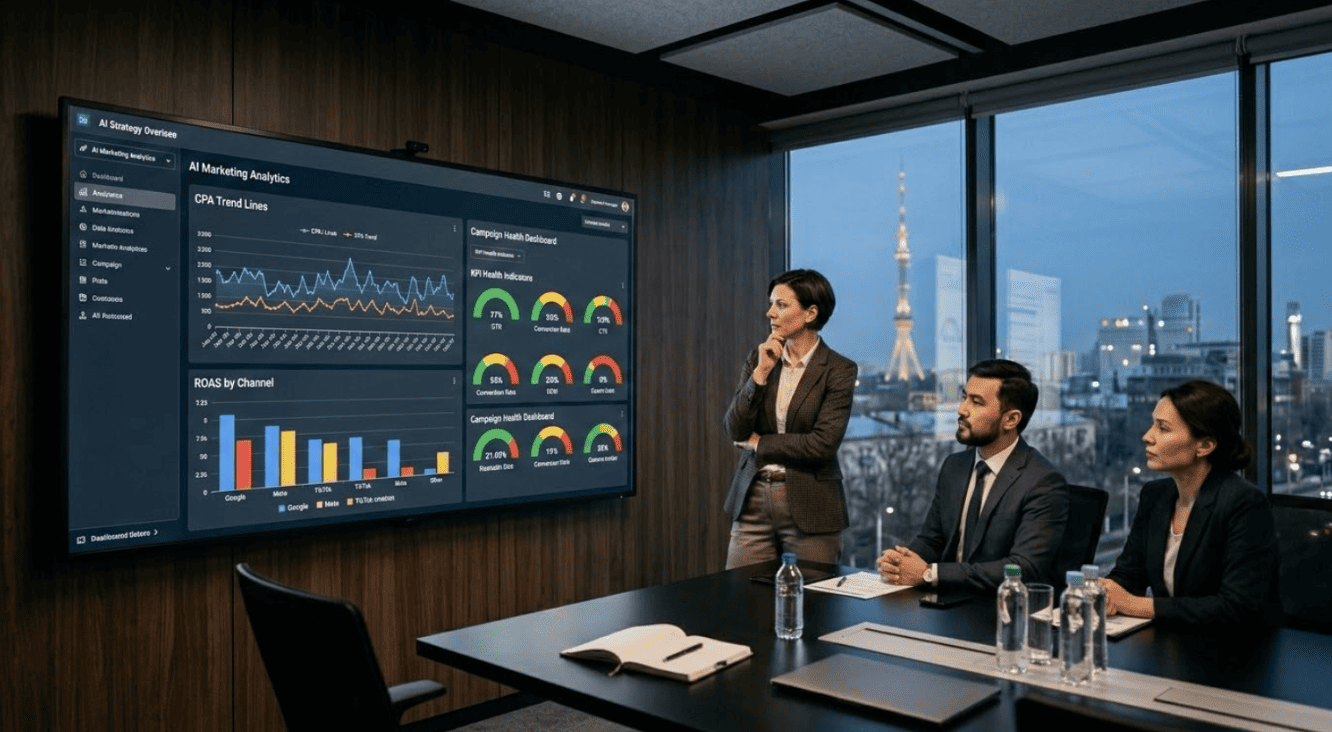
The most important number isn't the launch CPA — it's whether CPA is falling or flat-lining by day 60. Agencies using autonomous optimization consistently show a downward CPA curve as the system learns. Traditional retainer agencies typically show flat performance after the initial setup period, because manual optimization doesn't compound. Minora AI clients reach sub-60-day break-even on campaign investment.
ROAS Consistency Across Channels
A single high-ROAS channel doesn't tell you much. What matters is whether the overall portfolio holds ROAS as budgets scale. AI-driven autonomous media buying protects ROAS by constantly shifting budget away from deteriorating placements — something a human team reviewing data weekly cannot do with the same precision. Minora AI clients see an average +20% ROAS improvement after autonomous optimization is running.
Hours Recovered Per Week
This one is underrated. Teams running traditional retainer agencies report 80+ hours per week consumed by manual data pulls, reporting, and reactive budget changes. That's time not spent on strategy, creative testing, or new channel exploration. Autonomous marketing platforms recover that time directly — and the freed capacity either reduces headcount cost or gets reinvested into growth.
How Minora AI Reports on These Metrics
Minora AI's reporting doesn't require a human to compile a deck. The system tracks CPA, ROAS, reach, and budget utilization in real time — so CMOs see performance at the same moment the Optimization Agent is acting on it. There's no lag between what's happening and what's reported. That transparency is what makes performance-based pricing structures honest: the client can verify every claim the agency makes, instantly.
Conclusion
The impact of AI on digital marketing agencies isn't evenly distributed. It's concentrating advantage in agencies willing to replace manual execution with autonomous systems — and it's making the traditional retainer model look like a fee structure designed to protect agency margins, not client results. The agencies that survive this shift will be the ones that tie their income to outcomes and use AI infrastructure to deliver them reliably. For CMOs still paying flat monthly fees for weekly recap emails, the question isn't whether to change — it's how fast the current model is costing you.
Ready to stop paying for agency hours and start paying for results? Minora AI's four-agent system — Research, Strategy Personalization, Launch, and Optimization — runs campaigns the way growth partners should: autonomously, accountably, and with your CPA targets built in from day one.
FAQ
Q1: What is the impact of AI on digital marketing agencies in 2026? A: AI is splitting the agency market into two categories: commoditized service vendors and AI-powered growth partners. Agencies using autonomous marketing platforms can monitor hundreds of channels, reallocate budgets in real time, and launch campaigns in 48 hours — capabilities that fundamentally change what clients should expect from their agency relationship.
Q2: Why are traditional agency retainer models losing clients to AI-driven alternatives? A: The retainer model charges fixed fees regardless of performance and relies on manual reporting cycles that delay optimization by days or weeks. AI-driven growth partners tie compensation to measurable outcomes like ROAS and CPA, and use autonomous systems to act on data in real time rather than in weekly recap emails.
Q3: How does autonomous media buying differ from traditional campaign management? A: Traditional campaign management involves human media buyers reviewing data periodically and making manual budget adjustments. Autonomous media buying uses AI agents to monitor campaigns continuously across 450+ channels and reallocate spend instantly when a placement underperforms — without waiting for a human to notice, escalate, and approve.
Q4: Can a mid-market agency actually compete with holding companies using AI tools? A: Yes — and this is where the opportunity is clearest. Mid-market agencies (10-100 employees) can deploy white-label AI infrastructure like Minora AI to offer enterprise-grade campaign intelligence without building an internal data science team. The holding companies' advantage was always data processing scale; AI eliminates that moat.
Q5: What does a predictive CPA tool actually do before a campaign launches? A: A predictive CPA tool uses historical ad spend data and market signals to forecast the likely cost per acquisition before any budget is committed. Minora AI's Strategy Personalization Agent does this using a model trained on $30M+ in real campaign data — so CMOs can validate whether their CPA target is achievable before approving the media plan.
Q6: How long does it take to see ROAS improvement with an AI marketing platform? A: Most clients using autonomous optimization see measurable ROAS improvement within the first 30 days as the system identifies and eliminates budget waste in underperforming placements. Minora AI clients reach sub-60-day break-even on campaign investment, with an average +20% ROAS lift after full optimization is running.
Q7: What marketing jobs are most at risk from AI automation in agencies? A: Junior media buyer roles built around manual data pulls, spreadsheet budget management, and weekly reporting are the most directly replaceable. Senior strategic roles — campaign architecture, creative direction, client relationship management — are less affected. The shift is less about headcount reduction and more about where human judgment gets applied.
Q8: What should CMOs look for when evaluating AI-powered agency partners? A: Three things: whether the agency can show CPA forecasts before campaign launch (not just promises), whether optimization happens continuously or in weekly cycles, and whether reporting is real-time or compiled manually. An agency that can't answer all three with specifics is still running the old model with AI branding on top.
Q9: How does agentic AI differ from standard marketing automation tools? A: Standard marketing automation executes predefined rules — send this email when that trigger fires. Agentic AI makes decisions, adjusts strategy, and takes action across complex variables without a human scripting every scenario. Minora AI's agent system scans market conditions, forecasts outcomes, launches campaigns, and optimizes budgets — a full decision loop, not a trigger-response sequence.
Q10: Is AI marketing infrastructure accessible for agencies outside major Western markets? A: Yes, and the advantage is actually larger in markets like Central Asia, MENA, and Eastern Europe where local agency competition hasn't yet adopted autonomous systems at scale. Minora AI was built with exactly these markets in mind — the KoronaPay campaign in Uzbekistan is one documented example of what AI-driven performance marketing produces in a regional context where traditional agencies still dominate.
