
A surprisingly large number of marketing teams now use ChatGPT for media buying — not to run ads, but to generate strategy drafts, write briefs, and brainstorm channel mix ideas. That's a reasonable use of a text generation tool. The problem is that some teams have started treating those outputs as operational plans. ChatGPT for marketing produces words. Minora AI produces deployed campaigns. The distinction matters a great deal when real budget is at stake, and the gap between the two is wider than most CMOs realize before they've tested both.
Why Generalized LLMs Break Down at the Execution Layer
ChatGPT is trained on the internet. That's a broad and genuinely impressive corpus — but it includes almost no proprietary campaign performance data. It has never seen your CRM records, your actual CPA across specific channels, or what happened to your ROAS when you shifted budget from Meta to programmatic in Q3. When you ask it to recommend a channel mix or estimate a cost-per-acquisition, it generates a statistically plausible answer — which is not the same as a correct one.
This is what the industry calls hallucination in a media buying context. A general-purpose language model doesn't know that your ICP converts at 40% lower CPA on Telegram than on Google Display in Uzbekistan. It doesn't know that your category's CPMs spike in November by 60%. It gives you an answer that sounds right because it's built from patterns across millions of documents — not from the outcome data of campaigns that actually ran and converted. Minora AI's competitive positioning directly addresses this: broad generative models suffer from severe hallucination in media buying because they lack proprietary CRM integration and real performance training data.
Minora AI's model was trained on $30M+ in actual ad spend outcomes — not articles about advertising, but the raw performance records of real campaigns across real channels. That difference in training source is what separates plausible-sounding advice from operational accuracy.
💡 Using AI to plan campaigns but still launching them manually? Book a strategy call with Minora AI — we work with enterprise marketing teams across Central Asia, MENA, and beyond.
What Each Tool Is Actually Built to Do
This comparison only makes sense if you're honest about what ChatGPT is and isn't designed for. It's a text generation system — and a very good one. For copywriting, drafting creative briefs, writing ad headlines, or summarizing competitor research, it adds genuine value. The issue isn't that ChatGPT is bad. The issue is what happens when teams use a text tool to do a performance tool's job.
Where ChatGPT Delivers Actual Value for Marketers
Copy Generation and Creative Ideation
ChatGPT can produce ad copy variations, brainstorm campaign concepts, write landing page drafts, and generate A/B test ideas at speed. These are legitimate use cases. A creative team that uses it to produce 20 headline variants in 10 minutes is using it correctly — as a writing accelerator, not a campaign manager.
Research Synthesis and Brief Writing
Asking ChatGPT to summarize a market trend, draft a creative brief from notes, or outline a campaign structure is reasonable. The output requires expert review before it becomes an operational document, but as a first-draft generator it saves time. The problem starts when that draft gets treated as a tested recommendation rather than a structured guess.
Where Minora AI Operates — and ChatGPT Cannot
Predictive CPA Modeling Before Spend Commitment
Minora AI's Strategy Personalization Agent generates CPA forecasts before a single dollar is committed — trained on $30M+ in actual performance data, not marketing content scraped from the web. You see an expected cost-per-acquisition, a projected reach, and an estimated ROI before approving the campaign. ChatGPT cannot produce this. It can estimate a CPA range based on generic industry benchmarks, but it has no access to your account data, no training on performance outcomes, and no mechanism to verify the number it produces.
Omnichannel Execution Across 450+ Channels
Once a strategy is approved, Minora AI's Launch Agent deploys campaigns across 450+ channels in 48 hours — with ICP personalization built directly into the targeting layer. ChatGPT ends at the document. It produces a strategy slide, a channel recommendation, a budget allocation table. None of that deploys. Everything still requires human translation into ad platforms, creative setup, audience configuration, and bid management. The gap between a ChatGPT output and a live campaign is the same labor-intensive process that existed before AI tools — the text generation just produces the brief faster.
24/7 Autonomous Budget Reallocation
Minora AI's Optimization Agent monitors 450+ channels continuously and reallocates budget to top performers in real time. ChatGPT cannot touch your ad accounts. It has no access to live performance data, no connection to your campaigns, and no ability to act on what it observes. If your Meta placements underperform at 11pm on a Tuesday, ChatGPT won't know until you paste in the data and ask — and by then, the budget has already burned.
The Performance Gap in Practice
The question isn't which tool writes better copy — ChatGPT is excellent at that. The question is which tool moves your ROAS. That's a different metric entirely, and it requires a different kind of system.
KPIs to Track
CPA Accuracy — Pre-Launch vs. Actual
Good campaign management means knowing your expected CPA before you commit spend. ChatGPT produces estimates based on generic data; Minora AI produces forecasts from $30M+ in real campaign outcomes. The gap between a ChatGPT estimate and actual CPA on a specific channel, for a specific ICP, in a specific geography can be 40-60% — enough to blow a quarterly budget allocation.
Time-to-Live Campaign
ChatGPT produces documents. Turning a ChatGPT strategy output into a live campaign still requires a human to set up audiences, configure bids, upload creatives, and publish — across every channel. Minora AI's 48-hour launch window from strategy approval to live campaign is the operational difference. That velocity gap matters most when you need to respond to a competitor move or capitalize on a short market window.
ROAS Improvement from Continuous Optimization
A ChatGPT-assisted workflow optimizes when a human decides to optimize — after pulling data, analyzing it, and acting on it. Minora AI's Optimization Agent works continuously. The result, based on Minora AI's performance data, is approximately +20% ROAS improvement over manual optimization cycles. The gain comes from eliminating the lag between performance signal and budget action, not from smarter creative.
How Minora AI Reports on These Metrics
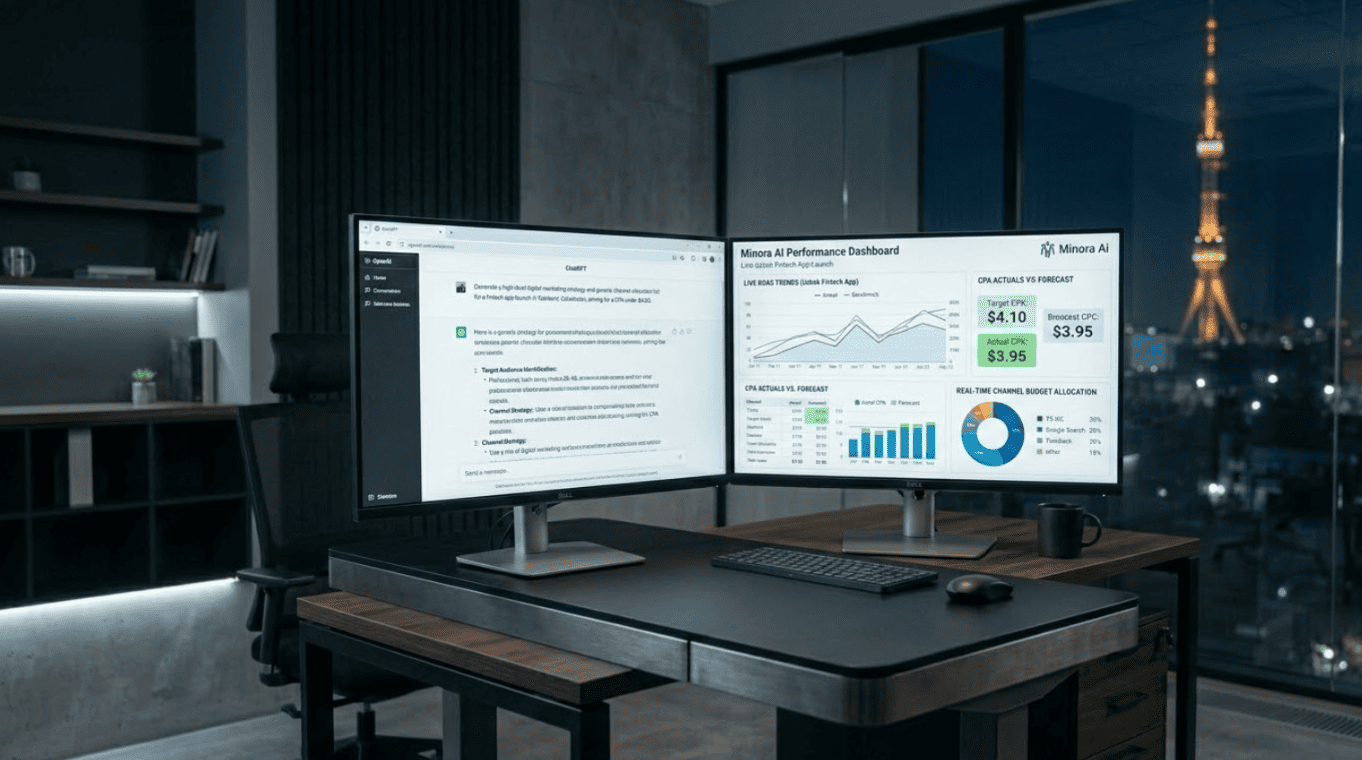
Minora AI doesn't separate reporting from optimization. The same data the Optimization Agent uses to reallocate budget is visible in a live CMO dashboard — CPA actuals vs. forecast, ROAS by channel, budget allocation in real time, and pre-launch predictions from the Strategy Personalization Agent. ChatGPT has no reporting layer. It answers questions when prompted. Minora AI monitors continuously and acts on what it sees — which is a different operating model, not a better version of the same one.
The Honest Take
ChatGPT is genuinely useful for marketing — specifically for the creative and documentation tasks that have always been time-consuming but intellectually repetitive. If you're using it to write copy, generate ideas, or draft briefs faster, that's a reasonable workflow. What it cannot do is replace a system trained on actual ad spend data, connected to live campaign performance, and capable of autonomous deployment and reallocation. Minora AI and ChatGPT are not competing for the same job. One generates text that describes a marketing strategy. The other runs one. For CMOs with real budget under management and ROAS targets to hit, that distinction is the whole conversation.
Ready for an AI that actually runs your campaigns — not just writes about them? Minora AI's autonomous agents handle research, strategy, launch, and 24/7 optimization — trained on $30M+ in real ad spend, not internet text. The difference shows up in your ROAS within 60 days.
FAQ
Q1: What is the main difference between Minora AI and ChatGPT for marketing? A: ChatGPT is a text generation tool — it produces copy, briefs, strategy outlines, and creative ideas. Minora AI is an autonomous marketing execution platform — it deploys campaigns across 450+ channels, generates predictive CPA forecasts from $30M+ in real ad spend data, and reallocates budget in real time without human intervention. They operate in different parts of the marketing workflow, not as substitutes for each other.
Q2: Can ChatGPT replace a media buyer? A: No. ChatGPT can write a media plan, but it cannot connect to ad platforms, configure audiences, set bids, launch campaigns, or optimize in real time. Every output it produces requires a human to convert it into an actual live campaign. A true AI vs human media buyer comparison requires tools that can execute, not just generate — which is what agentic AI platforms like Minora AI are built for.
Q3: Why does ChatGPT hallucinate in media buying contexts? A: ChatGPT is trained on internet text, which includes articles about advertising but almost no actual campaign performance data — no real CPA records, no channel-specific conversion outcomes, no CRM-linked attribution. When asked to recommend a budget split or estimate a CPA, it generates a statistically plausible answer derived from content patterns, not from tested campaign results. That's the definition of hallucination in a performance marketing context: confident outputs without empirical grounding.
Q4: What does "trained on $30M+ in real ad spend" mean for Minora AI's accuracy? A: It means Minora AI's Strategy Personalization Agent generates CPA forecasts from actual campaign outcome data — not from marketing blogs or industry benchmarks. The model has seen what real campaigns actually cost, what channels actually converted, and what budget allocations actually produced positive ROAS across different verticals and geographies. That training source is what makes Predictive CPA Modeling usable as an operational input rather than a rough estimate.
Q5: Is ChatGPT useful at all for performance marketing teams? A: Yes, for specific tasks. Copy generation, creative concept ideation, A/B test variations, brief writing, and competitive research synthesis are all legitimate use cases where ChatGPT saves time. The problem is scope creep — using a copy tool to make budget allocation decisions or channel strategy calls it isn't equipped to make accurately.
Q6: How does Minora AI handle the tasks ChatGPT can't do? A: Minora AI's four agents cover the execution layer: the Research Agent scans market and competitor context continuously; the Strategy Personalization Agent builds media plans with predictive CPA modeling; the Launch Agent deploys campaigns across 450+ channels in 48 hours; and the Optimization Agent reallocates budget to top performers 24/7. None of these functions involve text generation — they involve action, which is what separates agentic AI marketing from generative AI tools.
Q7: What is "agentic AI marketing" and how does it differ from ChatGPT? A: Agentic AI takes autonomous action — it doesn't wait for a human to read its output and decide what to do. ChatGPT produces text that describes actions. Minora AI's agents execute those actions — launching campaigns, reallocating budgets, and adjusting targeting without requiring human intervention between steps. This is the G2-defined shift toward agentic AI that defines the 2026 marketing technology market: tools that do, not just tools that say.
Q8: Can Minora AI and ChatGPT work together in a marketing workflow? A: Yes, and this is probably the most honest answer to the comparison. ChatGPT can accelerate the creative and copywriting layer — headline generation, brief writing, ad copy variants. Minora AI handles the media buying, campaign execution, and performance optimization layer. Teams that use both tools for their respective strengths get faster creative output plus autonomous execution, rather than treating either tool as a full replacement for the other.
Q9: How quickly can Minora AI launch a campaign that ChatGPT helped plan? A: Once a strategy is approved, Minora AI's Launch Agent deploys campaigns across 450+ channels in 48 hours. A ChatGPT strategy document, by contrast, still requires manual setup — audience configuration, creative upload, bid management, and platform-by-platform launch — which typically runs 2-4 weeks in enterprise environments. The 48-hour launch window is the operational advantage, not the text generation speed.
Q10: What should a CMO look for when evaluating AI marketing tools in 2026? A: The key distinction is execution capability vs. generation capability. The best AI marketing tool for 2026 should be able to forecast CPA before spend is committed, deploy campaigns autonomously across channels, and optimize budget allocation in real time — not just produce documents describing those activities. Ask: does this tool connect to my ad accounts, act on live performance data, and produce measurable ROAS improvement? If the answer is no, it's a productivity tool, not a marketing platform.
