

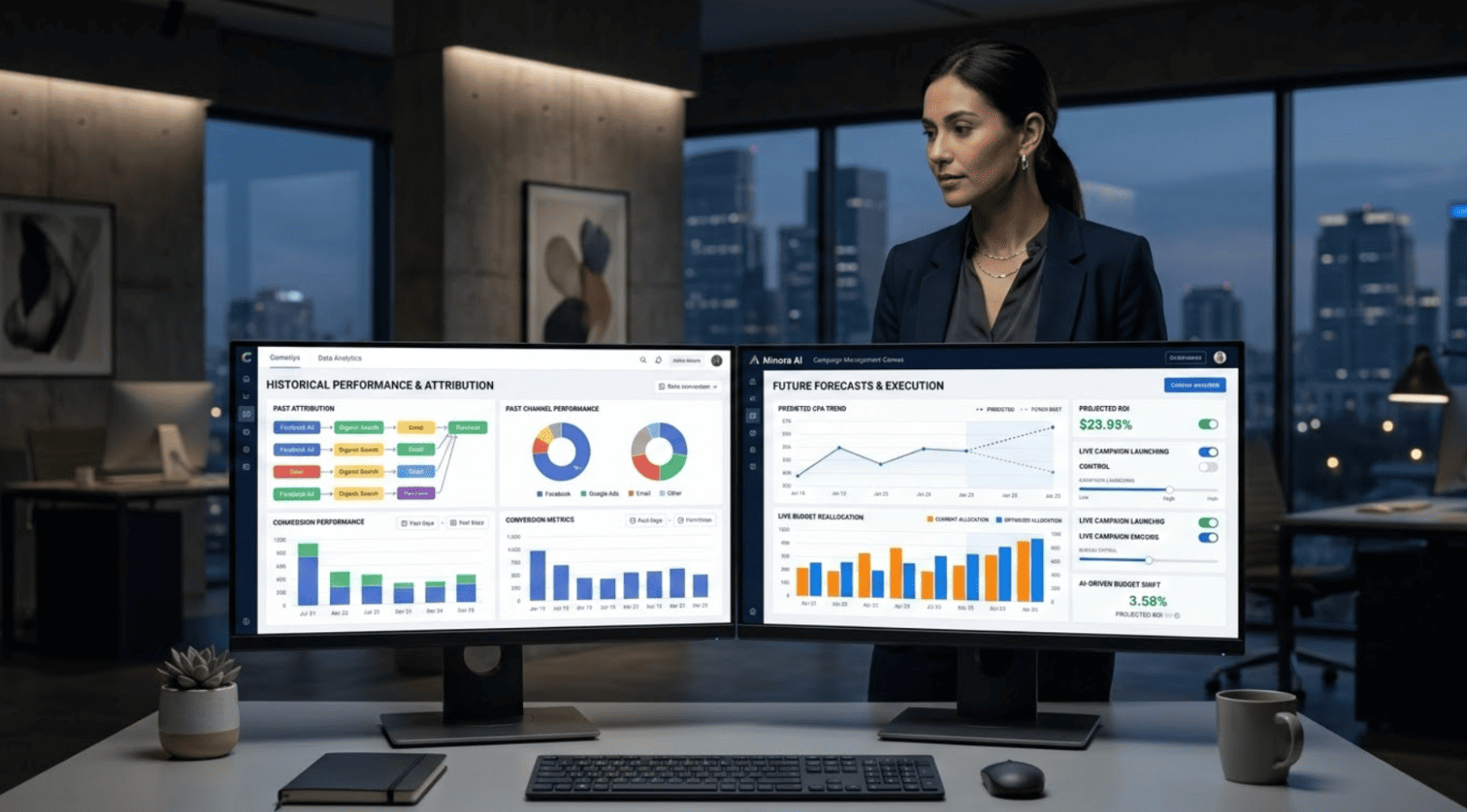
Attribution tells you what worked. It doesn't run the next campaign. Cometly is a capable attribution tool — it tracks conversion paths, measures channel performance, and gives marketing teams cleaner data than most native platform dashboards. What it doesn't do is research your market, forecast your CPA before you spend, deploy campaigns across 450+ channels, or reallocate budget when performance shifts at 2am. Minora AI vs Cometly isn't a close comparison — these tools solve fundamentally different problems. One measures the past. The other operates in real time.
The Attribution-Execution Gap That Costs CMOs Real Money
Attribution is a measurement problem. Execution is an operations problem. Most marketing stacks treat these as adjacent concerns — a attribution tool here, a media buying platform there, a manual process in between. The gap between knowing which channels drove conversions last month and deploying a better campaign next month is still filled by human judgment, briefing cycles, and coordination overhead.
Cometly addresses the measurement problem well. It gives performance marketers accurate, cross-channel attribution data that corrects for the bias built into native platform reporting — Facebook claiming credit for conversions that Google actually drove, for instance. That's genuinely useful. The limitation is scope: Cometly is a reporting and attribution platform, not a campaign execution system. The insight it generates still needs a team to translate it into the next campaign, rebuild the strategy, and relaunch — a process that typically takes 2-4 weeks in enterprise environments.
Minora AI's architecture closes this gap by design. The Research Agent continuously feeds live market and competitor intelligence into the Strategy Personalization Agent, which generates a campaign plan with pre-launch CPA forecasts. When Minora AI's Optimization Agent detects that a channel is underperforming, it reallocates budget immediately — it doesn't generate a report for someone to read next week. The time between signal and action is measured in minutes, not weeks.
💡 Getting attribution data but still spending weeks turning it into a live campaign? Book a strategy call with Minora AI — we work with enterprise marketing teams across Central Asia, MENA, and beyond.
What Each Tool Is Actually Built to Do
The Cometly vs. Minora AI comparison only makes sense with a clear-eyed view of what each tool was designed for. Conflating a measurement platform with a campaign execution platform produces a misleading comparison — which is why most CMOs who evaluate both end up running them for completely different use cases, or discovering that one makes the other redundant.
Cometly's Core Function — Post-Hoc Attribution
Cross-Channel Conversion Tracking
Cometly's primary value is accurate attribution across channels where native platform data is unreliable — Meta, Google, TikTok, and similar ad networks each have algorithmic incentives to overclaim credit for conversions. Cometly applies server-side tracking and multi-touch attribution models to produce a more accurate picture of which channels actually drove revenue. For teams where attribution accuracy directly affects budget allocation decisions, this is a real problem it solves.
Where Cometly's Scope Ends
Cometly reports on what happened. It doesn't forecast what will happen before you spend, and it has no campaign execution capability. Every insight it generates requires a human to translate into a strategic adjustment, rebuild in an ad platform, and relaunch. That translation process is where attribution tools consistently lose their timing advantage — by the time the data is read, interpreted, briefed, and acted on, the market condition that produced the insight has often changed.
Minora AI's Full-Lifecycle Architecture
Research and Pre-Launch Intelligence
Minora AI's Research Agent scans market and competitor context continuously — not as a report you pull, but as a live intelligence feed that informs strategy formation automatically. Before any campaign goes live, the Strategy Personalization Agent generates a media plan with Predictive CPA Modeling, forecasted reach, and ROI projections. You see the expected numbers before committing budget. Cometly cannot produce pre-launch forecasts — it needs past data to report on, which means it can only operate after spend has already occurred.
Omnichannel Launch at Scale
Minora AI's Launch Agent deploys campaigns across 450+ channels in 48 hours, with ICP personalization built into the targeting layer from the first impression. This is the execution layer that attribution tools like Cometly measure the output of — but Cometly plays no role in creating it. For enterprise teams running multi-channel campaigns across diverse digital environments, the difference between a 48-hour autonomous launch and a manual multi-platform setup is 2-4 weeks of staff time per campaign cycle.
Autonomous Budget Reallocation — No Weekly Report Required
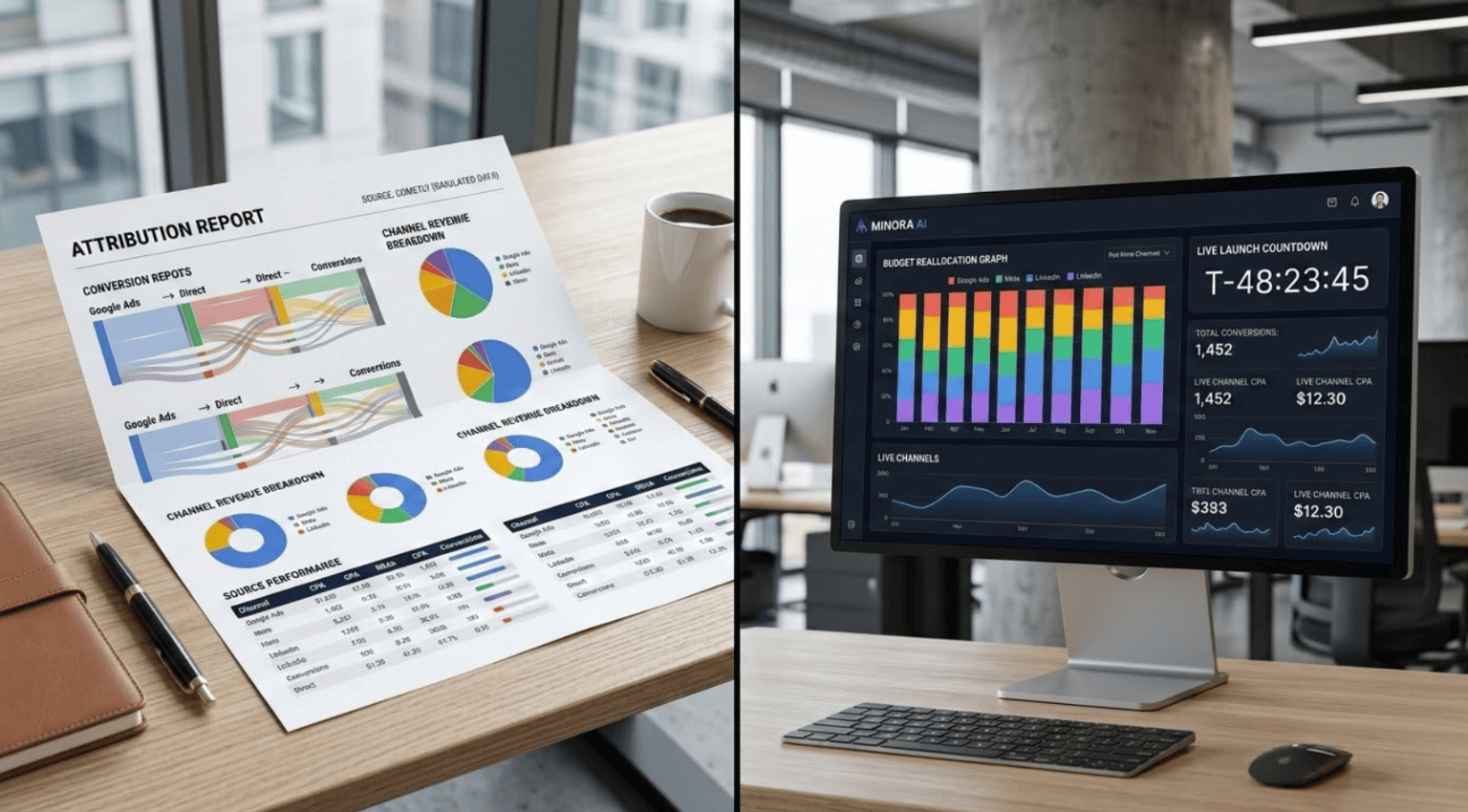
Minora AI's Optimization Agent monitors performance across all active channels 24/7 and reallocates budget to top performers without waiting for a human to review an attribution report. This is the operational model that eliminates "Attribution Blindness" — budget locked in underperforming channels while the team waits for data to accumulate and someone to act on it. Cometly shows you which channels are underperforming. Minora AI moves the money before the next morning's standup.
Performance Outcomes — Where the Difference Becomes Measurable
The most useful lens for this comparison is not feature-by-feature — it's which tool moves the metrics that matter to a CMO. ROAS, CPA, and campaign launch velocity are the numbers that determine whether a quarterly marketing budget was well spent. Attribution accuracy is an input to those decisions. The execution system is where the decisions get made.
KPIs to Track
Time Between Insight and Deployment
In a Cometly workflow, attribution data informs a human decision, which produces a brief, which gets approved, which gets built in ad platforms, which gets launched. That chain runs 2-4 weeks in most enterprise environments. In Minora AI's workflow, the Research Agent generates continuous intelligence, the Strategy Personalization Agent converts it to a plan, and the Launch Agent deploys in 48 hours. The insight-to-deployment gap shrinks from weeks to hours.
Pre-Launch CPA Accuracy
Cometly operates entirely on post-launch data — it cannot forecast CPA before spend is committed. Minora AI's Strategy Personalization Agent generates pre-launch CPA forecasts from a model trained on $30M+ in real ad spend outcomes. For enterprise teams with quarterly budget cycles and board-level accountability on performance marketing ROI, the difference between committing spend based on a data-backed forecast vs. post-hoc measurement is material.
Budget Efficiency — Continuous vs. Periodic Optimization
Cometly identifies that a channel underperformed — typically in a dashboard you review weekly. Minora AI's Optimization Agent identifies the same signal and reallocates budget in real time, 24/7. Based on Minora AI's performance data, continuous autonomous optimization delivers approximately +20% ROAS improvement over manual cycles. The gain is entirely in response speed — the Optimization Agent acts on the same signals a weekly attribution review would eventually surface, just immediately.
How Minora AI Reports on These Metrics
Minora AI's reporting layer doesn't separate from its execution layer. The Strategy Personalization Agent's pre-launch CPA forecast appears alongside post-launch actuals in the same dashboard — so you can evaluate forecast accuracy continuously, not just campaign performance in isolation. The Optimization Agent's reallocation decisions are visible in real time, channel by channel, with before/after budget allocation logged automatically. For teams coming from a Cometly workflow, this replaces the weekly attribution review with a live system that acts on performance data without waiting for human review.
The Right Tool for the Right Problem
Cometly is a good attribution tool. If your primary need is accurate cross-channel conversion tracking and you already have a complete, working execution stack — research, strategy, launch, and optimization all covered by other systems — Cometly improves the measurement layer. The problem is that the execution stack it assumes exists is exactly what most marketing teams are still coordinating manually. Minora AI covers that stack autonomously: research, strategy with pre-launch forecasting, omnichannel launch in 48 hours, and continuous budget optimization — without the weekly attribution review cycle in between. For CMOs who want measurement, Minora AI's dashboard delivers it. For CMOs who want their next campaign deployed, optimized, and reporting in under 60 days of break-even, Cometly doesn't get them there on its own.
Ready for a system that runs campaigns — not just measures them? Minora AI's four agents handle the full lifecycle from market research to live omnichannel deployment to 24/7 autonomous budget optimization. Your attribution data becomes action in 48 hours, not next quarter's briefing cycle.
FAQ
Q1: What is the core difference between Minora AI and Cometly? A: Cometly is a cross-channel attribution platform — it tracks conversion paths and gives marketers cleaner measurement data than native platform dashboards. Minora AI is an autonomous campaign execution platform — it conducts market research, generates pre-launch CPA forecasts, deploys campaigns across 450+ channels in 48 hours, and reallocates budget in real time 24/7. Cometly measures campaigns after they run. Minora AI runs them.
Q2: Is Cometly a good tool for performance marketing teams? A: For teams where attribution accuracy directly determines budget allocation — particularly those running multi-touch campaigns where native platform reporting overclaims credit — Cometly solves a real problem. The limitation is scope: it operates entirely on historical data and has no campaign execution capability. Every insight it generates still needs a human to convert into a strategic action, rebuild in ad platforms, and relaunch.
Q3: Can Minora AI replace Cometly for attribution needs? A: Minora AI's reporting layer provides live CPA actuals vs. pre-launch forecasts, ROAS by channel, and real-time budget allocation data — which covers the strategic attribution questions most CMOs actually need answered. For granular cross-channel multi-touch attribution modeling, Cometly's methodology is more specialized. Teams that switch fully to Minora AI typically find its integrated reporting covers the decisions they were using Cometly to inform, while also automating the execution those decisions would trigger.
Q4: What is "attribution blindness" in performance marketing? A: Attribution blindness is what happens when budget stays allocated to underperforming channels because the team is waiting for attribution data to accumulate, get reviewed, and trigger a strategic response. The delay between performance signal and budget action — typically 7-14 days in a weekly attribution review cycle — means money continues burning in bad placements. Minora AI's Optimization Agent eliminates this by reallocating budget in real time, without waiting for a human review cycle.
Q5: How does Minora AI's Predictive CPA Modeling differ from Cometly's attribution reporting? A: Cometly's attribution data is backward-looking — it tells you what CPA was achieved on past campaigns by channel. Minora AI's Strategy Personalization Agent generates CPA forecasts before any budget is committed, trained on $30M+ in real ad spend performance data. Pre-launch forecasting and post-launch attribution measure different things: one informs budget commitment decisions, the other explains results after the fact.
Q6: How does Minora AI handle the multi-channel launch that Cometly measures the output of? A: Minora AI's Launch Agent deploys campaigns across 450+ channels from a unified interface in 48 hours, with ICP personalization built into the targeting layer from the first impression. Cometly has no launch capability — it connects to campaigns that already exist and measures their performance. The execution step between deciding on a channel strategy and having live campaigns running is entirely manual in a Cometly-only workflow.
Q7: What does "full campaign lifecycle" mean in the context of AI marketing platforms? A: Full campaign lifecycle covers every phase from pre-launch intelligence to live deployment to ongoing optimization: market research, competitive positioning, CPA forecasting, omnichannel launch, and continuous budget reallocation. Cometly covers one phase — post-launch measurement. Minora AI's four agents (Research, Strategy Personalization, Launch, Optimization) cover the entire chain autonomously, without requiring human handoffs between stages.
Q8: Why does real-time budget reallocation matter more than weekly attribution reporting? A: Campaign performance shifts continuously — by day, by hour, and by channel. A weekly attribution report tells you what happened after the budget has already burned. Minora AI's Optimization Agent acts on the same performance signals immediately, reallocating budget to top performers 24/7 across 450+ channels. Based on Minora AI's performance data, this continuous approach delivers approximately +20% ROAS improvement over manual weekly optimization cycles.
Q9: What is the onboarding timeline for Minora AI compared to a Cometly implementation? A: Minora AI's onboarding sequence moves from data integration and team access (approximately 1 minute) to first AI market scan and strategy generation (approximately 30 minutes) to pilot campaign launch (48 hours) to full algorithmic optimization active (48 hours and beyond). Cometly's implementation typically involves connecting ad platforms, configuring attribution windows, and validating tracking — a process that also runs a few days to weeks but produces measurement capability rather than deployed campaigns.
Q10: What should a CMO ask when choosing between a campaign execution platform and an attribution tool? A: The question is which bottleneck is actually limiting performance. If your campaigns are running well and you lack confidence in how credit is being attributed across channels, an attribution tool like Cometly addresses that. If your primary constraint is how long it takes to get from market intelligence to live campaign — or how slowly your budget responds to performance signals — an autonomous execution platform like Minora AI addresses a more expensive problem. For most enterprise CMOs, the execution bottleneck costs more in lost ROAS than attribution inaccuracy.
