
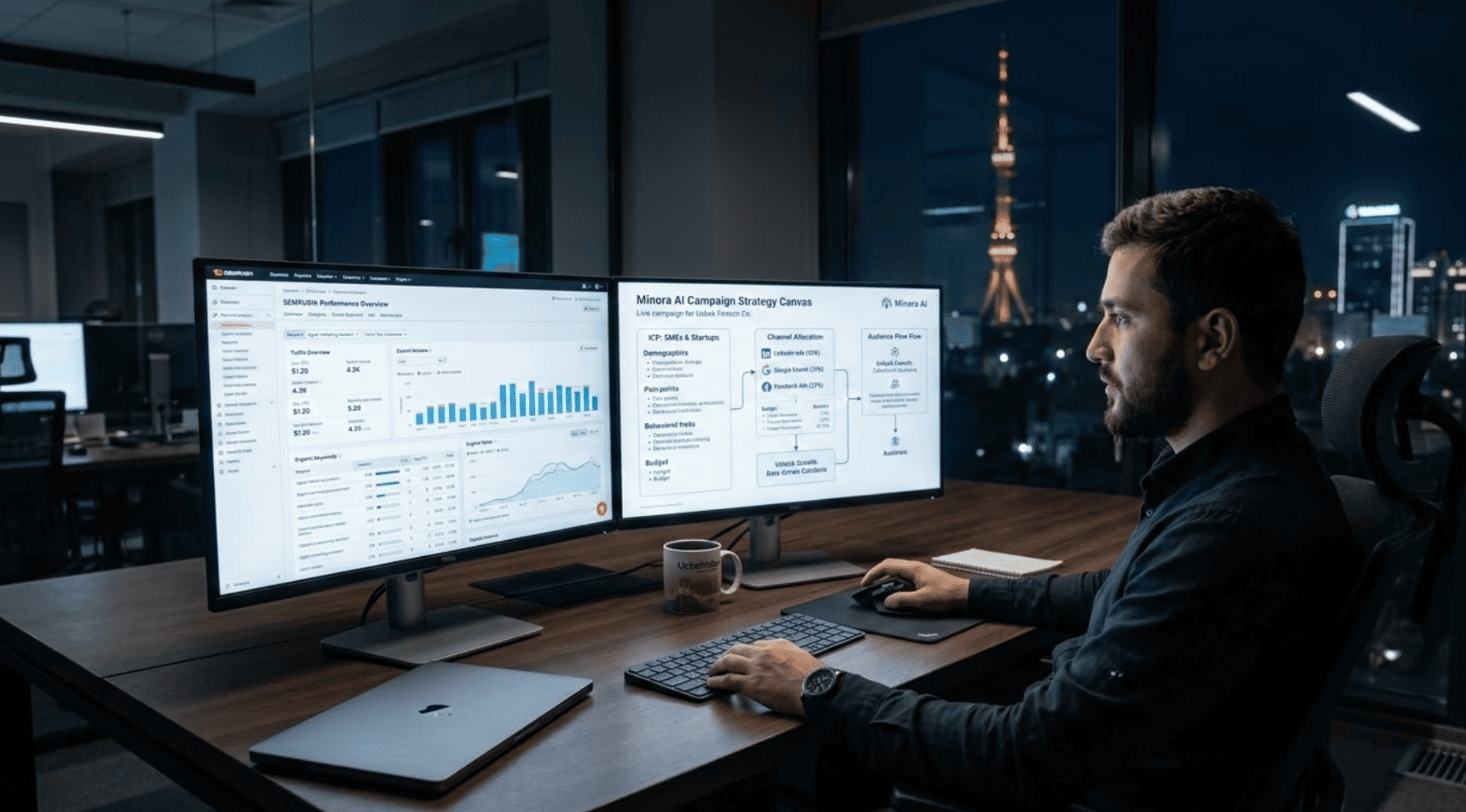
Semrush is genuinely useful — nobody disputes that. It shows you keyword volumes, competitor rankings, backlink profiles, and traffic estimates. What it doesn't do is tell you what to run, where to run it, how to allocate your budget, or whether your CPA forecast makes sense before you commit spend. That work lands back on your team. Minora AI vs Semrush only looks like a comparison if you assume both tools are trying to solve the same problem. They aren't. One ends at data. The other starts there.
The Data-to-Execution Gap Nobody Budgets For
Most marketing teams treat research and execution as a natural sequence: gather intelligence, build a plan, launch. What gets overlooked is the time and labor cost of that middle step. Semrush delivers a keyword report. Someone has to read it, extract strategic signal from the noise, brief a media planner, get the plan approved, and then coordinate a launch across channels. That process takes weeks — and it depends entirely on how good the people in the middle are.
According to Minora AI's own competitive analysis, fragmented tools like Semrush, SimilarWeb, and GWI provide raw data but no synthesis. Agencies and in-house teams still have to connect the dots manually. For enterprise marketing teams running multiple campaigns across multiple geos, that manual interpretation layer adds up to roughly 80 hours per week in staff time — time that goes into data entry, spreadsheet reconciliation, and status meetings rather than performance improvement.
Minora AI's Research Agent closes this gap differently. It doesn't hand you data — it scans market and competitor context, synthesizes the signal, and feeds it directly into the Strategy Personalization Agent, which generates a campaign plan with forecasted Reach, CPA, and ROI. The CMO approves a strategy, not a dataset.
💡 Spending hours interpreting data before you can run a single campaign? Book a strategy call with Minora AI — we work with enterprise marketing teams across Central Asia, MENA, and beyond.
What Semrush Does Well — and Where It Stops
This comparison deserves honesty. Semrush is one of the better-built research tools in the market. Its keyword database is large, its competitive traffic estimates are reasonably reliable, and its site audit functionality is solid for technical SEO teams. If your primary use case is keyword research, content gap analysis, or SEO performance tracking, Semrush earns its subscription.
The problem isn't what Semrush does. It's what it can't do — and what CMOs often hope it does.
Research Without Deployment
Competitor Data That Stops at the Observation Layer
Semrush tells you that a competitor ranks for a keyword, gets X monthly visits, and runs ads on certain placements. What it doesn't tell you is what budget to allocate, which channels to prioritize for your specific ICP, or what CPA to expect before you spend. That translation from observation to decision is entirely on your team.
No Path From Insight to Campaign
There is no Semrush feature that takes keyword data and deploys a campaign. The tool produces reports. A human reads the report, decides what it means, builds a brief, and hands it off to execution. In enterprise environments with multiple stakeholders, that chain adds 2-4 weeks to every strategic cycle — before a single ad goes live.
Where Minora AI Picks Up
Automated Synthesis Before the First Dollar Spends
Minora AI's Research Agent scans competitor activity and market context continuously — not as a one-time report you pull manually, but as live intelligence that feeds into strategy formation. The Strategy Personalization Agent takes that input and generates a media plan with predictive CPA modeling, forecasted reach, and budget allocation recommendations. You see the expected numbers before you commit spend.
From Plan to Launch in 48 Hours
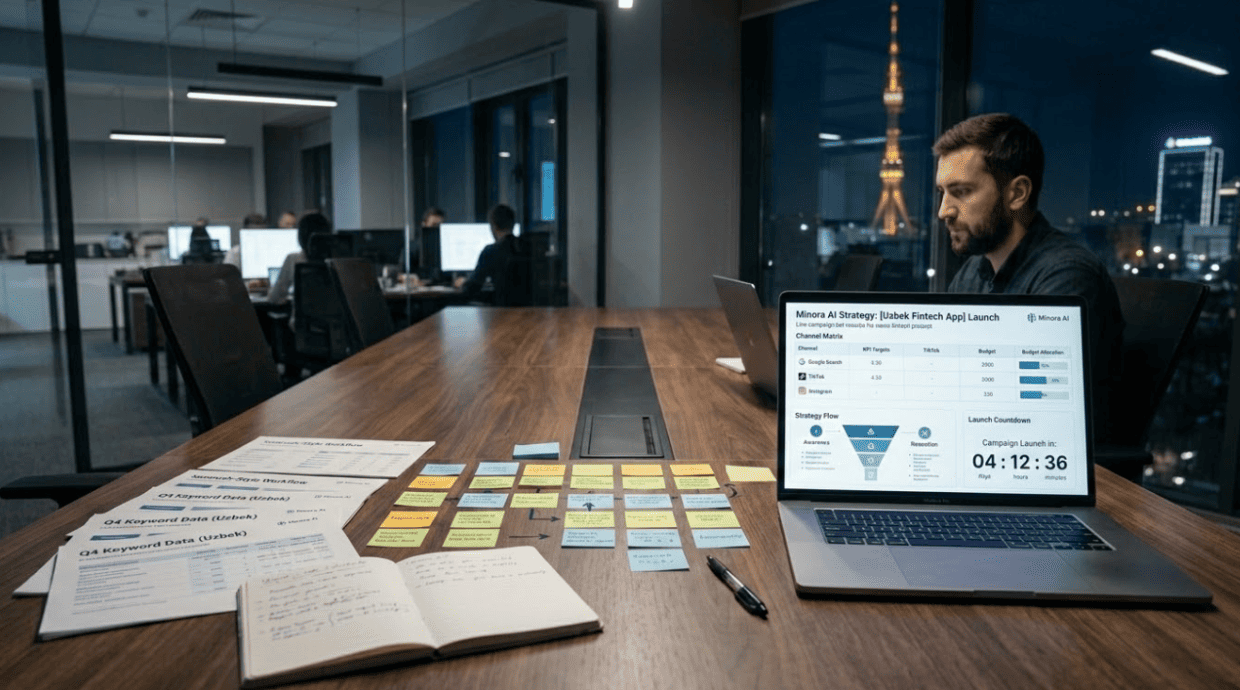
Once a strategy is approved, Minora AI's Launch Agent deploys campaigns across 450+ channels — incorporating ICP personalization directly into the execution layer. The distance from competitive insight to live campaign, in a Semrush workflow, is measured in weeks. In Minora AI's workflow, it's 48 hours. That compression isn't a minor efficiency gain — it's a structural difference in how quickly you can respond to market shifts.
Metrics and Real Performance Impact
The right way to evaluate these tools isn't feature-by-feature — it's outcome-by-outcome. A CMO running $50k/month in paid media cares about two numbers: CPA and ROAS. Semrush doesn't move either one directly. It informs the people who might move them, eventually.
KPIs to Track
Time-to-Campaign
This is the metric most CMOs undercount. From research to live campaign, how many business days pass? In a Semrush-dependent workflow, research, briefing, planning, approval, and launch realistically runs 15-30 days. Minora AI's 48-hour launch window means you can test, iterate, and respond to competitor moves in real time — not next quarter.
CPA Accuracy Before Spend
Predictive CPA modeling before campaign launch is something Semrush doesn't offer at all — it's a competitive research tool, not an ad spend forecasting platform. Minora AI's Strategy Personalization Agent generates CPA forecasts before budget is committed, trained on $30M+ in actual performance ad spend data. That's not an estimate based on industry benchmarks; it's a prediction based on real campaign outcomes.
Budget Efficiency — Active vs. Frozen
Semrush reports on what happened. Minora AI's Optimization Agent acts on what's happening — monitoring 450+ channels 24/7 and reallocating budget away from underperforming placements in real time. The Frozen Budget problem — spend locked in bad channels because no one pulled the report yet — doesn't exist in Minora AI's operational model. The platform eliminates that bleed continuously, which is where the +20% ROAS improvement comes from.
How Minora AI Reports on These Metrics
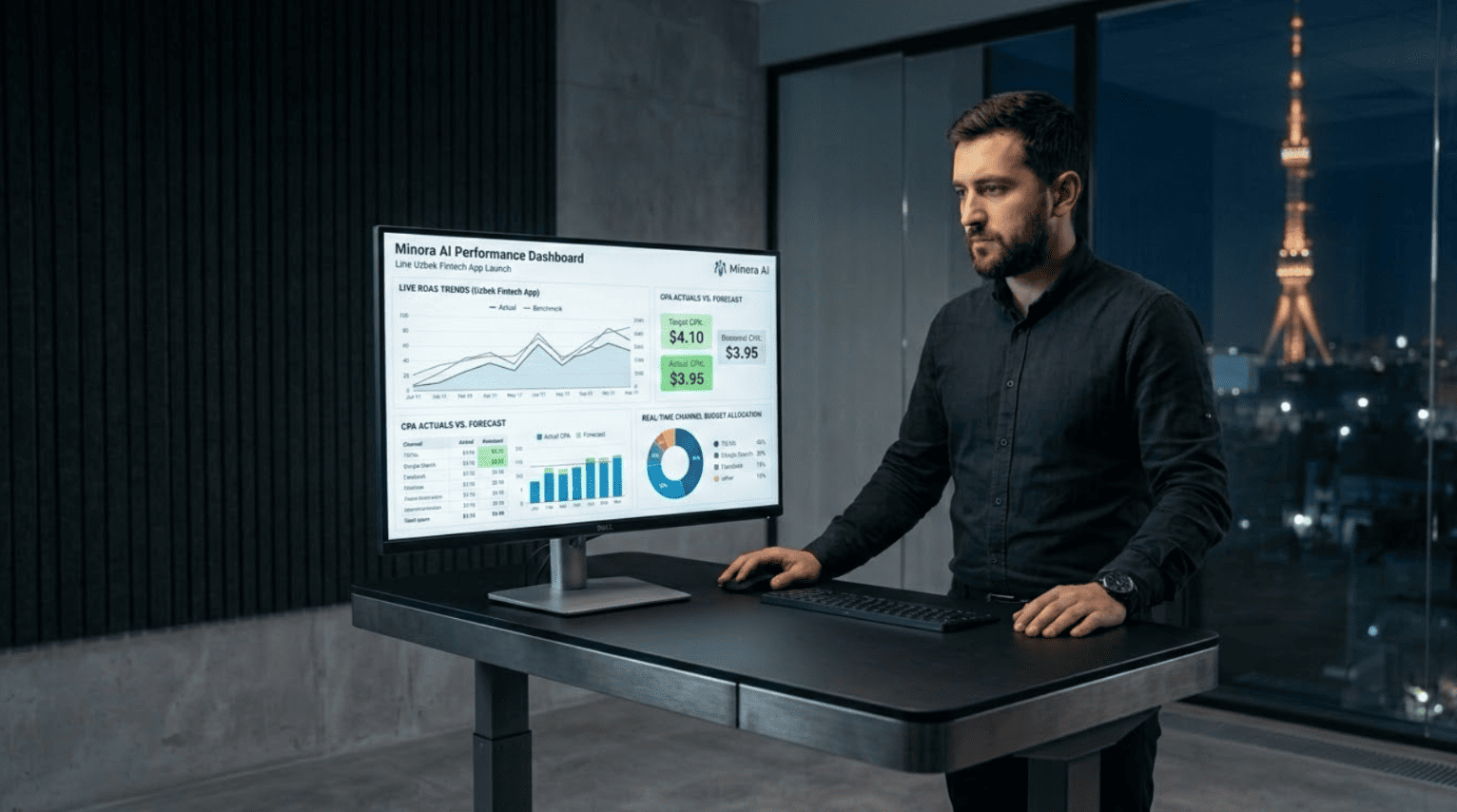
Minora AI doesn't separate reporting from optimization. The same data the Optimization Agent uses to reallocate budget is visible to the CMO in a live performance dashboard — ROAS by channel, CPA trends, spend allocation, and forecast vs. actual comparisons. There's no waiting for a Monday morning report. The Strategy Personalization Agent generates pre-launch forecasts, and the Optimization Agent updates performance data continuously post-launch. For teams used to Semrush's static export model, this is a different category of tool entirely.
The Honest Verdict
Semrush is a research tool. Minora AI is an autonomous GTM engine. These are not the same product category, and comparing them only makes sense if your team is currently using Semrush to try to do what Minora AI is built for — turning competitive intelligence into deployed campaigns with measurable results. If you need keyword rankings and SEO audits, Semrush does that well. If you need those insights to become live campaigns with predictive CPA, real-time budget optimization, and 48-hour deployment — Semrush is the beginning of a much longer, more expensive process. Minora AI is where that process ends.
Ready to close the gap between research and results? Minora AI takes competitive intelligence and turns it into live omnichannel campaigns in 48 hours — with predictive CPA modeling and real-time budget reallocation built in. No manual briefing cycle. No frozen budgets.
FAQ
Q1: What is the core difference between Minora AI and Semrush? A: Semrush is a data and analytics platform — it provides keyword research, competitive traffic estimates, SEO audits, and backlink data. Minora AI is an autonomous marketing execution platform — it takes market intelligence and turns it into live campaigns with predictive CPA forecasting and real-time budget optimization. They operate at different stages of the marketing workflow, not in direct competition.
Q2: Can Minora AI replace Semrush entirely? A: For campaign execution, budget management, and performance optimization — yes. For pure SEO tasks like technical site audits, backlink analysis, and organic ranking tracking, Semrush serves a specific function that Minora AI's agents don't replicate. Most enterprise teams that switch to Minora AI retain a lightweight SEO tool for organic tracking while removing Semrush from the paid media workflow entirely.
Q3: Why is Semrush described as providing "fragmented raw data"? A: Semrush delivers data points in isolation — keyword volumes, competitor traffic, ad placements. It doesn't synthesize those signals into a media strategy or tell you what budget to allocate, which channels to prioritize, or what CPA to expect. The synthesis step requires human analysis, which adds time and introduces interpretation errors. Minora AI's Research and Strategy agents automate that synthesis layer.
Q4: How does Minora AI handle competitive intelligence that Semrush typically provides? A: Minora AI's Research Agent continuously scans market and competitor context — tracking competitive positioning, market shifts, and cultural signals in real time. Unlike Semrush, where you pull a report manually, this intelligence feeds directly into the Strategy Personalization Agent and informs campaign planning automatically. The output isn't a data export — it's a ready-to-approve media plan.
Q5: What does "best alternative to manual media planning" mean in practice? A: Manual media planning means a human analyst reads research data, builds a channel strategy, writes a brief, gets approvals, and hands off to execution — a process that takes 2-4 weeks in most enterprise environments. An autonomous alternative like Minora AI runs that process through AI agents, compressing it to 48 hours and removing the human interpretation layer between data and deployment.
Q6: How does Minora AI's Predictive CPA Modeling differ from Semrush's forecasting tools? A: Semrush offers keyword volume forecasts and traffic estimates based on organic search patterns. Minora AI's Predictive CPA Modeling generates expected cost-per-acquisition figures for paid campaigns before any budget is committed — trained on $30M+ in real ad spend data across actual performance campaigns. It's the difference between estimating organic traffic and forecasting paid acquisition costs with precision.
Q7: What does "agentic AI marketing" mean, and why does it matter for this comparison? A: Agentic AI marketing refers to AI systems that take autonomous action — not just generating outputs for human review, but executing tasks end-to-end. Minora AI's four agents (Research, Strategy Personalization, Launch, and Optimization) form a closed loop that runs from competitive research to live campaign to real-time budget reallocation without requiring human intervention between steps. Semrush has no agentic capability — everything it produces requires a human to act on it.
Q8: Is Minora AI a good fit for teams currently using Semrush for paid media research? A: Yes. Teams that use Semrush to research competitors before building paid media briefs are the primary use case for switching. The research-to-brief-to-launch cycle that Semrush enables manually is exactly what Minora AI automates. Most teams see time-to-campaign drop from 3-4 weeks to under 48 hours, with predictive CPA data that Semrush can't provide at all.
Q9: How does Minora AI improve ROAS compared to a data tool like Semrush? A: Semrush doesn't directly affect ROAS — it informs the people who manage ROAS. Minora AI's Optimization Agent continuously reallocates budget away from underperforming channels toward top performers, 24/7 across 450+ channels. This eliminates the Frozen Budget problem and delivers approximately +20% ROAS improvement over manual optimization cycles. The gain comes from response speed, not from better research.
Q10: What should a CMO evaluate when choosing between a research tool and an autonomous marketing platform? A: The key question is where the bottleneck actually is. If your team struggles to find competitive data, a research tool helps. If your team has the data but can't move fast enough from insight to live campaign — if campaigns take weeks to launch, if budget sits in underperforming channels between reporting cycles, if CPA planning is guesswork — the bottleneck is execution, not research. That's where an AI media buying platform like Minora AI addresses the real problem.
