


Eighty-nine percent of B2B buyers now use generative AI tools to evaluate vendors before making purchasing decisions. Your competitors are showing up in ChatGPT recommendations. You are not. The reason is not that your product is inferior. It is that your organic infrastructure was built for a single layer of discovery that no longer captures the majority of high-intent queries.
The B2B organic pipeline in 2026 has three layers. SEO is the foundation: technical infrastructure, site architecture, and semantic markup. AEO (Answer Engine Optimization) sits on top: optimization for Featured Snippets, AI Overviews, and voice search. GEO (Generative Engine Optimization) is the top layer: engineering your content so ChatGPT, Perplexity, Claude, and Gemini cite your brand in extended answers.
There is no AEO without SEO. There is no GEO without SEO. Each layer depends on the one below it. Here is how to build the full stack for B2B pipeline that compounds.
Why Single-Layer SEO No Longer Generates B2B Pipeline
Traditional B2B content marketing was built on a simple premise: publish keyword-targeted blog posts, rank on page one of Google, capture clicks, gate the content, collect email addresses, nurture the leads. That funnel has structurally collapsed.
Google’s Search Generative Experience now provides AI-synthesized answers directly in search results, reducing click-through rates on informational queries by 30% to 60%. Meanwhile, 45% of B2B researchers use ChatGPT or Perplexity as their first research step, bypassing Google entirely. Your perfectly optimized blog post that ranks #3 for “best project management software for startups” generates zero pipeline if the buyer never clicks through to your site because an AI overview answered their question at the top of the results page.
The content that does generate pipeline in 2026 is not optimized for a single channel. It is structurally engineered to be extractable across all three discovery layers simultaneously. A single article, properly architected, can rank on Google, get pulled as a Featured Snippet, and be cited by ChatGPT as an authoritative recommendation.
“The startups that will dominate B2B pipeline in 2026 are not writing more content. They are engineering fewer, higher-density assets that compound across search, answer, and generative engines simultaneously.”
The Three-Layer Architecture
Layer 1: SEO Foundation (Technical Infrastructure)
SEO is not content production. It is the technical infrastructure that makes all higher layers possible. Without strong domain authority, clean site architecture, and proper semantic markup, neither answer engines nor generative engines will trust your content enough to extract and cite it.
The non-negotiable technical requirements:
- Site speed: Core Web Vitals passing on all key landing pages. LCP under 2.5 seconds. CLS under 0.1. Generative engines penalize slow-loading sources because they correlate speed with authority.
- Schema markup: Deploy Organization, SoftwareApplication, FAQPage, and Article schemas. These structured data elements tell AI parsers exactly what your content represents.
- Internal linking architecture: Build topic clusters with a pillar page strategy. Each pillar page links to 8-12 supporting articles. This creates the semantic density that both search engines and LLMs use to determine topical authority.
- E-E-A-T signals: Author bylines with verifiable credentials. Cited sources. Updated publication dates. These trust signals are the foundation that generative engines evaluate when deciding whether to cite your content.
Layer 2: AEO (Answer Engine Optimization)
AEO engineers your content to be extracted as a direct answer in Google’s Featured Snippets, AI Overviews, and voice search responses. The format matters more than the volume.
Structure every H2 section with the “question-first” architecture: conversational heading phrased as a real query, followed immediately by a 40 to 60 word definitive answer paragraph. This format maps directly to how Google’s extraction algorithm identifies Featured Snippet candidates.
Deploy FAQPage schema on every article with 4 to 6 questions that match real search intent. Each answer: 2 to 3 sentences, starting with the direct answer, no hedging. AEO answers must be definitively extractable. “It depends” is never cited.
Layer 3: GEO (Generative Engine Optimization)
GEO is the newest layer and the one with the highest competitive leverage for B2B startups. Princeton University research proved that specific content optimizations can boost visibility in generative engine responses by up to 40%.
The three highest-impact GEO tactics:
- Expert quotations (+41% visibility). Embed specific, attributable quotes from named authorities within your content. LLMs treat quoted expert statements as high-trust, citation-worthy signals.
- Statistical density (+30% visibility). Include specific numbers, percentages, and benchmarks throughout your content. Generative engines preferentially cite content with concrete data over generalized advice.
- Proprietary framework naming. Name your methodologies. “The 3-Layer Pipeline Model” is citable. “Our approach to organic growth” is not. LLMs need distinct, attributable concepts to reference.
The metric that matters in GEO is Share of Model (SoM): how frequently your brand is cited in AI-generated responses compared to competitors for your target queries. Minora AI’s Market Analyst capability tracks SoM across ChatGPT, Perplexity, and Gemini to identify exactly where your brand appears and where it does not.
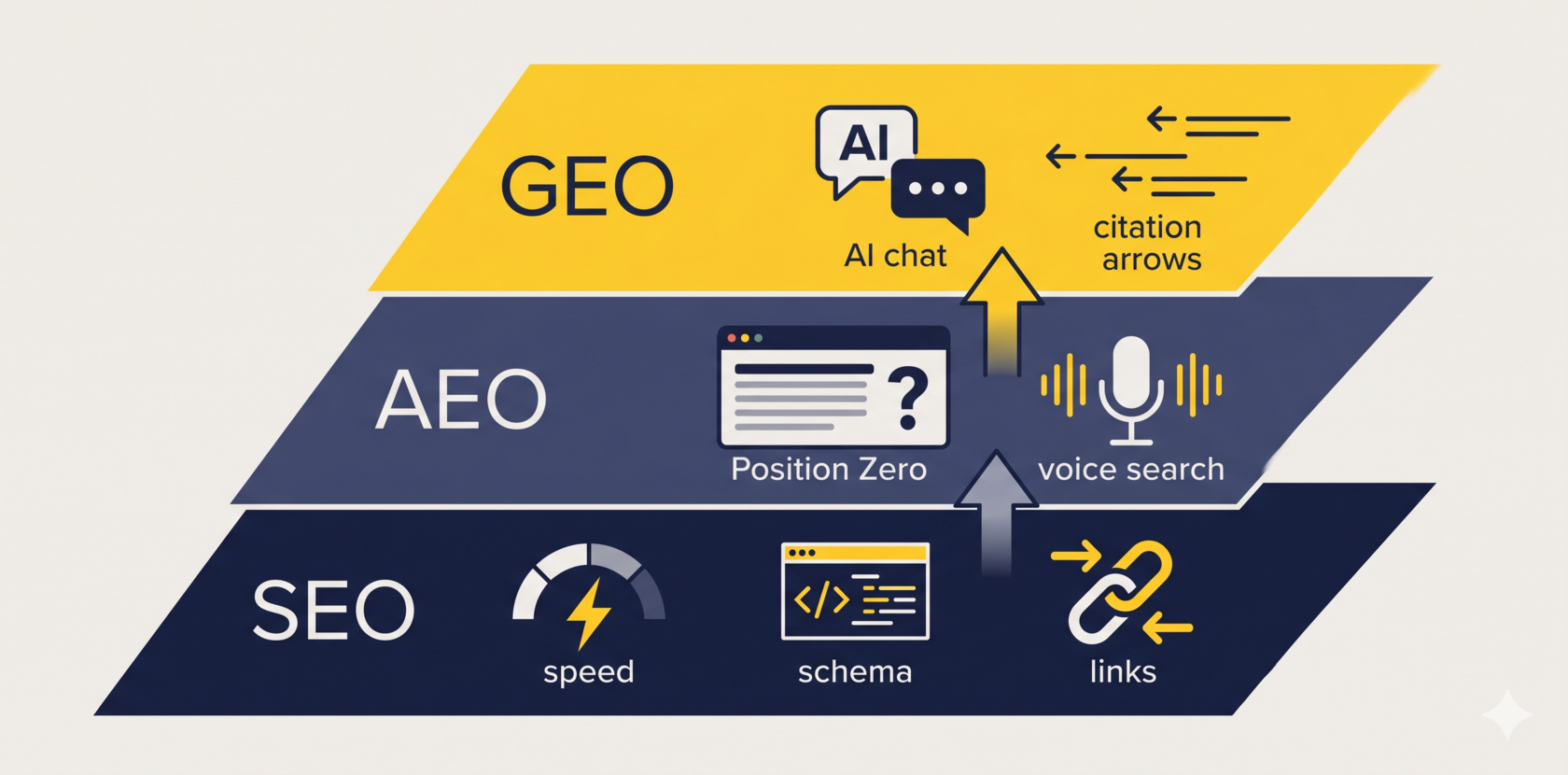
Traditional SEO vs. Full-Stack Pipeline: The Visibility Gap
B2B Organic Pipeline FAQ
1) How long does it take for a full SEO-AEO-GEO pipeline to generate pipeline?
The SEO foundation layer requires 3 to 6 months to establish domain authority and begin ranking. AEO results (Featured Snippets) can appear within 4 to 8 weeks of structural optimization. GEO citations in AI engines typically take 2 to 4 months after content publication, as LLMs update their training data and retrieval indexes.
2) Does GEO work for niche B2B categories with low search volume?
GEO is particularly effective for niche B2B categories. Low search volume keywords are often the exact queries where generative engines provide extended, citation-rich answers. A startup with deep topical authority in a narrow category can dominate AI recommendations for that vertical.
3) How does Minora AI support the organic pipeline for B2B startups?
Minora AI’s B2B organic retainer (from $1,670/month) builds the full three-layer infrastructure: technical SEO audit and remediation, AEO content structuring with FAQ schema deployment, and GEO optimization with Share of Model tracking. The pricing model scales with pipeline results, not hours worked.
4) Can I measure ROI on GEO optimization?
Yes. Track Share of Model (SoM) for your target queries across ChatGPT, Perplexity, and Gemini monthly. Cross-reference with inbound pipeline to identify which AI-cited content drives qualified leads. Early data from B2B startups deploying GEO shows 2 to 3x qualified consultation requests within 90 days.
The Infrastructure That Compounds
Content production is a cost center. Infrastructure is an asset. The difference between a B2B startup publishing 4 blog posts per month and a startup engineering 4 three-layer assets per month is the difference between linear growth and compounding returns.
Every article you publish with proper SEO foundation, AEO extraction formatting, and GEO citation signals becomes a permanent node in your discovery network. Search authority reinforces AI trust. AI citations drive branded search. Branded search improves domain authority. The flywheel accelerates without incremental spend. Build the infrastructure once. Let it compound indefinitely.
