

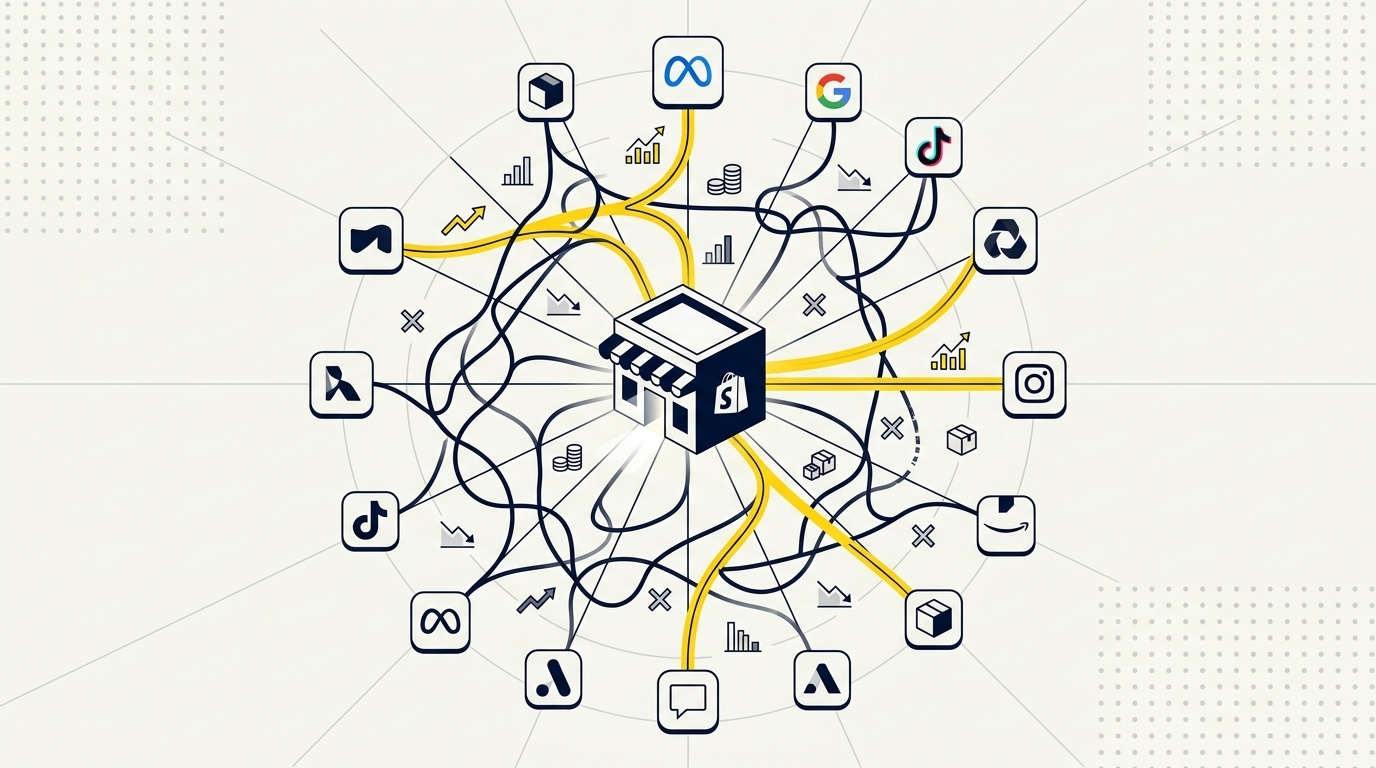
Customer acquisition costs surged 60% over the last decade. The D2C playbook built on cheap digital inventory and venture-subsidized “growth at all costs” is fundamentally broken. Today, an LTV:CAC ratio below 3:1 means you are burning capital to acquire transient, unprofitable cohorts.
The culprit isn’t just rising CPMs. It’s attribution blindness.
Since the rollout of aggressive privacy protocols like iOS 14.5 and Intelligent Tracking Prevention (ITP), brands have lost an estimated 42% of trackable display conversions and 38% of social conversions. When you lose signal fidelity, your proprietary acquisition algorithms operate blindly. You end up relying on last-click attribution, which systematically overvalues bottom-of-funnel channels and falsely penalizes the awareness campaigns actually driving your demand.
Here’s what brands getting this right do differently. They rebuild their data moat. They transition aggressively to server-side tracking architectures. They abandon human-defined heuristics and deploy AI-driven multi-touch attribution models to calculate the fractional impact of every single touchpoint.
This guide details exactly how to implement server-side tracking, leverage predictive ROI modeling, and deploy agentic AI to scale your D2C brand profitably.
The Great Recalibration and the Failure of Last-Click
The industry has entered the “Great Recalibration.” The executive mandate has shifted from GMV expansion to rigorous profitability and Free Cash Flow generation.
In this paradigm, last-click attribution is a liability. It assigns 100% of the conversion credit to the final touchpoint preceding a transaction. This creates a self-destructive feedback loop: brands cut their awareness spend because the dashboards present those channels as inefficient. Top-of-funnel intent generation gets choked off, the pipeline dries up, and acquisition costs spiral out of control.
“The companies most heavily utilizing AI tools are the ones most frequently burned by bad data. Scaling AI on an unstable data foundation exponentially scales financial risk.”
Fixing the Data Foundation
To scale sustainably, you must establish an architecture capable of surviving 2026’s regulatory environment.
The Server-Side Tracking Imperative
Client-side tags that execute vulnerable scripts within the user’s browser are obsolete. Server-side tracking processes event data within a secure, brand-controlled server environment before routing it to analytics platforms.
By bypassing browser restrictions and ad blockers, server-side setups recover an average of 20% to 40% of previously missing conversion data. First-party cookie durations, which are limited to 7 days under ITP, are extended to 90–400 days. This provides the uncontaminated data your AI algorithms require to optimize bidding strategies effectively.
AI-Driven Multi-Touch Attribution (MTA)
With high-fidelity data secured, AI resolves the multi-touch attribution problem. Sophisticated machine learning algorithms analyze thousands of converting and non-converting consumer paths.
Utilizing Shapley values and Markov chains, these models identify specific touchpoints that correlate statistically with purchase intent. They dynamically assign fractional credit to every interaction, determining the true incremental lift of a campaign. Organizations utilizing these real-time systems make strategic financial decisions five times faster than competitors relying on manual spreadsheets.
Predictive ROI Modeling
Resolving historical measurement is just the baseline. Scaling requires forecasting outcomes before capital is deployed.
Predictive Cost Per Acquisition (CPA) modeling has fundamentally altered media buying strategy. By utilizing robust propensity modeling, brands identify anonymous website visitors who exhibit behavioral footprints identical to historically high-LTV cohorts. Autonomous agents then instantly reallocate advertising budgets toward these specific high-propensity users.
Evaluating AI Attribution Infrastructure
The attribution software market has stratified to serve specific business models.
D2C AI Attribution FAQ
1) Why is last-click attribution considered inaccurate in 2026?
Last-click attribution systematically assigns 100% of the conversion credit to the final interaction, which fails to reflect modern multi-device consumer behavior. It drastically undervalues top-of-funnel awareness channels like paid social and influencer integrations, causing brands to cut spending on the exact channels driving their pipeline.
2) What is the financial benefit of migrating to server-side tracking?
Server-side setups bypass browser restrictions and consumer ad blockers, typically recovering 20% to 40% of lost conversion data. This high-fidelity data trains advertising algorithms (like Meta’s Advantage+) faster, drastically reducing wasted spend and lowering your overall Cost Per Acquisition.
3) How does predictive CPA modeling change media buying?
Instead of reacting to past performance, predictive models analyze historical and behavioral data to forecast the expected CPA of a cohort before capital is deployed. Autonomous agents use this data to dynamically reallocate budgets in real-time toward high-propensity users.
4) How does Minora AI use attribution data?
Minora operates as a Level 5 autonomous execution layer. It doesn’t just display attribution data on a dashboard; it acts on it. Using predictive CPA modeling, it autonomously shifts your budget across Meta, Google, and TikTok 24/7 to maintain your target CAC.
Retaining Customers in an Agentic Era
Scaling a brand in 2026 requires an unprecedented synthesis of data engineering and financial discipline. The complete collapse of traditional third-party tracking necessitates an immediate migration to server-side infrastructure. From this secure foundation, AI-driven multi-touch attribution models accurately illuminate the fragmented consumer journey.
The victors in this landscape will not simply be the entities that deploy the highest volume of AI. They will be the organizations that wield AI to engineer flawless operational efficiency, predicting demand and reallocating capital with surgical precision, while remaining fiercely dedicated to authentic consumer experiences.
