

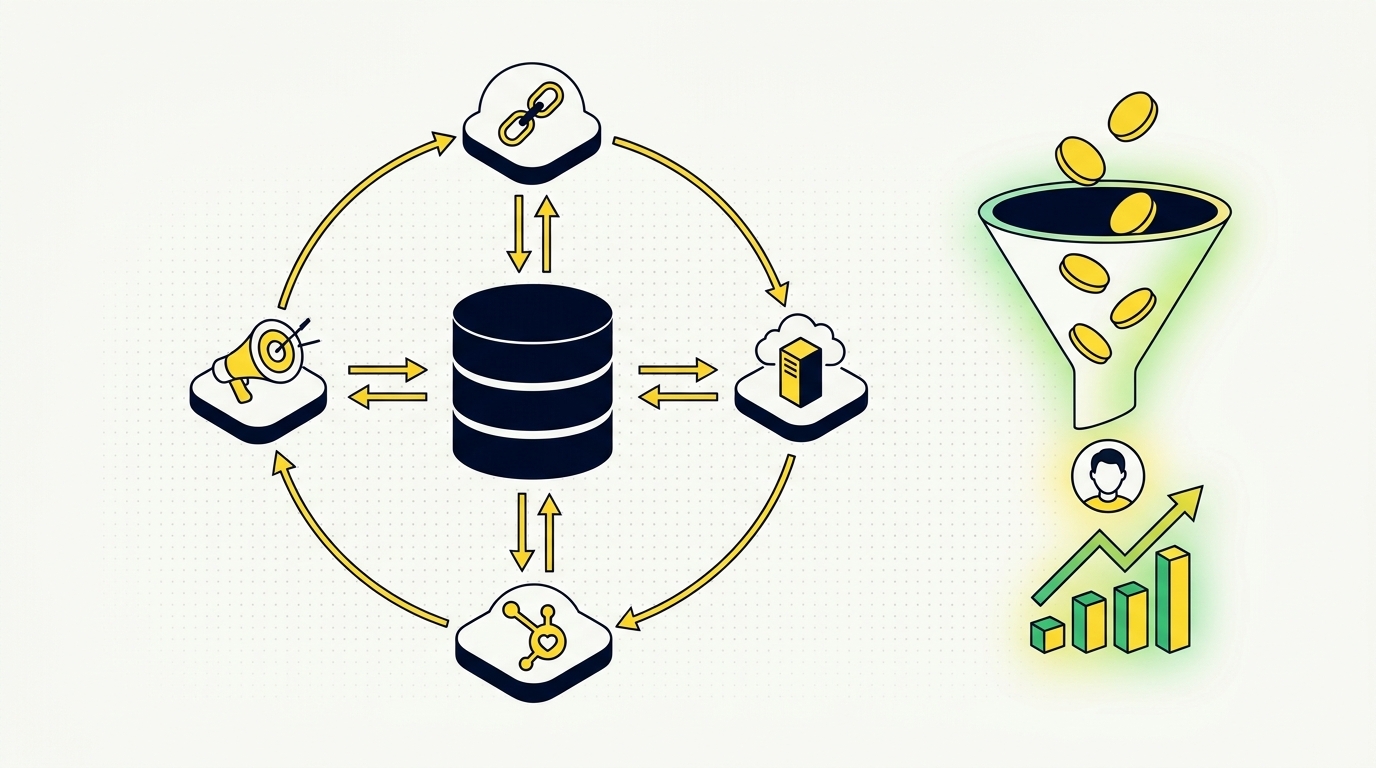
Seventy-nine percent of marketing-generated leads never become sales. Not because the campaigns are bad. Because the data stops at the form fill.
Here’s the precise mechanism of the waste: your ad platform doesn’t know what happened after the click. LinkedIn doesn’t know which MQL closed into revenue six weeks later. Google’s bidding engine doesn’t know that the $14 CPL lead from Campaign A converted at 2x the rate of the $8 CPL from Campaign B. So the algorithms keep optimizing for the metric they can measure — the click — and your CAC quietly inflates by up to 36%.
I’ve seen this pathology across high-growth B2B SaaS teams running $50K to $500K monthly in paid acquisition. The fragmentation isn’t a people problem. It’s a data architecture problem. Specifically: a CRM that isn’t talking to the platforms spending the money.
Here’s what teams getting this right do differently.
The Fragmentation Tax Is Compounding Every Quarter
The numbers documenting organizational misalignment between sales and marketing data are stark enough to reframe your entire infrastructure budget.
Companies operating with fragmented systems — where CRM data and ad platform data live in separate silos — experience an average revenue decline of 4% year-over-year. Highly aligned organizations running bidirectional data synthesis achieve 20% annual growth. That’s a 24-percentage-point competitive spread, driven almost entirely by data architecture.
The penalty compounds further down the funnel. In misaligned organizations, 73% of marketing-generated leads are never contacted by sales. This isn’t a capacity problem — it’s a definitional one. Research shows 62% of sales organizations operate with a fundamentally different definition of a qualified lead than their marketing counterparts. So the CRM fills up with contacts that never get worked, and the ad platform keeps bidding to acquire more of them.
The economic damage is direct: CAC climbs 36%, 50% of active sales time evaporates on unqualified prospecting, and between 60% and 70% of marketing content never gets used because it can’t surface the right moment.
“The algorithm will find you the cheapest leads it can. If you haven’t told it which ones closed, it’ll keep optimizing for cheap — not profitable.”
The fix isn’t hiring better people to manage the spreadsheets. It’s feeding revenue outcomes back into the bidding engine automatically, before the next auction.
How Closed-Loop Architecture Actually Works
Build the Bidirectional CRM Spine First
The foundation of any closed-loop system is a zero-latency data bridge between your marketing automation platform and your CRM. In practice, this means HubSpot and Salesforce syncing on a 15-minute trigger cycle — not nightly batch exports, not manual CSV uploads.
Every form submission, email open, meeting booked, and document view needs to trigger an automatic record update across both systems simultaneously. A B2B SaaS company we analyzed in the manufacturing vertical eliminated their entire manual list-upload workflow: when a new lead was tagged “manufacturing” in Salesforce, the integration automatically pushed that record into a dynamic LinkedIn audience segment within minutes. No human intervention. The result was a 31% improvement in LinkedIn campaign ROAS within the first month, driven entirely by audience quality, not creative changes.
Minora AI’s integration layer supports this exact architecture, connecting CRM signals directly to budget decision logic so the system knows which audience segments are generating pipeline before the next impression is served.
Close the Loop with Offline Conversion Sync and CAPI
Data synthesis alone doesn’t fix the bidding problem. The revenue signal needs to flow back into the ad platform’s machine learning engine via Conversion APIs (CAPI) and Offline Conversion Sync.
The mechanics: when a user clicks your LinkedIn ad, a click identifier is captured. When that lead converts to a closed-won deal in Salesforce three months later, the deal value gets sent back to LinkedIn against the original click ID. Now LinkedIn’s algorithm knows which audience segments, creative angles, and bid strategies are generating actual revenue — not just form completions.
Webex Events ran this exact architecture with a two-person paid media team. By feeding CRM offline conversions back into their ad platforms and triggering auto-pause rules on non-pipeline-generating campaigns, they increased pipeline by 60% while cutting their total ad budget by 73% — in 90 days.
Replace Manual Frequency Management with Predictive Impression Pacing
One of the most expensive hidden costs in B2B ad spend is impression concentration. Without algorithmic controls, a handful of high-value target accounts consume a disproportionate share of your delivery. Descope ran this analysis and found their top 100 target accounts were eating 38% of all impressions, leaving the remaining 90% of their TAM effectively unaddressed.
By implementing automated impression pacing and account-level frequency caps — and tying off-platform intent signals directly to CRM progression via CAPI — they cut the top-100 share from 38% to 24%, freed 140,000 impressions per month for unengaged high-value accounts, and drove a 25% increase in overall LinkedIn Ads ROI. The budget didn’t increase. The distribution intelligence did.
Shift Campaign Optimization from MQL Volume to Pipeline Velocity
The most common closed-loop failure isn’t technical — it’s the optimization target. Teams optimize ad campaigns for Marketing Qualified Leads because that’s the metric the ad platform can measure in real time. But MQL volume is a deeply flawed proxy for pipeline.
When you feed closed-won CRM data back into Google’s bidding engine, you’re explicitly telling the algorithm: find me more people who look like the ones who paid. The algorithm stops optimizing for the cheapest form fill and starts seeking the highest-intent searcher pattern. Automox ran this playbook with intent-signal scoring via predictive AI: they identified accounts exhibiting buying signals across the web before any form submission, triggered orchestrated multi-channel campaigns autonomously, and drove an 88% increase in closed-won deals — with 51% of their total closed-won revenue tracing directly back to this intent-driven architecture.
Manual vs. Closed-Loop vs. Predictive AI: What the Data Shows
FAQ: Closed-Loop B2B SaaS Attribution
What is closed-loop marketing attribution in B2B SaaS?
Closed-loop attribution means every ad impression, click, and campaign is linked back to a specific closed-won deal in your CRM. When a lead becomes a customer, that revenue event is sent back to the ad platform — overriding form fill as the optimization target and telling the bidding engine which audience patterns actually generate revenue.
How long does it take to see CAC improvement after closing the attribution loop?
Most teams see measurable CAC improvement within 30 to 60 days of activating offline conversion sync. The bidding algorithm needs enough closed-won events to update its model, typically 30 to 50 conversion events per optimization window. Teams with higher ad volume (and more frequent deal closures) see results faster.
Why do HubSpot and Salesforce need to sync bidirectionally, not just one way?
One-directional sync means your marketing platform has stale data and your CRM has incomplete context. When a sales rep updates a lead stage in Salesforce, that signal needs to propagate back into HubSpot to suppress active nurture sequences and update audience exclusion lists. Bidirectional sync on a 15-minute trigger cycle is the minimum viable architecture for a clean closed loop.
What percentage of B2B ad spend is wasted without closed-loop attribution?
The research is consistent: between 36% and 50% of paid acquisition budget in non-integrated B2B environments is consumed acquiring leads that never produce pipeline. The most common driver is the algorithm optimizing for MQL volume — which it does flawlessly — while consistently bypassing high-intent, higher-CAC prospects that actually convert to revenue.
Can Minora AI integrate with existing CRM stacks without rebuilding our data infrastructure?
Yes. Minora connects directly to HubSpot and Salesforce via native API integrations and supports CAPI connections to LinkedIn, Google, and Meta. The system ingests your existing closed-won history as training data and begins issuing budget reallocation signals within the first campaign cycle.
The Attribution Gap Is a Strategic Liability
The brands winning B2B pipeline in 2026 aren’t the ones running more campaigns. They’re the ones whose campaigns know what happened after the click.
Every week you run paid acquisition without closed-loop CRM data, you’re paying for the algorithm to get smarter about finding cheap leads — not profitable customers. The infrastructure to fix this exists, it’s not new, and the teams that close the loop earliest build a compounding cost advantage their competitors can’t close by headcount alone.
Data doesn’t get more valuable sitting in a CRM. It gets valuable when it moves budget.
