


CAC keeps climbing. Creative production can't keep pace. And the attribution data your platform dashboard shows you? Probably wrong. Scaling a D2C brand in 2026 means running harder just to stay in the same place — and the brands that figured that out too late are already bleeding margin. This article breaks down the four biggest challenges D2C brands face right now and what it actually takes to get ahead of them.
The CAC Crisis Is Not a Blip
Customer acquisition costs across Meta, Google, and TikTok have risen steadily for three straight years. Some D2C categories — health and wellness, sustainable goods, pet products — have seen CAC double since 2022. The economics that made D2C viable at scale are under real pressure, and no amount of creative testing fixes a structurally broken acquisition model.
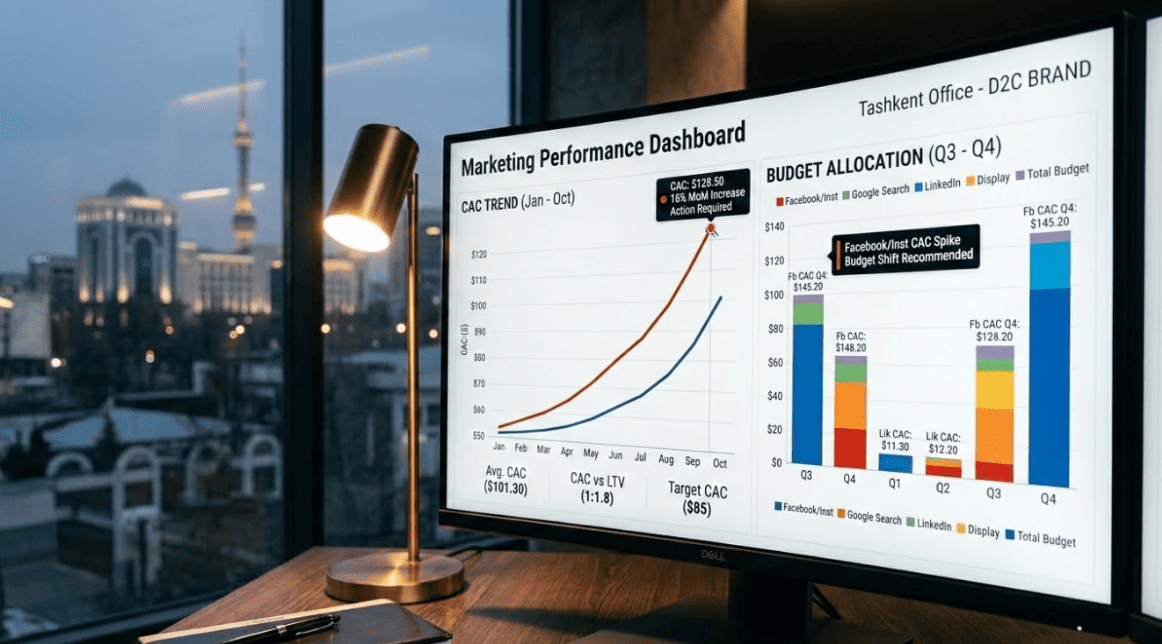
The problem underneath the problem is this: most D2C brands still optimize based on last-click attribution or platform-reported ROAS. Both are unreliable. Meta's algorithm optimizes for what it can measure, not for what actually converts. Google's Performance Max operates as a near-total black box — budget flows to placements you cannot see, weighted toward channels with the highest reported conversions, which are often the cheapest to attribute, not the most profitable. Brands relying solely on these dashboards tend to overspend on the wrong channels while missing pockets of localized profit sitting untouched.
The result is a real-money problem. Brands discover they've been paying $38 to acquire a customer worth $30 in gross margin — and they've been doing it at scale for months. The unit economics look fine in the platform dashboard. They look broken everywhere else.
Minora AI's Strategy Personalization Agent addresses this directly: it forecasts Reach, CPA, and ROI before a dollar of budget is committed, trained on $30M+ in actual ad spend data. That means you know the expected CPA before launch — not after you've burned the budget.
💡 Getting pressure on CAC from the CFO? Book a strategy call with Minora AI — we work with D2C brands running six-to-eight figure ad budgets to model CPA before spend, not after.
Creative Velocity: The Real Margin Killer
Most D2C founders think creative fatigue is a creative department problem. It isn't. It's a systems problem.
Platforms like Meta and TikTok cycle through ad creative faster than any internal team can produce. An ad that performs well in week one is fatigued by week three. The algorithm needs new variations to keep testing — new angles, new hooks, new formats. For brands running multiple product lines across multiple platforms, the production burden becomes unsustainable fast.
The economics break down like this: a professional video shoot costs anywhere from $5,000 to $25,000 and takes two to four weeks from brief to delivery. By the time the creative is live, the audience data that shaped the brief is already stale. Traditional agencies charge retainers of $10,000 or more per month and still can't keep pace. D2C founders describe this bottleneck as one of their biggest operating frustrations — not because they don't have ideas, but because the production pipeline is too slow and too expensive to scale.
The Platform Velocity Demand
Meta's Creative Churn Rate
Meta's algorithm rewards novelty. Once an ad's frequency climbs past 2.5 on a given audience segment, performance drops sharply. Brands running broad-reach campaigns need a minimum of 8 to 12 active creative variants per campaign to maintain performance — a production load that only autonomous creative systems can sustain at reasonable cost.
TikTok's Native Content Pressure
TikTok's algorithm penalizes content that looks like an ad. The formats that work — UGC-style, short, pattern-interrupting — require constant iteration. A single winning hook might hold for 10 to 14 days before CPMs rise and CTR falls. The brands winning on TikTok in 2026 treat creative as a data problem, not an aesthetic one.
The Autonomous Alternative
Eliminating Agency Production Lag
Minora AI's Launch Agent deploys campaigns across 450+ channels, personalizing creative distribution for the right audience segments without the production bottleneck. Budget doesn't sit idle waiting for a creative review — it moves to top-performing placements in real time.
Real-Time Creative-Budget Alignment
The Optimization Agent monitors channel performance 24/7 and reallocates budget to the variants that are working. When a creative fatigues, budget shifts — automatically. No Monday morning performance review required. No wasted spend accumulating over the weekend.
Attribution Blindness and the Budget Waste Problem
Attribution is broken. That's not a controversial statement anymore — it's the operating reality. iOS 14.5 started the collapse of deterministic tracking in 2021. By 2026, the patchwork of probabilistic models, platform-reported conversions, and first-party data gaps has become standard — and most D2C brands are making budget decisions inside it.
The specific pain point is this: brands often run three to five paid channels simultaneously — Meta, Google, TikTok, programmatic, email retargeting — and cannot accurately determine which combination actually drove a purchase. Platform dashboards each claim credit. Total reported ROAS looks healthy. Actual revenue growth is flat. Finance calls it attribution blindness; the marketing team experiences it as chronic uncertainty about where to put the next dollar.
Budget waste follows directly from this uncertainty. Conservative estimates put the average D2C brand's wasted ad spend at 20 to 30% of total budget — dollars allocated to underperforming channels because no reliable signal said otherwise. At $500,000 in monthly spend, that's $100,000 to $150,000 per month burning with no return.
What Good Attribution Actually Requires
Cross-Channel Signal Integration
Real attribution in 2026 requires integrating platform signals with first-party purchase data and modeling incrementality — not accepting last-click as truth. This means connecting CRM data, pixel data, and platform APIs into a unified view, then applying statistical modeling to estimate true contribution.
Incrementality Testing as Standard Practice
Holdout testing — running campaigns against a matched control group that doesn't see the ads — is the closest thing to a ground truth in modern attribution. Brands that run geo-holdout tests regularly make materially better budget allocation decisions than those relying purely on in-platform reporting.
How Minora AI Addresses Attribution Gaps
Predictive CPA Modeling Before Spend
Rather than reverse-engineering attribution after the fact, Minora AI's Strategy Personalization Agent forecasts expected CPA and ROI at the planning stage. You set the budget and goals — the system models the likely outcome before launch. That predictive layer reduces the need for post-hoc attribution forensics.
Real-Time Budget Reallocation Across Channels
The Optimization Agent monitors 450+ channels simultaneously and reallocates budget to top performers 24/7. Brands that reallocate budgets within a 48-hour window see approximately 18% improvement in ROI — a response time that manual teams cannot match at scale.

Measuring What Actually Matters
Most D2C brands track ROAS. Far fewer track CAC payback period, contribution margin per channel, or true incrementality. The metrics you prioritize determine the decisions you make — and a lot of D2C brands are optimizing for the wrong numbers.
KPIs to Track
CAC Payback Period
How long does it take to recover the cost of acquiring a customer, net of product COGS and fulfillment? The target varies by vertical — subscription businesses can accept 6 to 9 months; single-purchase products need closer to 3. Brands with long payback periods and poor retention are in structural trouble regardless of what their ROAS looks like.
Contribution Margin by Channel
Total ROAS masks channel-level profitability. A channel delivering 3.5x ROAS might be generating customers with poor repeat purchase rates and high return rates — net negative contribution after accounting for COGS, shipping, and refunds. Channel-level contribution margin forces a more honest conversation about where growth is actually coming from.
Creative Fatigue Index
Track CTR decay curves for each active creative variant. When CTR drops more than 25% from peak over a 7-day window, that variant is fatiguing. Monitoring this proactively — rather than reacting after CPA spikes — gives budget managers enough lead time to rotate creative before performance collapses.
How Minora AI Reports on These Metrics
Minora AI's four agents — Research, Strategy Personalization, Launch, and Optimization — generate performance visibility across the full campaign lifecycle. The Optimization Agent tracks channel-level data in real time and surfaces budget reallocation signals before waste accumulates. Rather than waiting for a weekly agency report, teams get a live view of what's working, what's fatiguing, and where the budget should move. That continuous signal loop is what separates autonomous AI optimization from the manual reporting cycles most D2C brands are still running.
Conclusion
The biggest challenges for D2C brands in 2026 come down to one underlying issue: the cost of operating at speed with manual systems. CAC rises faster than teams can respond. Creative production falls behind platform demand. Attribution data misleads budget decisions. And by the time the weekly report lands, the damage is already done. Minora AI was built for exactly this operating environment — four AI agents that model CPA before spend, launch across 450+ channels, and reallocate budget in real time without waiting for a human to pull a report. The brands that separate themselves in this market won't do it by working harder. They'll do it by closing the gap between signal and action.
Running a D2C brand with five-to-eight figures in monthly ad spend? The CAC and attribution problems described here have specific, testable solutions — and we can model your expected CPA before you commit a dollar. Book a strategy call with Minora AI to see what predictive budget optimization looks like for your specific vertical.
FAQ
Q1: What are the biggest challenges for D2C brands in 2026? A: The three most acute challenges are rising customer acquisition costs (CAC), creative velocity bottlenecks, and attribution blindness. CAC has doubled in some categories since 2022, creative production cycles can't keep pace with platform algorithm demands, and multi-touch attribution remains unreliable after the collapse of deterministic tracking. Brands that address all three systematically are outperforming those that treat each as an isolated problem.
Q2: Why is CAC rising for D2C brands in 2026? A: Paid social and search inventory has become more competitive as more brands shifted budgets online post-pandemic. At the same time, iOS privacy changes reduced the precision of audience targeting, so algorithms require more spend to find the same quality of customer. Brands relying on black-box platforms like Google's Performance Max without independent verification are often overspending on low-margin channels without knowing it.
Q3: What is attribution blindness and why does it hurt D2C brands? A: Attribution blindness is the inability to accurately determine which marketing channels are driving real purchases versus which ones are claiming credit from other channels. It leads to budget misallocation — brands continue funding underperforming channels because the platform dashboard shows favorable metrics that don't reflect actual revenue contribution. Conservative estimates put wasted D2C ad spend at 20 to 30% of total budget due to this problem.
Q4: How does creative velocity affect D2C performance marketing? A: Platforms like Meta and TikTok cycle through ad creative quickly — a well-performing ad can fatigue within 10 to 14 days as frequency rises and CTR drops. D2C brands need a continuous pipeline of new ad variants to maintain performance, but traditional creative production is too slow and expensive to keep pace. Brands running fewer than 8 active creative variants per campaign on Meta are structurally at a disadvantage.
Q5: How can AI reduce CAC for D2C brands? A: AI reduces CAC by improving budget allocation accuracy and speed. Instead of waiting for weekly reports to reallocate spend, AI-driven optimization systems monitor channel performance in real time and shift budget to top performers before waste accumulates. Autonomous budget reallocation within 48-hour windows has been shown to improve ROI by approximately 18%, directly reducing effective CAC.
Q6: What is predictive CPA modeling and how does it help D2C brands? A: Predictive CPA modeling uses historical ad spend data and machine learning to forecast the expected cost per acquisition before a campaign launches. Instead of discovering poor unit economics after the budget is spent, brands can model likely outcomes at the planning stage and adjust targeting, budget allocation, or creative strategy before committing spend. Minora AI's Strategy Personalization Agent does this using data from $30M+ in managed ad spend.
Q7: What KPIs should D2C brands prioritize in 2026? A: Beyond ROAS, D2C brands should track CAC payback period (how long to recover acquisition cost net of COGS), contribution margin by channel (profitability after all variable costs), and creative fatigue index (CTR decay curves per ad variant). These metrics surface problems that platform-reported ROAS consistently masks, including high-ROAS channels with poor customer lifetime value.
Q8: How does real-time ad budget optimization work? A: Real-time ad budget optimization uses AI to continuously monitor performance signals across multiple channels simultaneously and reallocate budget toward the best-performing placements without waiting for human review. Unlike manual budget management — which typically operates on weekly or daily cycles — autonomous systems can respond to performance changes within hours, preventing budget waste from accumulating over weekends and off-hours.
Q9: What D2C verticals face the worst CAC pressure in 2026? A: Health and wellness, sustainable/eco-friendly goods, and pet products face the most acute CAC pressure due to a combination of high market saturation, intense competitive bidding, and increasing consumer acquisition skepticism. These verticals also tend to have strong repeat purchase potential, making CAC payback period and customer lifetime value the critical metrics — not just initial ROAS.
Q10: How do D2C brands fix margin compression without cutting ad spend? A: Margin compression in D2C is typically driven by inefficient spend allocation, not total spend level. Fixing it requires moving budget away from channels with high reported ROAS but poor actual contribution margin, reducing creative production costs through autonomous systems, and tightening attribution to stop funding channels that claim credit without driving real incremental revenue. Reducing waste within existing budgets usually delivers more margin improvement than cutting total spend.
